Is this a 3-way switch?

Thread Starter

MikeA

Joined Jan 20, 2013
447
I'm trying to figure out the wiring to this antique switch which must have been installed while Thomas Edison was still alive.

Right now this switch controls a ceiling fan, and this switch is the only one able to turn it on/off.

Perhaps a ceiling light used to hang where the fan is now and there was another 3-way switch?
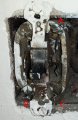
3way.jpg

I measured some voltages:

With the fan off, there is 120V between B and C. Also 120C between A and B. And 0V between A and C.

With the fan on there is 20V between B and C. Also 20V between A and C. And 0V between A and B.

Does it look like it's still operating in a 3-way configuration?
 

MaxHeadRoom

Joined Jul 18, 2013
30,654
Remove it an check the rear show a pic if possible. Determine colours of conductors etc.
What is your country of origin?
BTW, Two way and Three way can be the same thing, depending where you are.
Max.
 

Thread Starter

MikeA

Joined Jan 20, 2013
447
This is USA. The conductors are all identical. Copper in cloth.

I'm afraid to touch. :eek: At least before figuring out what to replace it with if its crumbles in my hand.
 

MaxHeadRoom

Joined Jul 18, 2013
30,654
For 3 way operation you would need another SW.
If there is no visible one present then replace it with a normal one way switch.
Max.
 

MaxHeadRoom

Joined Jul 18, 2013
30,654
Usually the top one is the load or feed and the other two are the 'strappers'.
Depending on what has been done to any possible previous 3 way configuration it may take some trial and error, you can easily detect if the top conductor is from the fan or the feed.
Does the switch have three terminals or is there a fourth, unused?
A & C look like possible candidates.
Max.
 

Thread Starter

MikeA

Joined Jan 20, 2013
447
It seems like the top conductor is indeed the fan. When the switch is off, the A wire is silent when I test it with a NCV tester. When the switch is on, wire A rings as does the wall going up from that switch. The wall above the switch is silent when the switch is off.

When the switch is off only wire B rings hot with the NCV. When the switch is on, all wires ring hot.

There is only 3 terminals on the switch. The 4th corner is not threaded for a mounting screw.

With all that's said above, does it sound like B is hot and A is the fan? Why A & C then?
 

MaxHeadRoom

Joined Jul 18, 2013
30,654
A simple empirical test will confirm it, after all only 3 conductors.
See which conductors are 'live' when disconnected, you already determined that A is the fan.
Max.
 

Thread Starter

MikeA

Joined Jan 20, 2013
447
B is hot when the switch is off. But why would C become hot when the switch is on? It would not be hot in a normal 3-way switch set up, right?

Unless somewhere else where the other 3-way switch used to be, the travelers were tied together at that location?
 

Externet

Joined Nov 29, 2005
2,630
Remove the switch after switching off breaker/fuse. Whatever it is, is replaceable. And will be clearly identifiable when removed, and for tracing wiring.
If it is a '3 way' there is no "switch is off" position. The fan or lamp fed by it may be off, but the switch itself has 'position 1, position 2'.
If the wires insulation crumbles, push a drinking straw or shrink tubing as sleeve to connect the new switch.

Since new, many things could have been altered in the wiring/load. If there is no other associated '3 way' nearby, it may be modified for single switch circuit.
 

Thread Starter

MikeA

Joined Jan 20, 2013
447
So I pulled it out of the wall. On the back it says "Made in USA" :D, "A2", "2612" and "Pat Appd For".

In the off position there is only continuity between A and C.

In the on position there is continuity between A and B.

With the breaker on wires just hanging there, B and C ring with the NCV tester now.

Now this makes even less sense. :confused:
 

MaxHeadRoom

Joined Jul 18, 2013
30,654
Why??
Obviously if previously a 3 way set up, the other location has been permanently connected one of the travelers to AC live.
Max.
 

RichardO

Joined May 4, 2013
2,270
This is USA. The conductors are all identical. Copper in cloth.

I'm afraid to touch. :eek: At least before figuring out what to replace it with if its crumbles in my hand.
I feel your pain. The wires in my nearly 100 year old house are also cloth insulation. Just looking at them causes the insulation to crumble. I always worry that I will force a wire against the metal box when I push the switch back into place. The force could easily crumble the insulation and cause a short. :eek:

The wire junctions are soldered and covered with cloth tape. Well, it was tape when it was installed. The glue is now a powder so just touching the tape can cause it to fall from the joint. I replace the tape with a wire nut if it doesn't look solid.


p.s. The last switch I replaced was probably the original one installed since its body was ceramic and not plastic.
 

MaxHeadRoom

Joined Jul 18, 2013
30,654
Also measuring voltages on a high impedance meter with a switch that looks 'slightly' burnt up, you may get all kind of readings.!o_O
Max.
 

Thread Starter

MikeA

Joined Jan 20, 2013
447
Why??
Obviously if previously a 3 way set up, the other location has been permanently connected one of the travelers to AC live.
Max.
Because when the switch was still in the wall, wire C did not ring hot with the switch in the off position. Now with the switch out of the wall, wire C rings hot. o_O
 

Reloadron

Joined Jan 15, 2015
7,887
Old cloth wiring leads me to believe there is no Ground in the wiring. However I would check resistance between A and the metal screws securing the switch. If you have continuity between A and the switch metal frame then A is a ground. That being my guess anyway.

Ron
 

Thread Starter

MikeA

Joined Jan 20, 2013
447
To add more mystery to this, I polished the exposed copper wire to get good readings and:

120v between A and B
85v between A and C
21v between B and C

:confused:
 
Top