Leakage might be the case. I just know the wiring is very wacky. There is at least 6 items hanging off a single breaker. This ceiling fan, ceiling lights, multiple outlets...
So from my description of the switch being tested out of circuit, I should just get a 3-way switch and wire it in exactly the same way?
As far as I can see an ordinary 1 way SW , you could tape the 3rd conductor, or going the 3 way SW should work also.
Do you have them on hand to test it?
Max.
As far as I can see an ordinary 1 way SW , you could tape the 3rd conductor, or going the 3 way SW should work also.
Do you have them on hand to test it?
Max.
Well, I put in a 1-way switch between A & B. The fan seems to be working. And I haven't noticed that anything else stopped working, so far. Thanks everyone.
Yes, it is a switch for a '3 way' circuit. (Common A, normally open B and normally closed C) Being used now as a single circuit.
To eliminate your mystery voltage readings, use a lamp probing A,B,C against neutral instead of a high impedance meter, and take as lamp on 120V; lamp off 0V.
It does indeed have the appearance of a standard 3-way switch from long ago. The important thing towards identifying 3 way switch installations is that there will be a minimum of 2 switches controlling the same thing. Also, there will indeed be three terminals as described by "externet". The strange voltages described are due to lots of conductive dirt and the use of a very high impedance voltmeter. The large amount of dirt inside is why switches have been enclosed for the last 80 years, or so. Prior to the invention of dirt, most electrical items did not need to be enclosed.
@Externet recommended using a lamp to test for voltage. In my house I moved an outlet for the refrigerator. I shut off the breaker that seemed like the right one for the outlet, but my NCVT (No Contact Voltage Tester) still indicated power present on the line. Unable to isolate with certainty which circuit I was working with I plugged my shop vac into that outlet. If it didn't come on then I knew the circuit was shut down. Years earlier I replaced an evaporative cooler on my roof. Whomever wired it up did some pretty weird and not to code wiring. There needed to be power for Low Fan, High Fan and Pump. Unable to determine which wire was which I took a lamp and started making connections until I figured exactly which wires were what. Later on I replaced the wires with a properly wired system. Nevertheless, using a lamp or a vacuum (noise) can clearly indicate when a circuit is not powered and safe to work on.
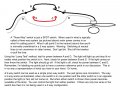
Below is a picture I just drew for your circumstances. In short, a 3 way switch can be used either as a single or a 3 way system. It's nothing more than a single pole double throw switch. Depending on switch position (both ends) you can turn a lamp on or off from either end.
Looking closer at your picture, what you call "B" - that looks like a hex head screw. It's typically a ground point in modern electrical wiring. Your "B" might be a ground. If "B" is ground then it would explain why you see 120 VAC between A & B. If the switch is "OPEN" then readings between A & C should be open as well. It could be a case of potential signal crossover (voltage being induced into a neighboring wire), that could be the reason why you're seeing 85 volts. But it would be a soft 85 volts (IF what I say is the case). 21 volts between C & B could also be crossover. Also called "Cross Talk". Again, leaning on what Externet said, use an actual load, not a meter to test for voltage (and current). You can have a potential voltage present but with no current, the light won't light up. Can get kind of confusing. As in the case of crossover, you don't have a hard connection but you DO have a presence of voltage. Since there is no hard connection no current can flow. Meaning a lamp or a vacuum won't come on just from crossover. You need a hard connection. Like I said, B might be a ground point. If you're seeing 120 VAC between A & B then B is likely a ground point.
What's going on here ? ? ? I read up to post 20 then it jumped to post 32. I missed a lot. And this isn't the first time it's happened. I'm trying to solve an already solved issue. That doesn't help anyone at all. Now I believe you can ignore my other posts - especially the one about B being ground. Geez! I hope I don't get someone killed because of this whacky problem with the site.
The circuit drawn by Tony is the correct one that should be kept memorized dealing with '3 way'
The problem is in the reality. The leftmost black and white wire ends may be coming from an outlet; from the ceiling, from the basement; from the who knows were. Specially in century old circuits where single wires were the norm.
That is the cause of confusion. It could be built/installed in several ways, as grabbing neutral from the attic direct to the fan and 'live' from an outlet below the switch and that is all invisible to the person trying to figure the troubleshooting.
The difficulty is we do not have X-ray vision to see the routes in the walls.
Seems that determining first which black is always live and which white is always neutral no matter if there is or not a load connected or position of switches should be the very first step in diagnosis of mindtwisting '3ways'. And that if they are not all old blacks...
It took me one hour+ last week to discern that the wiring was wrong since day-one on a seventies-built house plus one of the switches was intermittent
There are a few configurations of wiring up a 3way (2 way UK) light circuit, in the UK one way I was taught was use L & N pair direct to the to the first light drop, then a pair from the light to the first switch.
And three 'travellers' between each of the switches.
Max.
I had a challenging service call with a situation like that a few years back. A lady complained that the switch failed and so she replaced it and the light still did not work. After several minutes of checking it became obvious that both bulbs in the fixture had failed. She was not easy to convince, but when I put in one new bulb and it worked there was no alternative but to agree.

 Facebook
 Google
 GitHub
 Linkedin