Is the LM311 essentially the same as LM393?

Status
Not open for further replies.

Thread Starter

Hamlet

Joined Jun 10, 2015
560
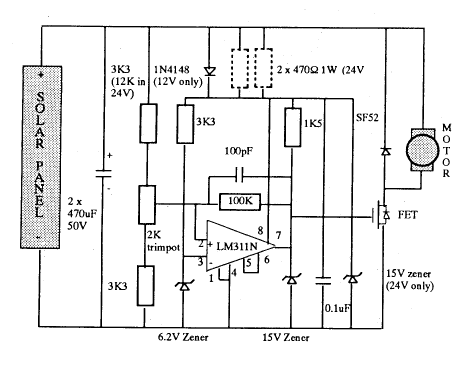
I'm building this:

http://www.voltscommissar.net/minimax/minimax.htm

I tried substituting an LM393, but any mosfet I've tried gets too hot to touch, and the performance
of the circuit seems poor as well, but I can hear it whine, so I guess it's working somewhat. Adjusting
to the 2k pot do make the difference between motor starting and not starting.

I've even tried a logic level IRLZ44N, but that too gets hot, although not
as quickly, it takes a few seconds more... The circuit and motor draw 8A.

Is it my choice of comparator, or do I need to look further?
 

hp1729

Joined Nov 23, 2015
2,304
I'm building this:

http://www.voltscommissar.net/minimax/minimax.htm

I tried substituting an LM393, but any mosfet I've tried gets too hot to touch, and the performance
of the circuit seems poor as well, but I can hear it whine, so I guess it's working somewhat. Adjusting
to the 2k pot do make the difference between motor starting and not starting.

I've even tried a logic level IRLZ44N, but that too gets hot, although not
as quickly, it takes a few seconds more... The circuit and motor draw 8A.

Is it my choice of comparator, or do I need to look further?
Not really. The LM311 can handle +V to -V inputs. The LM393 and LM339 can only handle +V inputs. The dual version of the LM311 is the LM319.
The LM311 has other inputs for zeroing and an open emitter output. The open emitter you handled correctly. I have never seen pins 5 and 6 (offset) tied together. I will have to try that and see what happens.
I have seen 5 and 6 tied to +V to increase input currents, but ... why?
Just leave them disconnected if not used.
 
Last edited:

hp1729

Joined Nov 23, 2015
2,304
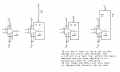
Design 1034 LM311 balance control.PNG Of course this works for op amps, too. For precision use actual measured value of the resistors.
Found in military applications where they wanted precision, didn't want to buy expensive parts and didn't want field techs f???ing with the boards.
 
Last edited:

Alec_t

Joined Sep 17, 2013
15,114
What is the spec of your solar panel?
Is 8A the rated motor current or its start-up/stall current (which will be much higher)?
The whining sound is probably due to the circuit oscillating. If the panel can't provide enough current to meet the start-up demand its voltage will drop, so the FET will turn off, so the current will cease, so the voltage will rise, so the FET will turn on, so the current demand will be high, ........ rinse and repeat.
An oscillating circuit would account for the FET overheating.
 

GopherT

Joined Nov 23, 2012
8,009
To add to @Alec_t theory, you can try...
1) add a capacitor (1uF or more) to stabilize the (-) input of the comparitor. You can place it between (-) input to ground. This should noticeably slow the oscillation (whine).

2) change the 6.2v Zener to 2.4 or 4.7V. Your solar panel may be sagging below the 6.2V as the motor kicks in and the comparitor is shutting off (because the Zener breakdown voltage is not reached). If you do this, change the resistor between ground and trim pot to 2.2k (if you use 4.7v Zener, and 1k if you use 2.4v Zener (and then add a bit to the resistor between trim pot and positive supply. )

3) try replacing 100k resistor for hysteresis to smaller resistance (22k to 47k) and this may also help if the sag from input voltage is less (try the other options first)
 
Last edited:

Thread Starter

Hamlet

Joined Jun 10, 2015
560
it has multiple issues, including applying 24v directly to the gate, ...


there could be many reasons for that, including too big of a motor.

conceptually, a 393 can be made to work here.
Okay, thank you. Let me try again. In the notes for this circuit, the 24v is an option. I built the 12v nominal version.
From the notes accompanying the schematic:

"An LM311 comparator is used to compare the working capacitor voltage (reduced by the adjustable voltage divider) with a reference voltage supplied by the 6.2 volt zener diode. The output of the LM311 drives the FET switch. The 100K resistor supplies positive feedback round the LM311 and creates about 0.5V of hysteresis between the switch on and switch off voltages. The 100pF cap. speeds the switching and suppresses transition oscillations. (The speed of the maximiser's oscillations could be doubled by increasing the 100K resistor to 220K) If a 24V version is required, the extra three components shown should be inserted to limit the LM311 supply to 15V, and the top 3K3 divider resistor should be replaced with a 12K (one of the 470 Ohm resistors replaces D1)"

Okay, let me go find a smaller motor, and fiddle with the circuit, following everyones suggestions...
 

dannyf

Joined Sep 13, 2015
2,197
I built the 12v nominal version.
all the circuit does is to turn on the mosfet when the voltage exceeds some limit programmed by the resistors + zener.

it can be done with pretty much any comparator, opamp, or a lowly TL431 (my favorite). which route to take will depend on what you have.

I think it is much simpler for you to design one yourself than to copy someone's idea (half cooked in this case I think).
 

Thread Starter

Hamlet

Joined Jun 10, 2015
560
The OP is building his own circuit so pin compatible us not an issue. What can't the LM393 do that the 311 can do?
Correct. I am aware that they are not pin compatible.

It's a week to 10days before I can get my hands on a LM311.

We're having unusually cold wintery weather here in the PacNW, and I am not in the mood to chain up the truck
and drive to a town that may or may not have one on the shelf, and I'm not paying for overnight shipping, just
to have them tell me to pick-up at the FedEx warehouse because the delivery guy couldn't make it up my road.

2017 snowstorm - Copy.JPG
 

dl324

Joined Mar 30, 2015
18,300
Correct. I am aware that they are not pin compatible.

It's a week to 10days before I can get my hands on a LM311.
LM311 was overkill in that circuit. Post the schematic for your circuit. The one you're copying from is poorly drawn...
We're having unusually cold wintery weather here in the PacNW, and I am not in the mood to chain up the truck
I haven't gone out since Tuesday. It's unlikely that much snow will melt before I have to go out, so I'll have to chain up too... At least we didn't lose power...
 

hp1729

Joined Nov 23, 2015
2,304
I'm building this:

http://www.voltscommissar.net/minimax/minimax.htm

I tried substituting an LM393, but any mosfet I've tried gets too hot to touch, and the performance
of the circuit seems poor as well, but I can hear it whine, so I guess it's working somewhat. Adjusting
to the 2k pot do make the difference between motor starting and not starting.

I've even tried a logic level IRLZ44N, but that too gets hot, although not
as quickly, it takes a few seconds more... The circuit and motor draw 8A.

Is it my choice of comparator, or do I need to look further?
Where did you get the idea of shorting pins 5 and 6 together? I would say remove the jumper. It is probably not related to your heating problem. That may just indicate you need a heat sink. When I put in that jumper on an LM311 the output went high which might keep your motor from turning off.
 

GopherT

Joined Nov 23, 2012
8,009
Where did you get the idea of shorting pins 5 and 6 together? I would say remove the jumper. It is probably not related to your heating problem. That may just indicate you need a heat sink. When I put in that jumper on an LM311 the output went high which might keep your motor from turning off.

Again people, please READ what the OP WRITES, this is NOT A PICTURE BOOK.

He has an LM393, he wants to use the schematic (exactly or similar to) the one posted with LM393. Got that? That LM393/311 issue is THE WHOLE REASON FOR THE QUESTION IN THE TITLE
 
Last edited:

Thread Starter

Hamlet

Joined Jun 10, 2015
560


To add to @Alec_t theory, you can try...
1) add a capacitor (1uF or more) to stabilize the (-) input of the comparitor. You can place it between (-) input to ground. This should noticeably slow the oscillation (whine).

2) change the 6.2v Zener to 2.4 or 4.7V. Your solar panel may be sagging below the 6.2V as the motor kicks in and the comparitor is shutting off (because the Zener breakdown voltage is not reached). If you do this, change the resistor between ground and trim pot to 2.2k (if you use 4.7v Zener, and 1k if you use 2.4v Zener (and then add a bit to the resistor between trim pot and positive supply. )

3) try replacing 100k resistor for hysteresis to smaller resistance (22k to 47k) and this may also help if the sag from input voltage is less (try the other options first)

I seem to have it working, with IRFZ44 replacement fet only warm under certain conditions.
Added a small heatsink as well. Hysteresis resistor reduced to 47k, and 2.2uf Added from -IN to ground.

Also added a larger working cap. I also swapped out a 5A motor for the 8A unit that was failing. So far, so good.
I'll order the LM311, and tinker with this circuit again. Much thanks.
 

OBW0549

Joined Mar 2, 2015
3,566
I'll order the LM311, and tinker with this circuit again. Much thanks.
If it were me, I wouldn't bother; you've got the LM393 working just fine now, and for a low-speed, ON/OFF application such as this it's just as suitable as the LM311.

The main difference between the two comparators, aside from differences in their connections, is that the LM311 is a lot faster (165 ns vs. 1.3 μs for the LM393), which can be important in circuits which rapidly switch back and forth at kHz rates. That's not a factor here, so I'd say you'll be just fine continuing to use the LM393.
 
Status
Not open for further replies.
Top