Facebook
 Google
 GitHub
 Linkedin

Hi,What about the mutual inductance between them?
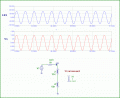
Theoretically, it would be something like this based upon the formula.
View attachment 144272
But practically, inductors don't have zero resistance and hence I was wondering whether net zero inductance is possible.
Two inductors stated as simply two inductors, taken at face value, are just two separate inductors with no interacting fields.
Two inductors with mutual inductance though should be stated as such, and in that case we have interaction in the core and the field.
If we look at it from the standpoint of flux in the core, one winding generates flux in one direction and the other coil generates flux in the other direction, so we end up with zero inductance. If there is winding resistance then we would have a total of 2 times the single winding resistance because the two coils are in series. So we might get the zero inductance, but we get some resistance. This is probably why some members started to bring low inductance resistors into the discussion.
This is an interesting question though i think because normally we dont do this because i dont think it has any benefit for an actual transformer (which is what this is). The idea does have a benefit when making low inductance resistors though.
Mutual inductance can be a fairly complicated calculation though, and to actually get perfect coupling the windings would have to be exactly the same in every aspect, and because the coupling must be exactly 1, that would mean both windings would somehow have to be in the exact same physical place in space which is not possible. This means even if the core flux balances perfectly, there is still the direct coil to coil flux to consider, and since there must be some small separation distance there must be a coupling less than 1. This would lead to imperfect coupling which in turn would lead to some small inductance anyway in the real life construction.