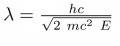
Is it all about frequency?

bogosort

Joined Sep 24, 2011
696
Coupling constants aren't dimensionless. If they were their place in the equation would have no effect on the dimensions of the resulting force.
http://hyperphysics.phy-astr.gsu.edu/hbase/Forces/couple.html

For two pointlike bodies in space F = G * (M1 * M2) / (Lr * Lr). So G = (F = MLT^-2) / (M^2L^-2) = (MLT^-2) * (M^-2L^2) = M^-1L^3T^-2.
You've got this backwards. To make the units work in formulas that use it, the gravitational constant G is defined as having those dimensions. But what is G, really? It's nothing more than a scale factor. Newton figured out that the gravitational force between two objects is proportional to the ratio of the product of the their masses and the square of the distance between them. But he only knew that these quantities were proportional up to some constant -- he didn't have the tools to find the exact value -- so he labeled the unknown factor G and called it a day.

G is like the k in Hooke's law: F = -kx. The constant k (like the constant G) isn't the important thing about the law -- which is, of course, the dynamics -- it just scales the resulting behavior. And like G, we have to define k with the appropriate units to make the dimensions work out in the equations.

What you've expressed is simply the second derivative of a body's position within said field.
The gravitational field generated by a mass is defined as the force per unit mass some other object would feel at every point in the field. That is, if we let M1 be our test mass, then F / M1 = G * M2 / r^2 defines the field for every distance r from the source mass M2. Clearly, though G is used in the calculation of the resulting force, the magnitude of the field does not have the same units as G.

I know it's very paradoxical isn't it? I don't get it either. And how can the field variables have dimension M/L? That implies only one particle is involved. Umm yeahhh...
I still don't understand what you mean by field constants and field variables.

Could be that charge is fundamental and mass is just an equivalence effect of the interplay of just charge, length, and time.
Remember, both electric charge and mass are fundamental physical properties of matter. They can't be defined in terms of each other. Length and time are, in a sense, actually less fundamental, though we can associate length with proper distance and time with proper time, the 'proper' versions of which are physical invariants and so fundamental.

In terms of units, though, we can use one or more physical constants -- most of which are dimensioned-- to algebraically manipulate the given dimensions and so define one dimension in terms of another, e.g., length in terms of time. But this is a human trick and speaks nothing of the underlying physical reality.

Or perhaps even more specifically the universe is basically just some kind of mathematical automatation...a program!
Then the question becomes, who's the programmer? :)
 

xox

Joined Sep 8, 2017
936
You've got this backwards. To make the units work in formulas that use it, the gravitational constant G is defined as having those dimensions. But what is G, really? It's nothing more than a scale factor. Newton figured out that the gravitational force between two objects is proportional to the ratio of the product of the their masses and the square of the distance between them. But he only knew that these quantities were proportional up to some constant -- he didn't have the tools to find the exact value -- so he labeled the unknown factor G and called it a day.


G is like the k in Hooke's law: F = -kx. The constant k (like the constant G) isn't the important thing about the law -- which is, of course, the dynamics -- it just scales the resulting behavior. And like G, we have to define k with the appropriate units to make the dimensions work out in the equations.
Then why is it that when we combine the Planck units like so Pl^3 * Pm^-1 * Pt^-2 you get G exactly? Because those are the actual dimensions of the coupling constant (the "field constant" I was referring to).

The gravitational field generated by a mass is defined as the force per unit mass some other object would feel at every point in the field. That is, if we let M1 be our test mass, then F / M1 = G * M2 / r^2 defines the field for every distance r from the source mass M2. Clearly, though G is used in the calculation of the resulting force, the magnitude of the field does not have the same units as G.
Right, now rearrange that equation and you get F = G * M1 * M2 * r^-2 = G * M^2 * L^-2. Which is the same thing I wrote in the last post.

Remember, both electric charge and mass are fundamental physical properties of matter. They can't be defined in terms of each other. Length and time are, in a sense, actually less fundamental, though we can associate length with proper distance and time with proper time, the 'proper' versions of which are physical invariants and so fundamental.
Again, from what I have already described there does seem to be a way to do away with at least one of those constants. And that means that either charge is a function of mass, length, and time, or mass is a function charge, length, and time. And I'm honestly starting to suspect it's the latter.

Then the question becomes, who's the programmer? 
I don't know, but they really should have used a better debugger!

*** EDIT ***

By the way, by "field variables" I mean the things you multiply with the field constant in order to get the resultant force. Like for gravity those would be M1*M2/r^2 variables with dimension M^2 * L^-2.
 

bogosort

Joined Sep 24, 2011
696
Then why is it that when we combine the Planck units like so Pl^3 * Pm^-1 * Pt^-2 you get G exactly? Because those are the actual dimensions of the coupling constant (the "field constant" I was referring to).
G is not a coupling constant, it's a proportionality constant, i.e., a way to scale the strength of gravity relative to the units used. If you change the system of units, the value of G changes, too. Coupling constants -- like the fine-structure constant -- are dimensionless and independent of units; they are pure magnitudes that reflect the strength of the interaction they describe within some regime (range of energy levels).

The simple reason that G falls out of your equation is that Planck units are defined in terms of G: each Planck unit includes a factor of G. So, it's really not surprising that one can arrange Planck units to make G pop out.

Let's do it explicitly. The Planck mass and length have the following definitions:
\[ P_L = \sqrt{ \frac{\hbar G}{c^3} }, \qquad P_M = \sqrt{ \frac{\hbar c}{G} } \]
Now, you derived G by multiplying the values of the speed of light squared by the value of the "length over mass constant". But I claim that this is a symbolic artifact of the way things are defined. To wit:
\[ \begin{align}
(\text{Cv2}) (\text{Cr}) &= c^2 \left( \frac{P_L}{P_M} \right) \\
&= c^2 \left( \frac{\hbar^{1/2} G^{1/2} c^{-3/2}}{\hbar^{1/2} c^{1/2} G^{-1/2}} \right) \\
&= G
\end{align} \]
In other words, G falls out of the equation algebraically, not due to some deep physical truth. What you've done is replace the symbols with their values, but the result is the same.

Right, now rearrange that equation and you get F = G * M1 * M2 * r^-2 = G * M^2 * L^-2. Which is the same thing I wrote in the last post.
But rearranging the equation changes the thing we're talking about! The field is defined in terms of F / M; you've changed the equation to talk about F, but F doesn't describe the field. If we're talking about voltage, and you're trying to show me that the units on both sides of an equation are voltages, you can't use Ohm's law to claim that resistances are voltages.

Again, from what I have already described there does seem to be a way to do away with at least one of those constants. And that means that either charge is a function of mass, length, and time, or mass is a function charge, length, and time. And I'm honestly starting to suspect it's the latter.
Constants of proportionality are human constructs, dependent entirely on how we define the references. A fundamental principle of science is that the physical world exists entirely independent of humans, and so anything that is physical should be independent of our measurements and conveniences. Properties of matter such as (rest) mass and electric charge are indeed physical properties; furthermore, to the best of our knowledge, they are irreducible. We can't express the property of mass in terms of the property of charge, or vice versa. However, when we abstract these physical properties and describe them in terms of units, we've introduced another degree of freedom that allows us to describe them in terms of the other. Constants of proportionality exist on this abstracted level, and so they're ripe for manipulation.

For example, in Planck units, G becomes the dimensionless number 1. Divide the cube of Planck length by the product of the Planck mass and the square of the Planck time, keeping track of the SI units throughout, and you'll end up with G = 1. That doesn't give us any profound insight into the cosmos, because it's just algebraic manipulation. And this goes for any other form of equation shuffling.

I don't know, but they really should have used a better debugger!
LOL!
 

xox

Joined Sep 8, 2017
936
G is not a coupling constant, it's a proportionality constant, i.e., a way to scale the strength of gravity relative to the units used. If you change the system of units, the value of G changes, too. [...]
The simple reason that G falls out of your equation is that Planck units are defined in terms of G: each Planck unit includes a factor of G. So, it's really not surprising that one can arrange Planck units to make G pop out.

Let's do it explicitly. The Planck mass and length have the following definitions:

[...]

Now, you derived G by multiplying the values of the speed of light squared by the value of the "length over mass constant". But I claim that this is a symbolic artifact of the way things are defined. To wit:

[...]

In other words, G falls out of the equation algebraically, not due to some deep physical truth. What you've done is replace the symbols with their values, but the result is the same.
Yes of course the specific value of G depends upon the units chosen; If all are set to unity then G is also one. But that still doesn't change the fact that the proportionality constant itself is purely a manifestation of the algebraic combination of the underlying dimensions, that is to say (M^-1)(L^3)(T^-2). You can verify this yourself by observing that (N = (M^1)(L^1)(T^-2)) = (G = (M^-1)(L^3)(T^-2))(V = (M^2)(L^-2)), where N is the force in newtons, G is the proportionality constant, and V represents the variables supplied to the gravitational force calculation (ie: M1*M2/r2). You claim it makes no difference but I just can't see how that can be so. Dimensional analysis follows the same rules as algebra; both sides of the equations MUST balance.


But rearranging the equation changes the thing we're talking about! The field is defined in terms of F / M; you've changed the equation to talk about F, but F doesn't describe the field. If we're talking about voltage, and you're trying to show me that the units on both sides of an equation are voltages, you can't use Ohm's law to claim that resistances are voltages.
From Wikipedia:

According to Newton's law of universal gravitation, the attractive force (F) between two point-like bodies is directly proportional to the product of their masses (m1 and m2), and inversely proportional to the square of the distance, r, (inverse-square law) between them.
So we are talking about a force.

We can't express the property of mass in terms of the property of charge, or vice versa.
Sure you can:

Q = sqrt(SLM)

And

M = Q^2/SL

Where Q is charge, M is mass, and S is equal to the scaling factor of 10^7.

However, when we abstract these physical properties and describe them in terms of units, we've introduced another degree of freedom that allows us to describe them in terms of the other. Constants of proportionality exist on this abstracted level, and so they're ripe for manipulation.
Then demonstrate this by eliminating either Planck time or length. You can't!

So please, don't just assume that this is some kind of algebraic hocus-pocus. It's easy for us to sort of position ourselves in a debating stance and then lose sight of the actual points being made. Forget about being right or wrong. I have shown you that it is possible to generate ALMOST ALL of the natural constants of nature USING JUST THREE PLANCK UNITS. Think about what that really means. I for one was never taught such a thing and I am fairly certain that you weren't either. So this is indeed something novel (though not necessarily earth-shattering).
 

Thread Starter

visionofast

Joined Oct 17, 2018
106
Just as some brief comments to your expertized discussion,
AFAIK, to instantly win a Nobel Prize in physics, you need to have an ability of good classification in your mind...

As a non-expert in Fundamental Sciences,I've gotten used to get through practice to find theoretical formulations.so,if it is to be jumping from theory to practice, we have to know,there are three types of events around, as observers:

deterministic events, stochastic events and chaotic ones...
therefore, you can say , events are deteministically independent , stochastically independent (or maybe chaotically ,one day) and the same process'd go for invariancy or other similar concepts.

I think,nowadays struggles in physics are more about stochastic observations/modelings than deterministic ones, and maybe it's been ended up with deterministic definitions in mass/ energy world (like I found more in this thread).or at least,It's just a migration from statistical observations to a deterministic formulation.
As for jumping from practice to theory, we assume that we have different fundamental types of "Fields" for fundamental "Forces",
and there're also some classifications for them then...for example , circulationg fields,conservative ones and other possible combinations of them...each one'd descibe how energy can applies the force to mass or other types of field.
based on various effects of these fields and their indpendent behaviours ,we can assume various independent "particles" would be there, that are dealers of recorded effects .and trying to attribute some invariance and quantified values for mass,charge,energy,etc then, that would not be absolute in formulations so.
BTW that, one time ,you'd say ,things are theoretically independent ,one time, you'd say they are practically independent.

In other hand, we also could have some classifications for different materials in relation to electromagnetic fields,in some cases, based on frequency.for example,we have electroactive materials (in lower frequencies),dielectrics(in middle freqs) ,metamaterials(higher freqs),etc.that you'd see lots of coupling coefficients there, if you desire.

anyway...who knows,maybe that mentioned string theory ,one day proves that ,the concept of mass (in plunk's scale or others) is a super campact form of energy with super high frequency by self...o_O
 
Last edited:

xox

Joined Sep 8, 2017
936
I think,nowadays struggles in physics are more about stochastic observations/modelings than deterministic ones, and maybe it's been ended up with deterministic definitions in mass/ energy world (like I found more in this thread).or at least,It's just a migration from statistical observations to a deterministic formulation.


Insomuch as the universe itself does not seem to be deterministic, we really shouldn't be thinking of physical theorems in those terms. Rather, each scientific theory provides SOME level of accuracy in making predictions. Quantum field theories for example give really accurate results but are computationally expensive. Point-like physics ignores things like the actual volume of the bodies in question and therefore the accuracy is much grainer. Temperature physics steps even farther back by neglecting the individual aspects of things and thus is by its very nature a statistical beast.


As for jumping from practice to theory, we assume that we have different fundamental types of "Fields" for fundamental "Forces", and there're also some classifications for them then...for example , circulationg fields,conservative ones and other possible combinations of them...each one'd descibe how energy can applies the force to mass or other types of field.


[...]


In other hand, we also could have some classifications for different materials in relation to electromagnetic fields,in some cases, based on frequency.for example,we have electroactive materials (in lower frequencies),dielectrics(in middle freqs) ,metamaterials(higher freqs),etc.that you'd see lots of coupling coefficients there, if you desire.


Amazing, isn't it? Various types of physical interactions create what essentially amounts to an unlimited number of possible effects.


anyway...who knows,maybe that mentioned string theory ,one day proves that ,the concept of mass (in plunk's scale or others) is a super campact form of energy with super high frequency by self...


String theory's been around for almost 50 years now and yet for some reason it still hasn't produced a single practical application. Methinks it's just more fizzbang to sell to the department heads in order to get more funding...
 

bogosort

Joined Sep 24, 2011
696
Yes of course the specific value of G depends upon the units chosen; If all are set to unity then G is also one. But that still doesn't change the fact that the proportionality constant itself is purely a manifestation of the algebraic combination of the underlying dimensions, that is to say (M^-1)(L^3)(T^-2). You can verify this yourself by observing that (N = (M^1)(L^1)(T^-2)) = (G = (M^-1)(L^3)(T^-2))(V = (M^2)(L^-2)), where N is the force in newtons, G is the proportionality constant, and V represents the variables supplied to the gravitational force calculation (ie: M1*M2/r2). You claim it makes no difference but I just can't see how that can be so. Dimensional analysis follows the same rules as algebra; both sides of the equations MUST balance.
I've read this three times but I'm still not sure of your point. You wrote it in response to my demonstration that G falls out of Cv2 * Cr algebraically because of how Planck units are defined. Presumably you agree with that. You seem to be emphasizing that G has dimensions (L^3)(M^-1)(T^-2), but I've never disputed that. What am I missing?

So we are talking about a force.
Newton's universal law of gravitation is expressed as a force, but the gravitational field is not a force. To have any hope of making sense to each other, we have to be clear about this distinction.

Sure you can:

Q = sqrt(SLM)

And

M = Q^2/SL

Where Q is charge, M is mass, and S is equal to the scaling factor of 10^7.
Ah, this gets us closer to the disconnect. When I speak of a property of matter, such as mass or electric charge, I mean the physical phenomenon that is experimentally observed to be invariant and irreducible. In other words, the properties refer to an external reality, completely independent of human conventions. On the other hand, the notion of physical dimension is a human construct, a conceptual scaffolding that helps us make sense of things. The property that we call mass is not equivalent to the dimension that we call mass; the former is physical, the latter is conceptual. The distinction is made clear by your example: we can easily and logically relate the various dimensions, but it is physical nonsense to "make" charge by mixing mass and length.

I think it's important to recognize that dimensional analysis is a bookkeeping tool, and that when we label things with base dimensions-- such as mass, or length, time, etc. -- we're applying a model. This model isn't even uniquely specified: there's freedom of choice in the base dimensions, and each choice leads to the same higher-level models of physics. This fact strongly suggests that dimensionality is a human convention and not a fundamental property of the universe (e.g., the physics of an alien race might not quantify phenomena dimensionally, yet still be as effective as ours). Thus, it's difficult to believe that we'll find any profound physical insights through rote dimensional analysis.

Then demonstrate this by eliminating either Planck time or length. You can't!
I don't understand your point. We can surely eliminate Planck time or length; simply don't use it! Of course, if you want a system of units for which G = c = h = ke = kB = 1, then you have to replace them with equivalent definitions, because that's precisely how Planck units were set up.

This is how I interpret the quote above: Let A = B*C*D*E. Try to eliminate C or D and still have A!

What am I missing?

I have shown you that it is possible to generate ALMOST ALL of the natural constants of nature USING JUST THREE PLANCK UNITS. Think about what that really means. I for one was never taught such a thing and I am fairly certain that you weren't either. So this is indeed something novel (though not necessarily earth-shattering).
First, there are many more physical constants than what you've generated. More importantly, the constants that you've generated are already included in the definitions of the chosen Planck units, namely, c, h, and G. I take it you're assuming that your Field(2) constant corresponds to the strong interaction, but what does it represent? The strong interaction's coupling constant is known to be near unity, so it's not that. What exactly is the novel find?
 

xox

Joined Sep 8, 2017
936
I've read this three times but I'm still not sure of your point. You wrote it in response to my demonstration that G falls out of Cv2 * Cr algebraically because of how Planck units are defined. Presumably you agree with that. You seem to be emphasizing that G has dimensions (L^3)(M^-1)(T^-2), but I've never disputed that. What am I missing?
Okay good so we agree on that.

Newton's universal law of gravitation is expressed as a force, but the gravitational field is not a force. To have any hope of making sense to each other, we have to be clear about this distinction.
Right, I'm talking about the resultant forces. We can go over more complex field interactions later.

Ah, this gets us closer to the disconnect. When I speak of a property of matter, such as mass or electric charge, I mean the physical phenomenon that is experimentally observed to be invariant and irreducible. In other words, the properties refer to an external reality, completely independent of human conventions. On the other hand, the notion of physical dimension is a human construct, a conceptual scaffolding that helps us make sense of things. The property that we call mass is not equivalent to the dimension that we call mass; the former is physical, the latter is conceptual. The distinction is made clear by your example: we can easily and logically relate the various dimensions, but it is physical nonsense to "make" charge by mixing mass and length.
[...]
I think it's important to recognize that dimensional analysis is a bookkeeping tool, and that when we label things with base dimensions-- such as mass, or length, time, etc. -- we're applying a model. This model isn't even uniquely specified: there's freedom of choice in the base dimensions, and each choice leads to the same higher-level models of physics. This fact strongly suggests that dimensionality is a human convention and not a fundamental property of the universe (e.g., the physics of an alien race might not quantify phenomena dimensionally, yet still be as effective as ours). Thus, it's difficult to believe that we'll find any profound physical insights through rote dimensional analysis.
Sounds more like a philosophical argument to me. Equivalence principles abound in physics so your point is basically moot anyway. If a specific algebra accurately describes some domain then there is nothing to debate. The job of a scientific model isn't to explain reality. It's to make predictions which can be verified experimentally. The rest is the realm of metaphysics, in my opinion.

I don't understand your point. We can surely eliminate Planck time or length; simply don't use it! Of course, if you want a system of units for which G = c = h = ke = kB = 1, then you have to replace them with equivalent definitions, because that's precisely how Planck units were set up.

This is how I interpret the quote above: Let A = B*C*D*E. Try to eliminate C or D and still have A!

What am I missing?
You're confusing units with dimensions. The numeric value would indeed get absorbed but the dimension of time itself remains. On the other hand, as I have already shown you can actually view things strictly from the point of view of charge or, if you so choose, from that of mass. Seems pretty novel to me but then I guess that's just because I haven't ever read that anywhere before. Have you?


I take it you're assuming that your Field(2) constant corresponds to the strong interaction, but what does it represent? The strong interaction's coupling constant is known to be near unity, so it's not that.
You said it yourself, coupling and proportionality constants are not the same thing. So whatever its value, it doesn't apply here.

First, there are many more physical constants than what you've generated. More importantly, the constants that you've generated are already included in the definitions of the chosen Planck units, namely, c, h, and G.
How about this. Give me a list of constants and I will generate them using nothing more than the products of charge, length, time, and any number of dimensionless constants (eg: 2 * pi, the fine structure constant, etc).

Would that convince you?
 

bogosort

Joined Sep 24, 2011
696
Sounds more like a philosophical argument to me.
You're the one who seems to be claiming that the "square root of charge" is physically meaningful. ;)

If a specific algebra accurately describes some domain then there is nothing to debate.
Let's be clear. The word "algebra" has two (very) different meanings. The way you are using it in the quote just above suggests that you are talking about algebras as formal mathematical structures, e.g., sigma algebras or Clifford algebras. In this usage, it is certainly true that we can (and often do) gain deep insights into a physical system if we can map it to a well-known mathematical structure (geometries, groups, vector spaces, algebras, etc.). Once in the mathematical domain, all of the unessential details are abstracted away and only the essential relationships remain, revealing aspects that would have been difficult (at best) to see in the physical system. This is how physics of the past century has progressed: framing gravity in terms of differential geometry, quantum mechanics in terms of Hilbert spaces, QFTs in terms of group theory.

But the algebra that you're using with Planck units is something entirely different. What you're doing is what most people think of when they see the word algebra: symbolic manipulation. It is the most basic form of abstraction -- it only describes the rules for shuffling symbols -- and so is incapable of providing deep insights. There can be no surprises or revelations when you rearrange the symbols in a true equation to form another true equation.

You're confusing units with dimensions. The numeric value would indeed get absorbed but the dimension of time itself remains.
On the contrary, the physical constants {c, h, G, ke, kB} are all dimensionless in the system of Planck units. That's the entire point of the system.

On the other hand, as I have already shown you can actually view things strictly from the point of view of charge or, if you so choose, from that of mass. Seems pretty novel to me but then I guess that's just because I haven't ever read that anywhere before. Have you?
The first time I came across the general idea was early in Wheeler's classic Spacetime Physics textbook:

1575738951396.png
How about this. Give me a list of constants and I will generate them using nothing more than the products of charge, length, time, and any number of dimensionless constants (eg: 2 * pi, the fine structure constant, etc).
You do realize that the only constants you'll be able to generate are those derived from the constants that are already cooked into the Planck units, yes? For example, the Josephson constant is defined as the ratio of electron charge to h, so that will unsurprisingly fall right out of the appropriate quotient of Planck units. On the other hand, there is precisely zero chance you will be able to generate, say, the Weinberg angle or the electron mass. You will surely win a Nobel prize if you can somehow find a way to derive any of the coupling constants just by mixing Planck units.

Generate any one of the Yukawa constants and I'll be convinced.
 

xox

Joined Sep 8, 2017
936
You're the one who seems to be claiming that the "square root of charge" is physically meaningful.
Actually it's Q = (MLS)^(1/2).

Let's be clear. The word "algebra" has two (very) different meanings.
[...]
But the algebra that you're using with Planck units is something entirely different. What you're doing is what most people think of when they see the word algebra: symbolic manipulation. It is the most basic form of abstraction -- it only describes the rules for shuffling symbols -- and so is incapable of providing deep insights. There can be no surprises or revelations when you rearrange the symbols in a true equation to form another true equation.
Okay so perhaps I was using the phrase a bit too loosely. All I really meant was a given physical model.

On the contrary, the physical constants {c, h, G, ke, kB} are all dimensionless in the system of Planck units. That's the entire point of the system.
Yes but the constants are still intrinsically tied to those dimensions. What is the point of tossing them aside anyway?!

The first time I came across the general idea was early in Wheeler's classic Spacetime Physics textbook:
The thing Wheeler misses however is that it's not the number we're interested in - that's just a scaling factor. It is the ratio of length per time (on the Planck scale) that really matters.

You do realize that the only constants you'll be able to generate are those derived from the constants that are already cooked into the Planck units, yes?
[...]
Generate any one of the Yukawa constants and I'll be convinced.
Ha touche! Look I'm just making a simple observation here. It is a very basic rearrangement of terms true but I still think the result is kind of intriguing.
 

bogosort

Joined Sep 24, 2011
696
Yes but the constants are still intrinsically tied to those dimensions. What is the point of tossing them aside anyway?!
The reason is entirely mundane: dropping the dimensions simplifies the resulting equations.

Physicists that play with particle accelerators like to characterize things in terms of the electronvolt (eV), which is nominally a unit of energy (on par with joules in SI). To use the electronvolt as a unit of mass, dividing eV by c^2 will give you the correct dimensions. Thus, a proton has a mass of about 0.9 GeV/c^2, the Higgs boson has a mass of 125 GeV/c^2, etc. We can also describe other common quantities in terms of eV: momentum (eV divided by c^1), time (hbar divided by eV), length (hbar * c divided by eV), etc.

If you're writing up a long paper on your latest experiment, and everything is in eV, you're going to have a ton of these factors of c and hbar littering your equations and figures. Since anyone who reads your paper will almost certainly be a professional HEP physicist, there's really no need to include all the conversion constants. So you use Planck units, setting c = hbar = 1 to be dimensionless, with confidence that the reader will take the correct meaning of eV from context. This is why we often see the Higgs mass quoted as being 125 GeV (full stop). If for some reason the units need to be converted into SI or whatever, it's an easy matter to apply the appropriate constant factors after the fact.

The thing Wheeler misses however is that it's not the number we're interested in - that's just a scaling factor. It is the ratio of length per time (on the Planck scale) that really matters.
I doubt Wheeler missed much. In any case, the ratio of length and time is not actually fundamental. Relativity has taught us that velocity -- i.e., the ratio of length and time -- is not a physical invariant, and so cannot correspond to something physically "out there". Moreover, space and time are not the orthogonal, independent aspects of reality that we've historically treated them as. Instead, they are both components of spacetime, with any distinction between them depending on the given metric and choice of signature. And though it's true that in flat spacetimes (e.g., the Minkowski metric) the components of space and time have opposite signs, and so seem to have some intrinsic structural difference, this doesn't necessarily hold in curved spacetimes. For example, under the Schwarzschild metric, the sign switches from the time component to a spatial component at the Schwarzschild radius: t becomes spacelike, and x becomes timelike.

The takeaway, I think, is that length and time seem fundamental at human scales, but that says more about us than about how the universe actually works.

Ha touche! Look I'm just making a simple observation here. It is a very basic rearrangement of terms true but I still think the result is kind of intriguing.
I totally get that, and I hope I didn't come off as a jerk in debating it. I've actually enjoyed going into the dimensional weeds with you, as it forced me to clarify and put into words some things that were previously just vague notions in my head.
 

xox

Joined Sep 8, 2017
936
The reason is entirely mundane: dropping the dimensions simplifies the resulting equations.
Which is precisely my point. Normally we just ignore them. But for a moment just imagine them as some sort of "reflexive" mass-space-time (or alternately charge-space-time) geometry interacting with these field variables/parameters to yield some force.

Physicists that play with particle accelerators like to characterize things in terms of the electronvolt (eV), which is nominally a unit of energy (on par with joules in SI). To use the electronvolt as a unit of mass, dividing eV by c^2 will give you the correct dimensions. Thus, a proton has a mass of about 0.9 GeV/c^2, the Higgs boson has a mass of 125 GeV/c^2, etc. We can also describe other common quantities in terms of eV: momentum (eV divided by c^1), time (hbar divided by eV), length (hbar * c divided by eV), etc.
Okay, let's look at that one then.

e = mc^2

Dimensionally:

E = M * (L/T)^2

So from the standpoint of charge:

E = (Q^2/(LS)) * (L/T)^2

And thus:

E = Q^2 * L^1 * T^-2 * S^-1

In other words the dimensions of energy are simply the acceleration of squared charge (all divided by the constant S).

In any case, the ratio of length and time is not actually fundamental. Relativity has taught us that velocity -- i.e., the ratio of length and time -- is not a physical invariant, and so cannot correspond to something physically "out there". Moreover, space and time are not the orthogonal, independent aspects of reality that we've historically treated them as. Instead, they are both components of spacetime, with any distinction between them depending on the given metric and choice of signature.
[...]
The takeaway, I think, is that length and time seem fundamental at human scales, but that says more about us than about how the universe actually works.
Again, it's the ratio of dimensions that I'm talking about here. The numeric ratio is just an artifact of the choice of units.

And though it's true that in flat spacetimes (e.g., the Minkowski metric) the components of space and time have opposite signs, and so seem to have some intrinsic structural difference, this doesn't necessarily hold in curved spacetimes. For example, under the Schwarzschild metric, the sign switches from the time component to a spatial component at the Schwarzschild radius: t becomes spacelike, and x becomes timelike.
You lost me at Minkowski. What exactly does that mean though, switching from timelike to spacelike?
 

bogosort

Joined Sep 24, 2011
696
Which is precisely my point. Normally we just ignore them. But for a moment just imagine them as some sort of "reflexive" mass-space-time (or alternately charge-space-time) geometry interacting with these field variables/parameters to yield some force.
To what end though? We use dimensionality to help us frame the stuff "out there" in a consistent manner; they're model-building tools. How is science improved by treating them as if they are the stuff "out there"?

Einstein developed special relativity in a purely logical manner: posit a couple of axioms and see what necessarily follows. Some time later, Minkowski modeled SR in a geometrical context, which turned out to be a really useful way to think about SR. Both models -- Einstein's algebraic approach and Minkowski's geometric approach -- describe the same theory and lead to the same physics, but some problems are easier to understand/solve in one context or the other.

In this light, I'm willing to grant the possibility that a {mass,charge}-spacetime geometry could provide an alternative, perhaps even insight-provoking context for high-energy physics. Of course, the full geometry would have to be worked out before we could know if it was useful (or even possible).

In other words the dimensions of energy are simply the acceleration of squared charge (all divided by the constant S).
That's one way to frame it, sure. Again, the fact that there is not a single, unique way to dimension something as fundamental as energy is clear evidence that dimensionality is a human construct, not a physical truth.

Again, it's the ratio of dimensions that I'm talking about here. The numeric ratio is just an artifact of the choice of units.
Note that I didn't mention units, I was talking about the dimensions of length and time (and their ratio as the dimension of velocity).

You lost me at Minkowski. What exactly does that mean though, switching from timelike to spacelike?
Intuitively, when we frame space and time geometrically, we use a function called the metric to define the interval (geometric distance) between two points. Our choice of metric determines the resulting geometry. For example, using the 2-dimensional Pythagorean metric -- where the distance ds between two points is defined as \( ds^2 = dx^2 + dy^2 \) -- leads to the familiar Euclidean geometry of the plane.

In 4D Minkowski space, the metric (with signature +---) is defined as \( ds^2 = (c dt)^2 - (dx^2 + dy^2 + dz^2) \). There are formal conditions under which a spacetime interval is considered timelike or spacelike (depending on the sign of ds), but for our purposes it suffices to say that we (dimensionally) think of the dt term as representing time and the {dx, dy, dz} terms as representing space, assigning units appropriately. In turn, these four terms are distinguished by their sign: whatever the metric signature, the spatial terms will have opposite sign of the time term. True, they are also distinguished by a factor of c, but, again, that's just a constant of proportionality that we can -- and often do -- dispose of.

The salient point is that, in any spacetime metric, the sign of the terms characterizes the behavior in time (dimensionally) and space (dimensionally). Now, Minkowski spacetime is flat, which makes it unsuitable to account for gravity. In order to do that, we need a metric that leads to curved spacetime. In these geometries, under certain conditions, the signs of the time and space terms, respectively, become flipped, causing the (dimensional) time component to represent behavior in space, and the (dimensional) space component to reflect behavior in time. In other words, while the dimensions of the variables of course stay the same, their corresponding physical behavior is switched, which is another indicator that dimensionality doesn't have a physical reality.
 

xox

Joined Sep 8, 2017
936
To what end though? We use dimensionality to help us frame the stuff "out there" in a consistent manner; they're model-building tools. How is science improved by treating them as if they are the stuff "out there"?
When equivalence relations arise from formulas it is often useful to explore. Here, by taking electric charge to be the base unit one obtains expressions for electric potential, gravity, and other possible forces.

Einstein developed special relativity in a purely logical manner: posit a couple of axioms and see what necessarily follows. Some time later, Minkowski modeled SR in a geometrical context, which turned out to be a really useful way to think about SR. Both models -- Einstein's algebraic approach and Minkowski's geometric approach -- describe the same theory and lead to the same physics, but some problems are easier to understand/solve in one context or the other.
It's like the jump from point-like physics to tensors. Doesn't mean one of them is wrong, the other is just "more right".

Intuitively, when we frame space and time geometrically, we use a function called the metric to define the interval (geometric distance) between two points. Our choice of metric determines the resulting geometry. For example, using the 2-dimensional Pythagorean metric -- where the distance ds between two points is defined as \( ds^2 = dx^2 + dy^2 \) -- leads to the familiar Euclidean geometry of the plane.

In 4D Minkowski space, the metric (with signature +---) is defined as \( ds^2 = (c dt)^2 - (dx^2 + dy^2 + dz^2) \). There are formal conditions under which a spacetime interval is considered timelike or spacelike (depending on the sign of ds), but for our purposes it suffices to say that we (dimensionally) think of the dt term as representing time and the {dx, dy, dz} terms as representing space, assigning units appropriately. In turn, these four terms are distinguished by their sign: whatever the metric signature, the spatial terms will have opposite sign of the time term. True, they are also distinguished by a factor of c, but, again, that's just a constant of proportionality that we can -- and often do -- dispose of.

The salient point is that, in any spacetime metric, the sign of the terms characterizes the behavior in time (dimensionally) and space (dimensionally). Now, Minkowski spacetime is flat, which makes it unsuitable to account for gravity. In order to do that, we need a metric that leads to curved spacetime. In these geometries, under certain conditions, the signs of the time and space terms, respectively, become flipped, causing the (dimensional) time component to represent behavior in space, and the (dimensional) space component to reflect behavior in time. In other words, while the dimensions of the variables of course stay the same, their corresponding physical behavior is switched, which is another indicator that dimensionality doesn't have a physical reality.
As you said yourself, maybe it's for tautological reasons. The math "picks up" just enough information to be able to sufficiently model the true physical system to some degree of accuracy.

I still don't quite understand much of Minkowski's work though. But I have already started to read up on it and it does look pretty interesting.

In this light, I'm willing to grant the possibility that a {mass,charge}-spacetime geometry could provide an alternative, perhaps even insight-provoking context for high-energy physics. Of course, the full geometry would have to be worked out before we could know if it was useful (or even possible).
I've only got the basic outline done and there's still much to do figuring out how exactly individual particles masses translate to charge insomuch as it seems to depend on the specific "effective" radii of these which is AFAIK not yet known to a sufficient level of accuracy. But the rest at least is fairly straightforward.

First define

S = Mu0 / 4 * Pi

where Mu0 is equal to the vacuum permeability constant.

Obviously

Q = charge
M = mass
L = length
T = time
F = force

Now assume that

M = Q^2 * L^-1 * S^1

And so

F = M^1 * L^1 * T^-2 = Q^2 * T^-2 * S^1

Starting with electric potential we see that the dimensions of our variables

Vq = (Q1 * Q2) / (Ld^2) -> Q^2 * L^-2 * S^1

Which of course implies that the true dimensions of the electric proportionality constant Fq are simply that of the speed of light squared! This topology then does not itself contain a dimension of charge. And so it is analogous to the identity element of special unitary (SU) groups, the "trivial group".

Going to the gravitational field we get

Vg = Q^4 * L^-4 * S^2

and

Fg = M^-1 * L^3 * T^-2 = Q^-2 * L^4 * T^-2 * S^-1

I haven't even begun to interpret the above results just yet, that's basically as far as I've gotten.

Finally, just as something to ponder for now, the following possible forms:

V(n) = (M^1 * L^-1)^n = (Q^2 * L^1 * S^1)^n
F(n) = (L^2 * T^-2) * (Q^-2 * L^2 * S^-1)^(n - 1)
 
Last edited:

bogosort

Joined Sep 24, 2011
696
I've only got the basic outline done and there's still much to do figuring out how exactly individual particles masses translate to charge insomuch as it seems to depend on the specific "effective" radii of these which is AFAIK not yet known to a sufficient level of accuracy. But the rest at least is fairly straightforward.
It might be helpful to think about what the actual physics will look like in this scheme. You could try to solve a known problem -- e.g., work out the energy levels in the classic "electron in a box" problem -- and see if something novel pops out or if it's just a mere re-labeling. Or see what happens when you try to do physics involving electrically neutral particles using charge as a base dimension. In a geometrical context, you might think about what vectors look like in charge-spacetime (5D?). What's the distance between two points? What does the angle between them represent? Can you find Lorentz-invariant transformations on the space? How does a base dimension of electric charge relate to the 4-current in Minkowski spacetime?

I think playing around with the physics (instead of the labels) will reveal much more about the value of the scheme. At the very least, it will give you a sense of whether or not it's worth exploring that path.
 

Thread Starter

visionofast

Joined Oct 17, 2018
106
in many cases,begining from theory dosn't make sense but it could be like a clue,for example,maybe the best formula to find a relation between mass ,frequency and energy is a combination of de Broglie and plank's equation for a fermion that is:
em.jpgso the mass "M" can be derived in relation to "F" frequency and "E" energy.indeed , the mass will be found as a driect proportion of F^2/E. so the mass ,looks like a kind of density of energy .
so if we one day can satisfy a physical condition that Energy directly dosn't change vs frequency or stay conservatively constant, we would find different condition that the mass is related to E and F.and who knows, maybe it could be a basic to make a interferometer for gravitional wave or something like.
 
Top