Thats the bad thing about this, Ive come here to get a little help, ask if / what can be done, if there's any new components out there and Im getting jumped on about the voltage of the batteries, how Ive made a couple of typo's, If I was writing out a official paper to introduce a new product onto the market then yes I could understand it.
Its best to change this forum, any new members must have a some sort of degree in electronics that has to be proved and thickos like me should be kicked off
Hi All, is this possible, I have a bunch of 18650s all doubled up making 7.2v, reg'ed down to 5v volts, what I need to do is have 2 x 5v outs but if one gets shorted or overloaded it wont pull the other one down, can it be done ?
Your project seems reasonably clear. Assuming you have getting a 5 volt supply from the batteries handled, you want to supply power to different loads without allowing a short or excessive current on one load impact the others. Your request is straightforward to me.
Fortunately, despite all the comments to the contrary, this isn't a difficult task. In fact, it's pretty common in devices (like a laptop) with multiple USB ports. Microchip has a number of USB Current Limit ICs designed to do exactly this. If the current goes over a limit (set by the choice of the IC or possibly adjustable by resistors), the power to that output gets cutoff.
It would be simple enough to add some features too, like low-current switches to turn on or off each output or an LED to show an output has drawn too much current.
Your project seems reasonably clear. Assuming you have getting a 5 volt supply from the batteries handled, you want to supply power to different loads without allowing a short or excessive current on one load impact the others. Your request is straightforward to me.
Fortunately, despite all the comments to the contrary, this isn't a difficult task. In fact, it's pretty common in devices (like a laptop) with multiple USB ports. Microchip has a number of USB Current Limit ICs designed to do exactly this. If the current goes over a limit (set by the choice of the IC or possibly adjustable by resistors), the power to that output gets cutoff.
It would be simple enough to add some features too, like low-current switches to turn on or off each output or an LED to show an output has drawn too much current.
How about using a buck/boost DC-DC converter?
They are versatile, inexpensive, efficient and readily available.
You can connect it directly to one battery and adjust the output voltage to suit your needs.
I looked Samsung's datasheet, not a sales sheet from a store.
The datasheet is 8 years old and maybe also your battery cells might be that old. Do they still work?
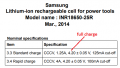
The datasheet (and me) say they are each charged to 4.2V and are fully charged when the charging current drops to a fairly low amount:
I looked Samsung's datasheet, not a sales sheet from a store.
The datasheet is 8 years old and maybe also your battery cells might be that old. Do they still work?
The datasheet (and me) say they are each charged to 4.2V and are fully charged when the charging current drops to a fairly low amount:
Your project seems reasonably clear. Assuming you have getting a 5 volt supply from the batteries handled, you want to supply power to different loads without allowing a short or excessive current on one load impact the others. Your request is straightforward to me.
Fortunately, despite all the comments to the contrary, this isn't a difficult task. In fact, it's pretty common in devices (like a laptop) with multiple USB ports. Microchip has a number of USB Current Limit ICs designed to do exactly this. If the current goes over a limit (set by the choice of the IC or possibly adjustable by resistors), the power to that output gets cutoff.

 Facebook
 Google
 GitHub
 Linkedin