Is a tiny IC chip easily destroyed by soldering?

Audioguru again

Joined Oct 21, 2019
6,826
The datasheet for the LM4871 amplifier says it produces 3 Whats into a 3 ohms speaker with 10% of awful sounding clipping distortion, or 1 Watt into an 8 ohms speaker with fairly low distortion, 0.5W at very low distortion.
Since its frequency response reaches 3MHz then a solderless breadboard is not recommended.

Doesn't a hot diode conduct both ways almost like a piece of wire?
 

DickCappels

Joined Aug 21, 2008
10,661
(some text removed for clarity)

Doesn't a hot diode conduct both ways almost like a piece of wire?
Certainly when you get to the point of melting the silicon it does. Below that point I assume that you just have to live with reverse leakage current increasing with temperature. Interesting, that suggests that for a diode detector there is an optimum temperature.
 

Audioguru again

Joined Oct 21, 2019
6,826
When I think of leakage current when there is a high temperature in a silicon diode, I think of impurities in it like some germanium. Then it is probably caused by poor quality.
 

Willen

Joined Nov 13, 2015
338
I am sorry that I missed this when it was posted close to a year ago. That's an interesting experiment. A heater can make crystal radio (or diode detector in general) somewhat more sensitive! I used baised Schottky diode detectors in the past but never thought of heating them up!
It was really interesting. :) The smaller the voltage drop gave me the louder output. An ordinary signal schottky diode has little bit higher voltage drop than power schottky diodes. In the situation, the power schottky diode performed very well.
 

Thread Starter

lame man

Joined Mar 16, 2021
14
I typically breadboard a simple test circuit for a basic go/nogo chip test or use a chip tester that I have. The tester is only good for some of the more popularly used chips though. Or, simply use a chip socket which is what I always do. If the circuit isn't working, simply pop the chip out of the socket and replace it with a known good one.
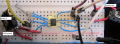
Since your reply I have spent hours hooking up the LM4871 on a breadboard. I've concluded that the chip is dead and useless and like many others that I have been sold. In studying the circuit (Shutdown, Bypass and +In have been connected to ground) I don't see any glaring error or omission in my implementation. With power reaching the chip as well as GND leaving the chip I should hear at least something from my speaker...some crackling or static; everything is silent. Earlier you said that you were surprised at how much heat these chips can withstand. I must be some sort of a masochist when it comes to frustration, meaning that I would fail with one circuit (eventually the contact might break off) and I would try it all over again with the same chip. To the point of going through five LM4862 s. From blind faith I've gone to skepticism. I think that all these chips are DOA - all purchased from Mouser. If you have the right tester you might want to test their LM4871, LM4875 and LM4862. The LM386N-3/NOPB was the only chip I could put to work. I'll want an answer from Mouser and then there is Yelp and the BBB for me to complain to.
 

Attachments

dl324

Joined Mar 30, 2015
18,337
I have spent hours hooking up the LM4871 on a breadboard
1645314921375.png
Stranded wire doesn't work well with solderless breadboards. Buy yourself some SMT to DIP adapters, some #22 solid wire, and, if you're going to attach wires like that, some #30 solid wire.
 

KeithWalker

Joined Jul 10, 2017
3,608
Since your reply I have spent hours hooking up the LM4871 on a breadboard. I've concluded that the chip is dead and useless and like many others that I have been sold. In studying the circuit (Shutdown, Bypass and +In have been connected to ground) I don't see any glaring error or omission in my implementation. With power reaching the chip as well as GND leaving the chip I should hear at least something from my speaker...some crackling or static; everything is silent. Earlier you said that you were surprised at how much heat these chips can withstand. I must be some sort of a masochist when it comes to frustration, meaning that I would fail with one circuit (eventually the contact might break off) and I would try it all over again with the same chip. To the point of going through five LM4862 s. From blind faith I've gone to skepticism. I think that all these chips are DOA - all purchased from Mouser. If you have the right tester you might want to test their LM4871, LM4875 and LM4862. The LM386N-3/NOPB was the only chip I could put to work. I'll want an answer from Mouser and then there is Yelp and the BBB for me to complain to.
I don't see any resistors or capacitors in your breadboard circuit. It does not match the schematic you posted. You have probably blown every IC you tried by connecting them up in such a random fashion. It is pointless to complain to Mouser. They have an excellent record for quality products and customer satisfaction.
We have offered you a lot of advice which you do not appear to comprehend. If you wish to be successful in electronics, you must start by learning how to translate a schematic diagram into a breadboard circuit neatly and accurately. If you can not do that, maybe knitting would be a less expensive hobby for you.
 

Ya’akov

Joined Jan 27, 2019
10,241
I wonder what you mean by testing a chip. I have a TI IC LM4871 that I'm trying to test. I had an idea (probably a stupid one) to use a breadboard to connect everything with without risking heating the chip. Is there another way to test a chip?
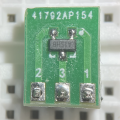
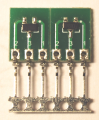
The soldering of the IC is so haphazard that it is entirely unclear if things are connected properly. To use SMD components with a breadboard you can either use a breakout board or a socket. The breakout boards still require precision soldering but only to attach the package to traces, which should be considerably easier than what you are trying to do there.

1645357614595.png
Different package, same idea. Randomly on my bench.

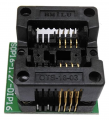
Because SOIC packages, unlike DIP, don't have legs to "plug in" the sockets that are generally available are intended for programming but they will still work for breadboarding, and they won't require you to desolder the IC if you want to use it somewhere else.

This is an example. I haven't used this one myself, but I generally trust the vendor (Hiletgo) and have purchased many items from them without any major disappointments. Not visible in this photo are the DIP-spaced headers on the bottom which will plug into the breadboard.

1645357995718.png
Whatever you do you can't expect more than random success if you continue to use the method you are using, it's just not going to be reliable. Overheating is certainly possible, but just properly wiring is more of a problem.
 

DickCappels

Joined Aug 21, 2008
10,661
When chips are soldered they get plenty hot. Thermal damage to transistors because of heating of the package while soldering is rare.

In some datasheets soldering conditions are noted, but they seem to be getting rare in these days.
LF155 Op Amp:
1645368728246.png
 

dl324

Joined Mar 30, 2015
18,337
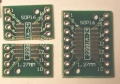
Here an example of an SOIC to DIP adapter:
1645374468704.png
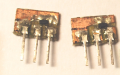
I needed 8 pin, so I cut a 16 pin in half.

When I use SOT-23 to SIP adapters, I use some lead frames so I can stand them up:
1645374563866.png
In a pinch, you can make your own:
1645374609983.png
The lead frames cost more than the adapters, when you can find them.
 

Thread Starter

lame man

Joined Mar 16, 2021
14
I don't see any resistors or capacitors in your breadboard circuit. It does not match the schematic you posted. You have probably blown every IC you tried by connecting them up in such a random fashion. It is pointless to complain to Mouser. They have an excellent record for quality products and customer satisfaction.
We have offered you a lot of advice which you do not appear to comprehend. If you wish to be successful in electronics, you must start by learning how to translate a schematic diagram into a breadboard circuit neatly and accurately. If you can not do that, maybe knitting would be a less expensive hobby for you.
I'm sorry that you feel that I should take up knitting.
 

KeithWalker

Joined Jul 10, 2017
3,608
I'm sorry that you feel that I should take up knitting.
I don't feel that you should take up knitting, but if you are not able to make a simple circuit like that work, with the help of some of the smartest electronic gurus on the internet, maybe it would be a valid alternative.
 

dl324

Joined Mar 30, 2015
18,337
To the point of going through five LM4862 s. From blind faith I've gone to skepticism. I think that all these chips are DOA - all purchased from Mouser.
This device is sensitive to ESD. Were you handling it appropriately?
1645463138112.png

Does the device package have a pad on the bottom that's supposed to be used as a heat sink?
 
Top