IR circuit

Thread Starter

optus

Joined Oct 25, 2019
92
hi,
How are you measuring the current in the IR emitter.?
Did you try that test I suggested.?
E
Hi
I did not try because i am not at home at the moment.I will do the measurment tomorow then i will reply.
I measured between + of 3V suply and a positive leg of a ir led
 

ericgibbs

Joined Jan 29, 2010
21,440
hi optus,
I expect you did not measure the IR current when the 555 was running, if you did it that way with a DVM, you would get a 'low' value reading.
The test I am suggesting should test out the NPN and IR circuit also you could try using just a 1.5v battery, via a 525R to the Base.
This should confirm if the driver is working as expected.

BTW: as a rule most designers would consider a transistors saturated current Gain to be 10 thru 20
E
 

Thread Starter

optus

Joined Oct 25, 2019
92
Might use a darlington transistor like MPSA13 or better N ch. logic level FET like FDD6530A, 36 m ohm,
Thank you for your reply...
I like your sugestion bit it will took some time for me tu use a fet because i must order it first since i dont have fet on my disposal...My bigest doubt is NPN and his data sheet.On 6 V hfe is min.120...i have a suply of 3 V so i cant predict hfe on such voltage and that present a big problem for calculating proper base biasing

hi optus,
I expect you did not measure the IR current when the 555 was running, if you did it that way with a DVM, you would get a 'low' value reading.
The test I am suggesting should test out the NPN and IR circuit also you could try using just a 1.5v battery, via a 525R to the Base.
This should confirm if the driver is working as expected.

BTW: as a rule most designers would consider a transistors saturated current Gain to be 10 thru 20
E
Thank you...i must say that i apriciate every help from you and all members.I am not sure what DVM stands for?? I measured when everything was ON including 555.My guestion is:why are values so low?
 

ericgibbs

Joined Jan 29, 2010
21,440
hi,
DVM Digital Volt Meter.
If you use a current meter to measuring a current which is switching On/Off you will not measure the peak current thru the IR LED
E
 

Thread Starter

optus

Joined Oct 25, 2019
92
hi,
DVM Digital Volt Meter.
If you use a current meter to measuring a current which is switching On/Off you will not measure the peak current thru the IR LED
E
Thank you...that was a god explanation and helping point for my further testings.My measurment are done with handheld osciloscope/VM.Can you give me advice how to more precise measure curent?
 

ericgibbs

Joined Jan 29, 2010
21,440
hi,
As you know the High output state voltage of the 555 with a 3v supply is approx 1.5V, so I would use 1.5V battery via 525R to the NPN Base or configure the 555 so that its output pin #3 is High all the time, then measure the continuous IR LED current for a few seconds.

This should give you an indication of the peak current when the 555 is running and driving the NPN.

E
 

Thread Starter

optus

Joined Oct 25, 2019
92
hi,
As you know the High output state voltage of the 555 with a 3v supply is approx 1.5V, so I would use 1.5V battery via 525R to the NPN Base or configure the 555 so that its output pin #3 is High all the time, then measure the continuous IR LED current for a few seconds.

This should give you an indication of the peak current when the 555 is running and driving the NPN.

E
Thank you
From datasheet of TLC555CP i can read that on a 2V suply min.output voltage high state is 1.5 V and typical is 1.9 V.For 3 V i asume it is going to be a bit higher...But,since i runing 555 on 60% duty cycle this voltage is switching between 0 and 60% of anything that comes through the output of 555.Please corect me if am wrong
 
Last edited:

Audioguru again

Joined Oct 21, 2019
6,826
1) An IR diode is not 0.8V. It is probably 1.2V to 1.5V.
2) The hFE of a transistor is when it is an amplifier with plenty of Vce (it is far from saturation). The base current should be 1/10th the collector current for it to produce a saturation voltage loss of 0.3V.
3) The Cmos 555 has a very low output sourcing current which is not enough for your circuit.
4) The battery is 3V only when it is new. It drops to 2V or less.
 

KeithWalker

Joined Jul 10, 2017
3,607
First of all thank you very much for your reply.I apriciate that
All of my measure are done with uni t 81c handheld osciloscope.On the pin 3 i measured the voltage first witouth load,and then with transistor conected to it with ir led diode and resistor in colector region.
The problem is i do not getting desired gain(curent through ir led) and since datasheet of transistor said that at 6V hfe is min.120 i am not sure that my transistor even is saturated though i doubt since Vbe is around 0.45 V and Vce near 2 V??My suply is 3V.
The first point is :
There will be a drop of about 1,3 volts across the IR diode when it is on. When the transistor is saturated, Vce will be about 0.2 volts.
That will give about 1.5volts across the 7.5 Ohm resistor (3 - 1.3 - 0.2 = 1,5). Therefore the maximum current through the diode will be 1.5/7.5 = 0.02 amps or 20 mA.

The second point is:
There appears to be something wrong with the transistor. The Vbe should be about 0.7 volts, not 0.45. Are you sure you have it connected the right way round? If it is connected correctly it is eithe faulty or you have a DC offset on the zero volts reference on you oscilloscope.
 

Thread Starter

optus

Joined Oct 25, 2019
92
1) An IR diode is not 0.8V. It is probably 1.2V to 1.5V.
2) The hFE of a transistor is when it is an amplifier with plenty of Vce (it is far from saturation). The base current should be 1/10th the collector current for it to produce a saturation voltage loss of 0.3V.
3) The Cmos 555 has a very low output sourcing current which is not enough for your circuit.
4) The battery is 3V only when it is new. It drops to 2V or less.
Thank you for your replay...with you guys i learn more and more.Although i have guestion on 3 and 4.
Is it not that the source curent is only a curent that shold run between emiter and base? And curent that would run through ir led when transistor is in saturation mode(acting as a switch) is curent in the base gained by some factor?? Then i think that it can source enough curent since max sourcing is 10 mA??
You sugesting that it would not operate on 3V bateries?Or in the other words you are saying that when circuit is on batery voltage droos to 2V and all calculations for 3V drops in water??
Thans for your answer

The first point is :
There will be a drop of about 1,3 volts across the IR diode when it is on. When the transistor is saturated, Vce will be about 0.2 volts.
That will give about 1.5volts across the 7.5 Ohm resistor (3 - 1.3 - 0.2 = 1,5). Therefore the maximum current through the diode will be 1.5/7.5 = 0.02 amps or 20 mA.

The second point is:
There appears to be something wrong with the transistor. The Vbe should be about 0.7 volts, not 0.45. Are you sure you have it connected the right way round? If it is connected correctly it is eithe faulty or you have a DC offset on the zero volts reference on you oscilloscope.
Thank you very much for your answer.
I want to clear the thing you wrote first and be free to correct me because i am still learning.If duty cycle is 60% how can i get 1.3 V on a diode and 1.5 V on resistor?? Datasheet of TLC555CP said that with suply of 2V min.output high stage is 1.5 V and typical is 1.9 V.Since i have suply of 3V i think it going to be a bit higher so my base of a transistor is switching on and off between 0 and 60% of that voltage that came out of pin 3 on 555 timer...am i right?
 

KeithWalker

Joined Jul 10, 2017
3,607
I stated that "There will be a drop of about 1,3 volts across the IR diode when it is on. When the transistor is saturated, Vce will be about 0.2 volts."
That is the condition when the transistor is on and saturated. It has nothing to do with duty cycle.
Did you read my second comment? if the transistor is connected wrong or faulty it will never work.
 

Thread Starter

optus

Joined Oct 25, 2019
92
I stated that "There will be a drop of about 1,3 volts across the IR diode when it is on. When the transistor is saturated, Vce will be about 0.2 volts."
That is the condition when the transistor is on and saturated. It has nothing to do with duty cycle.
Did you read my second comment? if the transistor is connected wrong or faulty it will never work.
Transistor is conected properly...Base with resistor on output 3 of a timer,emiter on - batery,colector circuit(led and resistor in series) on +
I just want to tell that when transistor is on it is on for 60% of time so it will never reach the suply voltage or in other words transistor stays on until base reach 60% of a pin 3 voltage
 
Last edited:

KeithWalker

Joined Jul 10, 2017
3,607
Transistor is conected properly...Base with resistor on output 3 of a timer,emiter on - batery,colector circuit(led and resistor in series) on +
Then you are either measuring the Vbe wrongly or the transistor is faulty. The Vbe should be about 0.7 volts when the output from the 555 is high.
 

KeithWalker

Joined Jul 10, 2017
3,607
Transistor is conected properly...Base with resistor on output 3 of a timer,emiter on - batery,colector circuit(led and resistor in series) on +
I just want to tell that when transistor is on it is on for 60% of time so it will never reach the suply voltage or in other words transistor stays on until base reach 60% of a pin 3 voltage
That statement is incorrect. What will never reach the supply voltage?
As soon as pin 3 goes high (1 volt?) the base current of 5.7 mA will turn on the transistor and Vbe will be approximately 0.7 volts. It will stay turned on until pin 3 goes low. When pin 3 goes low, the transistor will turn off. It does not matter what the duty cycle is.
 

KeithWalker

Joined Jul 10, 2017
3,607
Transistor is conected properly...Base with resistor on output 3 of a timer,emiter on - batery,colector circuit(led and resistor in series) on +
I just want to tell that when transistor is on it is on for 60% of time so it will never reach the suply voltage or in other words transistor stays on until base reach 60% of a pin 3 voltage
I have just realized why your measurements are not making sense. You said that you were using an oscilloscope, which shows the dynamic wave form with high and low values. I just checked what an "81C" oscilloscope is. I am assuming that it is a "UNI-T UT81C Digital Multimeter with Oscilloscope" and that you are not making your measurements with the oscilloscope but with the DC voltmeter.
Try looking with the oscilloscope at the waveforms at pin 3 of the 555 and on the collector of the transistor and record the high and low voltages of the waveforms you see. That will let us know what is really going on in your circuit.
 

Thread Starter

optus

Joined Oct 25, 2019
92
Then you are either measuring the Vbe wrongly or the transistor is faulty. The Vbe should be about 0.7 volts when the output from the 555 is high.
Transistor has all conditions for working properly but still it does not...he is new bought...nevertheless
I have just realized why your measurements are not making sense. You said that you were using an oscilloscope, which shows the dynamic wave form with high and low values. I just checked what an "81C" oscilloscope is. I am assuming that it is a "UNI-T UT81C Digital Multimeter with Oscilloscope" and that you are not making your measurements with the oscilloscope but with the DC voltmeter.
Try looking with the oscilloscope at the waveforms at pin 3 of the 555 and on the collector of the transistor and record the high and low voltages of the waveforms you see. That will let us know what is really going on in your circuit.
Thank you.I apriciate it.Every minute i learned something new.I will try tomorrow an then will we see...
Thanks
 

BobTPH

Joined Jun 5, 2013
11,515
You seem to be confusing duty cycle with voltage. If you have a PWM signal of 3V at 60%, that does not make the voltage 1.8V. The voltage is either 3V or 0V in the two parts of the cycle.


A Voltmeter will read something like 1.8V because it is measuring an average.

But that is NOT the voltage to use in your LED resistor calculation. The voltage you should use for that is 3V minus the Vcesat of the transistor.

Assuming a saturation voltage of about 0.3, and 80 mA, the calculation looks like this:

3 - 0.3 - 1.3 = 0.08 R

R = (3 -0.3 - 1.3) / 0.8 = 17.5 Ohms

Bob
 

Audioguru again

Joined Oct 21, 2019
6,826
The transistor does not saturate because its base current is too low.

The base current is low because the TLC555 has a very small output current when it sources current (when it goes high).
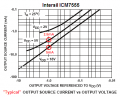
On the datasheet it shows a minimum output current of only 300uA (0.3mA) when its supply is 2V and its output voltage is only 1.5V. Its output current is a little higher when its supply voltage is higher and is probably 0.8mA when the supply is 3V and the output voltage is 2.2V.

With a 0.8mA base current then the transistor would have a saturated 8mA collector current but the collector current will be about because the transistor is not saturated and is amplifying the base current maybe 20 times, the collector resistor is not doing anything.
0.8mA in the 525 ohm base resistor produces a voltage across the resistor of 0.42V. Then the output voltage of the TLC555 will be limited to 3V - 0.7V (base voltage) - 0.42V (resistor voltage)= 1.88V which is less than the 2.2V with 1mA so its output current will be a little higher than 0.8mA or maybe 0.82mA. The datasheet for the Intersil ICM7555 which is the same as a TLC555 shows a "typical" output high current of about 1.5mA when the supply is 3V and the output is driving a dead short. The current is less when its is not so heavily loaded and where will you buy a "typical" IC instead of getting a "minimum" one? Also, will you replace the battery every day so its voltage is always 3V?
 

Attachments

Top