Interfacing to an unkown stepper motor

Thread Starter

spinnaker

Joined Oct 29, 2009
7,830
After having an old HP scanner up in my attic for years, I am ready to start on my PCB etchant agitator project. The scanner is non operational.

I have never interfaced to a stepper motor before so I need a little help.

I have the stepper motor removed and snapped a pic of it below. It has no markings other than the number J07A98KC which I assume is an HP number because it does not yield any results in a search at all. I assume it is an internal HP number.
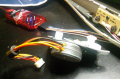
upload_2017-12-16_20-43-17.png


There are two bundles of wires. Each set of wires has 3 wires for a total of 6 wires.

The colors are yellow, red orange and black, red, brown.

The order of the wires on the connector are

1- Red (batch 1)
2- Red (batch 2)
3- Orange (batch 2)
4 - Brown (batch 1)
5 - Yellow (batch 2)
6-Black (batch 1)

I get connectivity on the following pairs of pins

1-6
1-4
2-5
2-3


1. How would I figure out my current requirements for this motor?

2. Voltage requirements?

3. I assume pins 1 and 2 are my common pins? Both are red.

4. Can I assume that Pin 1 is the common for Brown/Black (pin 4 and 6) and Pin 2 is the common for orange/yellow (pins 3 and 5)?

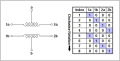
5. I found the following "logic" table on another site for the sequence for a stepper motor. How do I correlate this to my motor? I think I got the A and B OK but which wire would A be and which (not)A? Like wise for the B windings. How would I figure that out? Just trail and error?

upload_2017-12-16_21-19-20.png
 

Thread Starter

spinnaker

Joined Oct 29, 2009
7,830
Thanks I have read about them elsewhere too and have a basic idea of how hey work.

I need to now how to figure the specifications on the one I have based on what I have laid out.
 

Thread Starter

spinnaker

Joined Oct 29, 2009
7,830
If you don't have any conception about stepping motor then you can see the circuit below to figure out the basic control theory and it will help you to solve your problem.


Scott Wang's Blog.

What is the purpose of the diodes between the 4017 and UNL2003? I could not be for back emf? the UNL2003 should provide that protection.
 

ScottWang

Joined Aug 23, 2012
7,501
What is the purpose of the diodes between the 4017 and UNL2003? I could not be for back emf? the UNL2003 should provide that protection.
Two diodes combined as OR gates with the input of ULN2003 included forward and reverse, so there are four 2 inputs OR Gates.
 

ElectricSpidey

Joined Dec 2, 2017
3,335
Also whenever you combine the outputs of CMOS the diodes are needed to keep high and low playing nice with each other.


Nice test circuit BTW.


I hope the reason the scanner doesn’t work is not because of the motor…
;)
 

MaxHeadRoom

Joined Jul 18, 2013
30,661
1- Red (batch 1)
2- Red (batch 2)
3- Orange (batch 2)
4 - Brown (batch 1)
5 - Yellow (batch 2)
6-Black (batch 1)

I get connectivity on the following pairs of pins

1-6
1-4
2-5
2-3
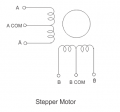
The logic chart is for a Bi-polar stepper, you have a Uni-polar by the look of it.
Those motors are often fed from a 12v source, a 5amp source should do it.
The phasing sequence consists of 8 steps, not 4.
Max.
upload_2017-12-16_22-55-15.png
 

Thread Starter

spinnaker

Joined Oct 29, 2009
7,830
Also whenever you combine the outputs of CMOS the diodes are needed to keep high and low playing nice with each other.
Wut???

I hope the reason the scanner doesn’t work is not because of the motor…
;)
Not me. I really don't care about the rest od the scanner. And if I was, and the issue was the motor then the scanner would be toast anyway for lack of replacement.
 

Thread Starter

spinnaker

Joined Oct 29, 2009
7,830
The logic chart is for a Bi-polar stepper, you have a Uni-polar by the look of it.
How do you know this? Is it because it has a common? The article I got the chart from has a similar arrangement.

upload_2017-12-17_7-10-32.png


Those motors are often fed from a 12v source, a 5amp source should do it.
The phasing sequence consists of 8 steps, not 4.
Max.
View attachment 141851
How do I know which wire is 1a and which 1b and which is 2 a and which is 2 b? Does it matter?
 

MaxHeadRoom

Joined Jul 18, 2013
30,661
How do I know which wire is 1a and which 1b and which is 2 a and which is 2 b? Does it matter?
You can visibly see the two separate stators/wires You can find how to match the polarity by using a DC source from centre tap to one conductor and see the way it jumps or indexes, then try it on the second stator and check for same direction.
Max.
 

Thread Starter

spinnaker

Joined Oct 29, 2009
7,830
You can visibly see the two separate stators/wires You can find how to match the polarity by using a DC source from centre tap to one conductor and see the way it jumps or indexes, then try it on the second stator and check for same direction.
Max.


Negative on Pin 1 positive on 6 Clockwise
Negative on Pin 1 positive on 4 Counter clockwise
Negative on Pin 2 positive on 3 Clockwise
Negative on Pin 2 positive on 5 counter clockwise.
 

RichardO

Joined May 4, 2013
2,270
Can you tell what the voltage scanner used for the motors? As Max says it was probably 12 volts but 24 volts is also possible. Have you measured the resistance of the windings? The one that matters is from common to either end of the coil.

Steppers of this type were designed to work with the ULN2003 class of drivers so expect the current to be in the range of 200 to 300 ma.
 

DNA Robotics

Joined Jun 13, 2014
670
Try connecting 1 and 2 together feeding +12 volts to it through a 10 ohm 10 watt resistor. then ground the other pins in the sequence 3, 4, 5, 6. Then try the sequence 6, 5, 4, 3 for the other direction. Wired that way, you can run it with logic level N MOSFETs and a computer LPT1 or micro controller.
 

Thread Starter

spinnaker

Joined Oct 29, 2009
7,830
Can you tell what the voltage scanner used for the motors? As Max says it was probably 12 volts but 24 volts is also possible. Have you measured the resistance of the windings? The one that matters is from common to either end of the coil.

Steppers of this type were designed to work with the ULN2003 class of drivers so expect the current to be in the range of 200 to 300 ma.

No scanner is dead as I wrote above. Stepper actually indexes as low as 5V. I need to hook it up to a pic now to see if I can get a full range of movement.
 
Top