inteligent relay or control

AnalogKid

Joined Aug 1, 2013
12,129
Back in the ooooooold days, a relay symbol was based on how a relay works mechanically - when the coil is energized, it pulls the armature toward itself. Old symbols have a dashed line from the center of the coil to the center of the armature to show this invisible linkage.

http://www.celpics.com/edit.php
http://www.gomog.com/BLAIR/tech/electrical/relay/troubleshoot_relay.html

What's interesting is that I can't find the old style symbol, with the inductor oriented vertically and the switch contacts oriented horizontally above it, exactly how an old control relay is constructed:
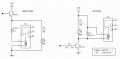
upload_2018-2-15_11-30-52.gif

ak
 

ebeowulf17

Joined Aug 12, 2014
3,307
Back in the ooooooold days, a relay symbol was based on how a relay works mechanically - when the coil is energized, it pulls the armature toward itself. Old symbols have a dashed line from the center of the coil to the center of the armature to show this invisible linkage.

http://www.celpics.com/edit.php
http://www.gomog.com/BLAIR/tech/electrical/relay/troubleshoot_relay.html

What's interesting is that I can't find the old style symbol, with the inductor oriented vertically and the switch contacts oriented horizontally above it, exactly how an old control relay is constructed:

View attachment 146069

ak
I'm inexperienced enough that I have no right to an opinion, but here's my take on things anyway.

I love that design software makes it easy to separate coils and contacts when you want to, because that can really clean up a messy schematic where lots of lines would be crossing.

On the other hand, if you're going to keep the coil and contacts near each other on the schematic anyway, it makes an awful lot of sense to orient all the parts in the logical way you've described. It just makes everything visually more intuitive. It's a thing I've always taken for granted and hadn't thought about, but I think it's a better way.

Regardless of what you're finding now, I've definitely seen what you're talking about a million times before, just never thought specifically about it until now. The are a lot of things they got right in the oooooold days!
 

Reloadron

Joined Jan 15, 2015
7,889
Back in the ooooooold days, a relay symbol was based on how a relay works mechanically - when the coil is energized, it pulls the armature toward itself. Old symbols have a dashed line from the center of the coil to the center of the armature to show this invisible linkage.

http://www.celpics.com/edit.php
http://www.gomog.com/BLAIR/tech/electrical/relay/troubleshoot_relay.html

What's interesting is that I can't find the old style symbol, with the inductor oriented vertically and the switch contacts oriented horizontally above it, exactly how an old control relay is constructed:

View attachment 146069

ak
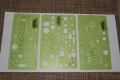
My software includes relays exactly as you describe, if you look real hard you can see the relay symbol(s).
Templates.png

This was my state of the art software. :) I came across these when I cleaned out my desk and retired. I also found several mechanical pencils which made the software function and a slide rule.

Ron
 
Last edited:

Reloadron

Joined Jan 15, 2015
7,889
I still have mine, and around a dozen slide rules from various ages. Geezer-geek-toys.

ak
While it is all pretty humorous today's software is really incredible. When I retired I could turn a drawing in likely 1/8 the time it took with templates. Years ago the company I was with dumped all the old drafting tables and the chairs. Employees could buy a nice table for about ten bucks. The chairs were five bucks along with the machines for the tables. My dad's old table still resides in what was my parents house basement down in Worthington, Ohio as my sister now has the old house.

Toward the end of my career I just hired new engineers who were up on state of the art. :)

Ron
 

AnalogKid

Joined Aug 1, 2013
12,129
I'm not married to mechanical no. Size is no issue I'm assuming not much larger than packet of cigarettes and has screw down terminals for all external connections max cable size will be 1.5mm. I'm in the uk.
Size is no problem.
4 screw terminal positions on one end (+12, GND, camera, GND) and two on the other (AC-1, AC-2), or all in a row?
Not familiar with British wire sizes. 1.5 mm is half way between AWG sizes 14 and 15, both very large for "under 1 A". Can you translate?
Screw terminals like this?
 

AnalogKid

Joined Aug 1, 2013
12,129
The way the circuit is now, if motion triggers the camera light switch output such that the camera switch is closed at the end of a previous inhibit period (by additional motion during the inhibit period), the lights come on immediately when the inhibit releases. Another option is that the circuit ignores any camera input unless the camera input goes low and then high again *after* an inhibit has finished. This might be a simple as differentiating the trailing edge of the camera signal, but I think it will be more complex than that. I haven't worked through the details yet. Goal is to keep everything in a single non-PIC chip.

Another note - At this output current level there are two types of small solid state relays, MOSFET and dual-SCR. The SCR parts cost less, but put a 1.6 V step in the output AC waveform zero-crossing. MOSFET parts do not do this, but have less operating margin and cost more.

Is this for personal or commercial use?

ak
 
Last edited:

Thread Starter

laurent Adams

Joined Feb 14, 2018
20
Size is no problem.
4 screw terminal positions on one end (+12, GND, camera, GND) and two on the other (AC-1, AC-2), or all in a row?
Not familiar with British wire sizes. 1.5 mm is half way between AWG sizes 14 and 15, both very large for "under 1 A". Can you translate?
Screw terminals like this?
1.5 is small house lighting wiring
 

Thread Starter

laurent Adams

Joined Feb 14, 2018
20
The way the circuit is now, if motion triggers the camera light switch output such that the camera switch is closed at the end of a previous inhibit period (by additional motion during the inhibit period), the lights come on immediately when the inhibit releases. Another option is that the circuit ignores any camera input unless the camera input goes low and then high again *after* an inhibit has finished. This might be a simple as differentiating the trailing edge of the camera signal, but I haven't worked through the details yet. Goal is to keep everything in a single non-PIC chip.

Another note - At this output current level there are two types of small solid state relays, MOSFET and dual-SCR. The SCR parts cost less, but put a 1.6 V step in the output AC waveform zero-crossing. MOSFET parts do not do this, but have less operating margin and cost more.

Is this for personal or commercial use?

ak
Personal use although I am an electrician so do have wiring voltage safety awareness
 
Top