inteligent relay or control

Thread Starter

laurent Adams

Joined Feb 14, 2018
20
its a normally open/closed contact , I'm switching a 12v dc supply to operate my lighting relay.
I don't think time delay is the correct road. its the second output we need to ignore for 30-40secs.

I had Siemens look at a solution and they could only resolve with a mini PLc £135!
 
Last edited:

ebeowulf17

Joined Aug 12, 2014
3,307
its a normally open/closed contact , I'm switching a 12v dc supply to operate my lighting relay.
I don't think time delay is the correct road. its the second output we need to ignore for 30-40secs.

I had Siemens look at a solution and they could only resolve with a mini PLc £135!
I think we cross-posted at the same time. Did you see my suggestion in post 17?

I'm fairly confident that handles the timing properly, defining a specific period of time after the signal turns off during which new signals will have no effect on the lights. You just need one timer if it's got NC contacts, or one timer and one additional relay if not.
 

AnalogKid

Joined Aug 1, 2013
12,129
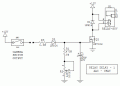
Something like this. The transistor turns on a few milliseconds after the camera switch closes, turning on the lights. They stay on as long as the switch is closed, plus the delay time. When the switch opens, C1 keeps the transistor turned on while R1-R2 discharge the capacitor slowly. After about 2 time constants the Q1 gate voltage is low enough to turn it off. The timing will vary somewhat from one transistor to another, and also with changes in ambient temperature, so add 5-10 seconds to the minimum delay needed.

Estimated cost is less than £135. Send the balance to Ohio.

ak
Delay-Relay-1.gif
 
Last edited:

ebeowulf17

Joined Aug 12, 2014
3,307
I did Ebe but couldn't understand it.
I'm at work now and can't take the time to do a good diagram, but I'll try to draw a rough schematic and a state diagram tonight or tomorrow. Hopefully it'll make more sense with visual aids (or I'll realize I got it wrong in the process of trying to document it - wouldn't be the first time!)
 

Thread Starter

laurent Adams

Joined Feb 14, 2018
20
AK But all you have done is delay the off. As soon as the camera sees the lights go off delayed or not the camera will bring lights on again
 

AnalogKid

Joined Aug 1, 2013
12,129
AK But all you have done is delay the off. As soon as the camera sees the lights go off delayed or not the camera will bring lights on again
That was my question in #12. I just re-read your response and now I understand (maybe):

When the camera opens its switch, the lights can go off immediately.
Then the circuit holds the lights off and ignores the camera for 30 seconds.
Then the circuit looks to the camera for the next trigger signal.

yes?

ak
 

Thread Starter

laurent Adams

Joined Feb 14, 2018
20
Yes that's right


[QUOTE/]When the camera opens its switch, the lights can go off immediately.
Then the circuit holds the lights off and ignores the camera for 30 seconds.
Then the circuit looks to the camera for the next trigger signal.

yes?

ak[/QUOTE]
 
Last edited:

AnalogKid

Joined Aug 1, 2013
12,129
Something like this?

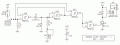
When the camera switch is closed, the input signal is high. R1-R2 holds pin 4 high, so pin 10 is low, pin 11 is high, and the transistor is on.

The falling edge of the camera signal as it turns off the lights triggers a true monostable. Pin 4 goes low, which turns off Q1 and holds it off no matter what happens at its input.

D1 reduces the timer reset time to around 1 second.

This circuit has much more stable performance because the gate transition levels are more tightly controlled than the threshold voltage of an individual FET. However, it requires a relatively high quality, low leakage cap for C1 because the peak charging current is less than 12 uA and the min is around 4 uA.

ak
Camera-Inhibit-1.gif
 
Last edited:

Thread Starter

laurent Adams

Joined Feb 14, 2018
20
Are there companies or diyers that would build that on a pcb ?
AK don't we need Q1 to hold off for 30+ secs circa 40?
 
Last edited:

AnalogKid

Joined Aug 1, 2013
12,129
The instant the camera switch opens, U1 pin 8 goes low and that propagates through to turn off Q1. U1 pin 2 also goes low to trigger the monostable, which holds Q1 off for a time period adjustable from approx 22 to 45 seconds with the parts shown. Adjust the timing components for other ranges.

When the monostable times out, U1 pin 4 goes high. If the camera switch still is open, the system sits with the lights off. If the camera switch is closed (because the camera detected motion during the inhibit period), the lights come on and the monostable resets, waiting for the next inhibit command.

What does "30+ secs circa 40" mean?

I can build as many as you want.

ak
 

AnalogKid

Joined Aug 1, 2013
12,129
Are there companies or diyers that would build that on a pcb ?
Physical size limits or restraints?
Packaging options? bare board, simple plastic box, rugged metal box, DIN rail, weatherproof, extreme temperatures, etc?
Power source, power quality?
Quantity?
Where are you located?

ak
 

ebeowulf17

Joined Aug 12, 2014
3,307
Ok, @AnalogKid's idea is probably better and cheaper - he always does a great job here!

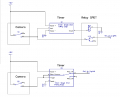
Having said that, I often enjoy trying to figure out what I can do by my own wits alone, just for the sake of working through the process. Here's what I came up with, using off the shelf components:
camera-light_trigger-cancel.png
The two versions of the diagram are for using a solid state timer, which would require an external relay, or a timer with a relay output. In both cases, the timer selection should be "Single Shot Falling Edge" which means that the relay will be active for a selected amount of time after the trigger signal goes low:
singe-shot-falling-edge.png
The idea here is that the power switched through the camera outputs directly powers the lights most of the time through the NC contacts of the relay. After that output goes low, the timer activates the relay briefly, breaking the circuit through the NC contacts and disabling the lights until the time has expired. Once time has expired, NC contacts are closed again, ready for the lights to turn on as soon as the camera activates them again.

There are probably other options for the timers, and probably from cheaper sources, but here are examples I found that I believe would do the job:
https://www.macromatic.com/products-main/time-delay-relays/encapsulated

http://www.weisd.com/ProductView.ph...wvkyxNdRn0WokRn7bdirgrugsnWHu424aAv8ZEALw_wcB

http://www.weisd.com/ProductView.ph...cVdNLHNOB-cBNZEOOxiakaa6WtCgeVCMaAuB9EALw_wcB

https://www.alliedelec.com/macromatic-thr-12266-32/71079045/
 

Thread Starter

laurent Adams

Joined Feb 14, 2018
20
I'm not married to mechanical no. Size is no issue I'm assuming not much larger than packet of cigarettes and has screw down terminals for all external connections max cable size will be 1.5mm. I'm in the uk.
 

Thread Starter

laurent Adams

Joined Feb 14, 2018
20
Certainly cleaver guys(or gal!)
My other would like is a dimmer that has 2 set points half or 3/4 and full but the rise from half to full must be slow at circa 1.5secs when an input is received ! Enjoy.
230vac led driver so needs to be led capable dimmer circuitry
 

ebeowulf17

Joined Aug 12, 2014
3,307
Interesting - I didn't know about the closest-to-the-coil convention. My software dumps coils and contacts in as separate elements you can rearrange for schematic clarity, and in this case I just happened to arrange them this way so there would be fewer trace crossings in the schematic. I suppose I could've just flipped the contacts upside down, but I had no idea there were implications to the placement (although perhaps I should've guessed!) I mistakenly assumed that relay contacts were always depicted in their "off" state. Now I know something new!

Anyway, excuses aside, you've understood my intent correctly. In both cases the idea is to connect the lights to the NC contact and only have the contact open during the period when the timer output is "on."
 
Top