Facebook
 Google
 GitHub
 Linkedin
I am back on adjustable negative power supply using operational amplifier.
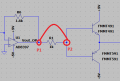
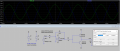
First, I am sorry we really have some reservations on component selection. I understand there are other operational amplifiers with large output current and some are cheaper too but we are limited to use the operational amplifier AD8397 and the PNP and NPN as shown in the attached schematic.
Regarding output load impedance and load characteristics, there is nothing much information given for now. I just use 1k Ohm as load in simulation. We actually need to change the negative voltage across the load very slowly. This can be with a pause of at least one second or more.
I am considering operational amplifier based solution for adjustable negative power supply. There is a change in the input voltage to the operational amplifier. The input voltage to the operational amplifier AD8397 is supplied by the digital to analog DAC which is interfaced to the FPGA through I2C. The digital to analog DAC can have maximum of 2.5 V. This device is again selected. We can have 0 to 2.5 V out from DAC which is connected to operational amplifier's inverting input.
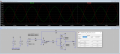
The operational amplifier is inverting the input and with some gain and using push-pull BJT booster stage can have 0 to -3.3 V across the load. I have simulated the attached circuit using sine wave full swing at the input on the operational amplifier, just to see the output.
I have some questions.
1- There has to be a feedback resistor for stability. I am not sure if I am getting it completely. Kindly explain bit more where can I put the feedback resistor.
2- The push-pull class AB stage have cross-over issue which can be resolved by two diodes or biasing the gates of both BJTs in such a way that they always conduct. It's not an issue if we don't solve the cross-over issue completely. We don't need full swing anyways.
3- There are gain margin and the phase margin related issues. I need some help here too. Kindly have a look at the attached circuit and let me know how can I address them along with the stability.
4- How clean would be this adjustable negative power supply using operational amplifier and push-pull BJT booster stage, compared to SMPS and linear regulators.
First, I am sorry we really have some reservations on component selection. I understand there are other operational amplifiers with large output current and some are cheaper too but we are limited to use the operational amplifier AD8397 and the PNP and NPN as shown in the attached schematic.
Regarding output load impedance and load characteristics, there is nothing much information given for now. I just use 1k Ohm as load in simulation. We actually need to change the negative voltage across the load very slowly. This can be with a pause of at least one second or more.
I am considering operational amplifier based solution for adjustable negative power supply. There is a change in the input voltage to the operational amplifier. The input voltage to the operational amplifier AD8397 is supplied by the digital to analog DAC which is interfaced to the FPGA through I2C. The digital to analog DAC can have maximum of 2.5 V. This device is again selected. We can have 0 to 2.5 V out from DAC which is connected to operational amplifier's inverting input.
The operational amplifier is inverting the input and with some gain and using push-pull BJT booster stage can have 0 to -3.3 V across the load. I have simulated the attached circuit using sine wave full swing at the input on the operational amplifier, just to see the output.
I have some questions.
1- There has to be a feedback resistor for stability. I am not sure if I am getting it completely. Kindly explain bit more where can I put the feedback resistor.
2- The push-pull class AB stage have cross-over issue which can be resolved by two diodes or biasing the gates of both BJTs in such a way that they always conduct. It's not an issue if we don't solve the cross-over issue completely. We don't need full swing anyways.
3- There are gain margin and the phase margin related issues. I need some help here too. Kindly have a look at the attached circuit and let me know how can I address them along with the stability.
4- How clean would be this adjustable negative power supply using operational amplifier and push-pull BJT booster stage, compared to SMPS and linear regulators.
Attachments
-
 63.5 KB Views: 18