Facebook
 Google
 GitHub
 Linkedin

Hello AAC forum,
Beginning in 2015 PIRs have been used in a variety of use cases, closets, staircases and
other home automation projects and circuits.
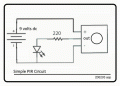
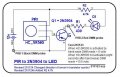
These are three of the circuits that were used in the beginning,
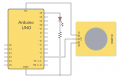
Recently a different type of motion sensor has been discovered, the Infineon BGT60LTR11AIP
BGT60LTR11AIP | XENSIV™ 60GHz first completely autonomous radar sensor for motion sensing - Infineon Technologies
The data sheet has been downloaded and carefully perused. The data sheet
has little technical info and is mostly marketing.
Does any one have technical info on the Infineon BGT60LTR11AIP?
Research has been done to find a simple circuit like the ones
copied above with no success.
Does any one have any experience with the Infineon BGT60LTR11AIP?
Is there a schematic for a simple circuit using the Infineon BGT60LTR11AIP?
Thanks.
Allen Pitts
Beginning in 2015 PIRs have been used in a variety of use cases, closets, staircases and
other home automation projects and circuits.
These are three of the circuits that were used in the beginning,
Recently a different type of motion sensor has been discovered, the Infineon BGT60LTR11AIP
BGT60LTR11AIP | XENSIV™ 60GHz first completely autonomous radar sensor for motion sensing - Infineon Technologies
The data sheet has been downloaded and carefully perused. The data sheet
has little technical info and is mostly marketing.
Does any one have technical info on the Infineon BGT60LTR11AIP?
Research has been done to find a simple circuit like the ones
copied above with no success.
Does any one have any experience with the Infineon BGT60LTR11AIP?
Is there a schematic for a simple circuit using the Infineon BGT60LTR11AIP?
Thanks.
Allen Pitts