How to use Infineon Power MOSFET models in LTspice

Thread Starter

hoyyoth

Joined Mar 21, 2020
528
Dear Team,

I will be using infineon BSL802SN in my application.When I downloaded the spice model I obtained a .lib file which contains the spice models of many mosfets including the one I need.

I copied this file to the sub folder and in my ltspice schematic I used '.include OptiMOS2_20V_LTSpice.lib' and I changed the mosfet name to BSL802SN.

Received the below error message.

I am attaching the spice model and test circuit along with this mail.

may I know how to use the spice models when you receive files like this which contain many parts
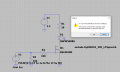
1747915977187.png
 

Attachments

Papabravo

Joined Feb 24, 2006
22,066
There are two ways that MOSFET symbols are used:
  1. The parameters of the device are represented by a ".model" card with a list of parameters and values.
  2. The device is represented by a ".subckt" which allows devices that are not properly represented by the standard model to be accommodated.
The error message clearly indicates that LTspice is looking for a ".model card". If I recall correctly the, the symbol needs to have the prefix attribute set to 'X' in order to link to the sub-circuit properly.

ETA: Which version of LTspice are you using?
 

Papabravo

Joined Feb 24, 2006
22,066
The BSL802SN device requires a symbol with 5 pins. They are as follows:
  1. drain
  2. gate
  3. source
  4. Tj - Voltage representing the junction temperature(?)
  5. Tcase - Voltage representing the case temperature(?)
I have such a symbol, but with the parts and values in your schematic the operation was not what I expected and the simulation would not run with reasonable values for V1 & V2. I've never seen a MOSFET operate exclusively from 3.3 Volts. Where did you get such a quaint notion?

1747926223629.png
 

Attachments

Last edited:

eetech00

Joined Jun 8, 2013
4,704
The BSL802SN device requires a symbol with 5 pins. They are as follows:
  1. drain
  2. gate
  3. source
  4. Tj - Voltage representing the junction temperature(?)
  5. Tcase - Voltage representing the case temperature(?)
I have such a symbol, but with the parts and values in your schematic the operation was not what I expected and the simulation would not run with reasonable values for V1 & V2. I've never seen a MOSFET operate exclusively from 3.3 Volts. Where did you get such a quaint notion?

View attachment 349703
Hi PB

There is no internal default value for Tj, so if you use this symbol and subckt, you must set Tj to a integer value.
Use a DC voltage source and set its value, for example, to 25v to represent 25 degrees C, and then connect it to the Tj pin.

There is a different .subckt in the .lib file that can be used that doesn't simulate the case temperature, so it will use a standard 3-pin mosfet symbol. Use either BSL802SN_L0 or BSL802SN_L1. The mosfet 3-pin symbol prefix attribute will still need to be changed to X.
 

Papabravo

Joined Feb 24, 2006
22,066
Hi PB

There is no internal default value for Tj, so if you use this symbol and subckt, you must set Tj to a integer value.
Use a DC voltage source and set its value, for example, to 25v to represent 25 degrees C, and then connect it to the Tj pin.

There is a different .subckt in the .lib file that can be used that doesn't simulate the case temperature, so it will use a standard 3-pin mosfet symbol. Use either BSL802SN_L0 or BSL802SN_L1. The mosfet 3-pin symbol prefix attribute will still need to be changed to X.
I don't have much experience with these sub-circuits, but I was vaguely aware of them since they are part of the libraries from @Bordodynov
In an effort to be helpful without a deep understanding of the situation I may have bit off more than I care to chew. It is up to the interested parties to push the boundaries.
 

Thread Starter

hoyyoth

Joined Mar 21, 2020
528
I've never seen a MOSFET operate exclusively from 3.3 Volts. Where did you get such a quaint notion?
May I know what is the issue of using this mosfet working with 3.3V
The gate of this mosfet will be getting signal from a MCU which is working at 3.3V
The entire board will be working at 3.3V
This circuit is an IR transmitter.The LED used in this is not the one in the board.It has no spice model
 

Irving

Joined Jan 30, 2016
5,070
Like this:

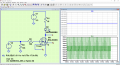
1747938703405.png

Top pane; power dissipation, drain voltage, drain current of MOSFET
Middle: power dissipation, diode voltage, current of LED
Bottom: gate voltage and current of MOSFET

This circuit is an IR transmitter.The LED used in this is not the one in the board.It has no spice model
There will be one for a similar device somewhere, or create from datasheet.
 

Papabravo

Joined Feb 24, 2006
22,066
May I know what is the issue of using this mosfet working with 3.3V
The gate of this mosfet will be getting signal from a MCU which is working at 3.3V
The entire board will be working at 3.3V
This circuit is an IR transmitter.The LED used in this is not the one in the board.It has no spice model
The first model from the library that I tried did not produce the expected results. It seems that the other models with suffixes L0 and L1 do not suffer from the same defect.
 

Irving

Joined Jan 30, 2016
5,070
The first model from the library that I tried did not produce the expected results. It seems that the other models with suffixes L0 and L1 do not suffer from the same defect.
It's not a defect, it's by design. In my example I showed the power dissipation of the MOSFET; the 5-pin version extends that idea and translates it to case and junction temperatures based on a thermal model of the package. To work the model needs to know ambient temperatures of case and junction which are represented by voltages and heat flux by current ie joules/sec = Watts. So a 25volt source connected to the case node represents an infinite heatsink at 25C. Connected via a resistor would represent a heatsink at ambient of 25C where 1ohm maybe represents 1C/W thermal resistance.
 
Top