Good luck with that I done told you my best bet The last i guy i wasted my time teaching wanted to figure it out and tried too.
But most don't even try and some IEC drawing suck Hell some stuff don't even ship with drawing or there wrong LOL
now days
Oh and I did say teaching cause I've only seen one guy out of 10 that come looking for a job that tried to learn his job.
most of the people I see think it's just hooking up wires a replacing parts there not even going to try to fix faults.
Maybe you should just say the answer so we can check your work LOL just kidding but there is know way to
see what's going on there.
But on a side note if you want a good maintenance technician watch them take the test see who really trying to find the fault
hire that person on the spot.
There the only one that going to try to get the job done and the only one that will learn what's needed for there job in a short time.
The answer is E.
Here's my work:
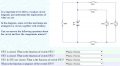
1. Start out with the knowledge that a e-stop/safety relay has a N.O. circuit to set it (labeled here as "control voltage: ON"), and a N.C. circuit which if broken will reset it (labeled here as "control voltage: OFF")
2. Examine option A. S01 NC contact is not faulty because if it were, there would be no voltage at X82, pin 8 (see condition #2 below drawing)
3. Examine option B. S02 NC contact can't be the fault for the same reason as S01, see above.
4. Examine option C. S03 N.O. contact can't be the problem because voltage is present at S34 of the safety relay when S03 is pressed (see condition # 3 below drawing)
5. Examine option D. Can't be K01 for the same reason as above.
6. Examine option E. If voltage is present at pin 8 of X82 but not at terminal S11 of the relay, that means it is leaving the page and not returning. So this is the only possible option so far.
7.Examine option F. Since E is possible, this can't be correct.
Therefore, E.
The only issue I have identified with the question so far is that which Max has pointed out, that the initial assumption of how a safety relay operates might be flawed as it is limited to only that which i have experienced. So if there are other modes of operation then the question is flawed from the top down and should be scrapped altogether.
Maybe the real problem is people are getting hung up on how the drawing isn't as "pretty" as what they are used to or would like to work with. Going with the assumption that an e stop circuit is normally closed anyone should be able to trace the visible parts and at least come up with a logical trouble shooting process. Personally there are days I would give anything to have even a poorly drawn diagram instead of tracing harnesses.
Not one speck of my comment was about appearance, but rather about lacking information. Once a system is built and working the common use of a circuit diagram is for finding a fault so that repairs can be made and production can resume. useful documentation that is easy to interpret rapidly tends to make diagnostics move faster, while cryptic drawings lacking important information tend to slow them. So it is important and valuable to have better documentation.
In reality if faced with an issue such as the circuit with the device shown, the rest of the circuit, as well as the Safety Relay details would normally be accessible in order to do logical troubleshooting.
If including just a block DWG of such as a safety relay, which can come in many configurations, a little more info would help.
e.g. JPG's of the Relay.
Max.
I work with PID drawing all day long and the drawing above is terrible. The power rail is confusing and doesn't need to be. I would say none of the above. In my mind the E-stop circuit has a ground issue or the contact is shorted open.
Certainly the drawing is not in the format used by any of the USA auto companies. And it is not like any useful drawing style that I have seen in my entire career of designing industrial equipment. But perhaps the purpose was to see who could trace out a partial drawing in a totally unfamiliar format and come up with a conclusion.
But really, the drawing is closer to what I have seen created by folks with no formal training but a small amount of knowledge. The other group that produces such drawings are those who presume that nobody needs to be given all of the information about a system.
I work with PID drawing all day long and the drawing above is terrible. The power rail is confusing and doesn't need to be. I would say none of the above. In my mind the E-stop circuit has a ground issue or the contact is shorted open.
So far the drawing's in above posts have been in EU format, which has horizontal power rails and progress from top to bottom.
As opposed to N.A. which portray the ladder between vertical powerails and progress the logic from left to right
I have worked with both systems although I do prefer the N.A. method and symbols, and personally create all documentation drawings in N.A. format.
Quite large amount of equipment is imported from Europe, so one has to be knowledgeable in both formats in order to install and trouble shoot these systems.
Max.
Certainly the drawing is not in the format used by any of the USA auto companies.
But really, the drawing is closer to what I have seen created by folks with no formal training but a small amount of knowledge. The other group that produces such drawings are those who presume that nobody needs to be given all of the information about a system.
But most a folks electricians nowadays don’t be on "thou" with electricity.
Example. I have rather long corridor in our technological underground, thus whilst going into Cleanroom one must go via 7 doors. If any build with switcher even then there is dilemma how in the mad darkness to switch off from input when I am at output. So I did the classical corridor circuit what allows to switch on/off simply by CHANGING the position of switcher. So, sometimes the ON is upside and sometimes down. Then the University electrician gang came in and tried to understand WHAT IS THIS. HOW IT CAN BE SO. I rapidly explained - it is simply this and that, if want I may draw it. I drew, they witchcraft three days and at last made the grand short-circuit. Then I dared to write to the boss of the boss of their boss them entrance is disallowed.
I have been able to avoid the majority of that stuff fairly easily since it was not acceptable to the vast majority of our clients. Little details like wires being tagged as to the terminals that they connect to rather than the circuit number, making circuit tracing a challenge at best. The explanation for that was "You do not need to know that, you only need to know where to connect it." That level of arrogance in a supplier reduces the chance that they will ever be considered again. And I observe that they do not sell a lot of robots in the USA any more, and none to at least one auto company.
Many of the machines I have worked on were purchased from Europe due the unavailability of them on the N.A. market, Mainly German used in the CNC Locomotive maintenance M/C's and users of CNC Lasers etc. Some Italian specialty M/C's.
N.A. has adopted many of the IEC practices and format of equipment such as the DIN standard and one of the latest as to NFPA is the wire colour standard such as using orange colour insulation in place of yellow for live conductors in an enclosure that are live when the local disconnect is OFF which is EU in origin..
Another N.A. standard I expect to follow the IEC code is the mandatory use of Safety Relays.
Max.
Yepp, that was for me the shock about EU colour code. Old russian standard said - blue.red means DC, black and two white or black and white and yellow its AC and black may be substituted by brown or blue. Green is gnd.
And then Europe means blue is nil, green is gnd, but hot is black or brown. After first dozen of times I tried to connect with naked hands to mass I beat-in the dull head that code have been changed. However until today my feeling is saying the white, yellow and rosy and brown are signal leads and black are gnd. Sorry, but Europe will not understand this!
If you have a ground short on the circuit before it gets to 11 this would explain why there isn't voltage present. I have found when there is a micro ground that this is one of the hardest things to troubleshoot as it's not a complete ground but voltage is disappearing. One thing to always check is the temperature of the power supply as a micro ground will over drive the supply and usually cause an early failure. In most electrical drawings if the E-stop circuit continues on another page the page number and line is identified.
Your circuit is much too difficult to understand and relies on specific component knowledge which is unfair. Here's one from my Ohm's Law Tutorial (admittedly for raw recruits).
Your circuit is much too difficult to understand and relies on specific component knowledge which is unfair. Here's one from my Ohm's Law Tutorial (admittedly for raw recruits).
This is why it is neccesary to aquire knowledge of the methods used in alternate jurisdictions, if working on foreign equipment, in this case IEC. Symbols and method is used.
Max.
I have been able to avoid the majority of that stuff fairly easily since it was not acceptable to the vast majority of our clients. Little details like wires being tagged as to the terminals that they connect to rather than the circuit number, making circuit tracing a challenge at best. The explanation for that was "You do not need to know that, you only need to know where to connect it." That level of arrogance in a supplier reduces the chance that they will ever be considered again. And I observe that they do not sell a lot of robots in the USA any more, and none to at least one auto company.
Departing from accepted practices and standards can be found in any equipment manufacturer anywhere. It is not an indication that equipment from a certain area of the world defines the quality.
Certain standards are set and agreed on such as the IEC (International Electrotechnical Commission) which recommends and publishes international standards for all electrical, electronic and related technologies.
In N.A. there are also publications by NFPA..
Max.

 Facebook
 Google
 GitHub
 Linkedin