Inductor question

Thread Starter

trem

Joined Jul 14, 2011
8
I am going to ask this in two parts so please bear with me.

In a simple series circuit with a light bulb, an iron core coil and AC wall voltage from any country..... is the light bulb going to function.
Not sure how to assign values for the wattage of the bulb or the henrys of the coil, but hopefully we can ignore that.
I ask, because i always see videos, when explaining coils, say they will not pass or will impede AC.
Thank You
 
Last edited:

MrChips

Joined Oct 2, 2009
34,632
I am going to ask this in two parts so please bear with me.

In a simple series circuit with a light bulb, an iron core coil and AC wall voltage from any country..... is the light bulb going to function.
Not sure how to assign values for the wattage of the bulb or the henrys of the coil, but hopefully we can ignore that.
I ask, because i always see videos, when explaining coils, say they will not pass or will impede AC.
Thank You
Don't believe everything you see in videos. In this case they are making a statement taken out of context or they are blatantly wrong.

You cannot ignore the inductance of the coil, units of henries.
The reactance of of the inductor is a function of frequency and can be calculated as

XL = 2πfL (in ohms)

1715916240092.png

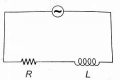
Will the light bulb (shown as R) turn on?

You need to compare the reactance of the inductor with the resistance of the light bulb. (To complicate things, the resistance of the light bulb changes with the current flowing).

However, you can still do a ballpark estimate.
Assume that the line voltage is 120VAC @ 60Hz.
Assume that the bulb is rated at 60W.
Calculate the nominal resistance of the bulb when consuming 60W.
Calculate the inductance of the coil of the same reactance.
 

Thread Starter

trem

Joined Jul 14, 2011
8
OK.
Gonna be sorry i did not just ask my transformer question. I think i out-smarted myself.
This is not the road i had intended to go down. :)
Assuming 2H and 60Hz in the usa
Round numbers................ 2x 3.14 x 60 x 2 = 754 Ohms
Not sure what a 100 watt bulb resistance is after it gets hot. 12 Ohms cold. Certainly will not be drawing 10 amps. :oops:
 

MrChips

Joined Oct 2, 2009
34,632
Also, here is why your question as stated cannot be properly answered.

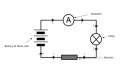
1715918602166.png

One can say, "Resistors impede the flow of current".
If we put a resistor in series with a light bulb, will the bulb light?

Or to ask another question, how high does the resistance have to be so that the lamp is off?

We cannot answer this question unless we can define at what point the lamp is off.
 

MrChips

Joined Oct 2, 2009
34,632
OK.
Gonna be sorry i did not just ask my transformer question. I think i out-smarted myself.
This is not the road i had intended to go down. :)
Assuming 2H and 60Hz in the usa
Round numbers................ 2x 3.14 x 60 x 2 = 754 Ohms
Not sure what a 100 watt bulb resistance is after it gets hot. 12 Ohms cold. Certainly will not be drawing 10 amps. :oops:
To calculate the resistance of the bulb, use this formula:

Power (watts) = voltage x voltage / resistance

or

Resistance = voltage x voltage / power

A 100W bulb at 120VAC would have a resistance of 144Ω.
 

WBahn

Joined Mar 31, 2012
32,714
OK.
Gonna be sorry i did not just ask my transformer question. I think i out-smarted myself.
This is not the road i had intended to go down. :)
Assuming 2H and 60Hz in the usa
Round numbers................ 2x 3.14 x 60 x 2 = 754 Ohms
Not sure what a 100 watt bulb resistance is after it gets hot. 12 Ohms cold. Certainly will not be drawing 10 amps. :oops:
When it is at normal operating temperature, the resistance of a 100 W bulb is going to be about R = (120 Vrms)²/100 W = 144 Ω

So an inductive reactance of 754 Ω in series with that is going to reduce the current significantly. Very possibly to a point where there is negligible visible light being emitted.
 

Thread Starter

trem

Joined Jul 14, 2011
8
To calculate the resistance of the bulb, use this formula:

Power (watts) = voltage x voltage / resistance

or

Resistance = voltage x voltage / power

A 100W bulb at 120VAC would have a resistance of 144Ω.
Thank You
I was just searching for a picture of the Ohms Law Wheel :)
 

MrChips

Joined Oct 2, 2009
34,632
Thank You
I was just searching for a picture of the Ohms Law Wheel :)
I have never had a use for Ohms Law Wheel.
Simply work out the principles of Ohm’s Law.

The current I through a resistor R increases with increasing applied voltage V and decreases with increasing R.

I = V / R
 

Thread Starter

trem

Joined Jul 14, 2011
8
My apologies for all the above.
This was not really what was on my mind.
Sorry

I have NO education in electronics. I bought a few books to read and then visit places like this.
Like i said earlier, when you see a video on Youtube that gives a simple explanation of how a coil works, it makes it seem like AC will not pass an inductor as it "resists" a Change In Current.
It seemed to be the opposite of a capacitor that blocks DC.
I thought a coil did the same to AC

So it made me wonder how a transformer ever gets started.
The primary coil must be resisting the AC wall supply, and the secondary coil must be resisting the inductance from the Primary.
But it seems like a Transformer has no problem with inductance.
AC hits the primary, has no problem with that inductor, it induces an AC Voltage onto the secondary, and that inductor has no problem with the AC.
It just happily turns the 120 Primary into 360V or 500V or 24V, Etc etc.
The 2 coils in a transformer seem to offer no resistance to a change in current at all.
 

WBahn

Joined Mar 31, 2012
32,714
Oh, the coils of a transformer most definitely do offer resistance to changes in current.

If they didn't, then as soon as you powered up a transformer it would blow the fuse/breaker protecting the circuit or burn it out or start a fire -- some kind of bad thing would happen. But yet if you power up a transformer with no load connected to the secondary, it will draw very little current, which confirms that there is a lot of resistance (reactance is the proper term) to AC current flow.
 

MrChips

Joined Oct 2, 2009
34,632
Here is how I would explain it.

Imagine a short piece of #16 AWG copper wire, 1 ft long. This is a conductor of electricity.
Every piece of conductor has resistance R, inductance L, and capacitance C. The length of wire is so short that all three R, L, and C are close to zero but not zero.

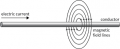
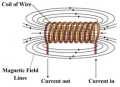
When an electric current is flowing through the wire, a magnetic field is created.

1715953788419.png

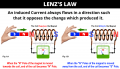
If the electric current is changing, so will the magnetic field. The changing magnetic field will induce a current in the wire. The induced current has to flow in a direction that opposes the applied current, otherwise the magnetic field would keep on increasing and we would have free energy!

This is known as Lenz's Law.

1715973318260.png


Now, imagine that the wire is 10 feet long. R, L, and C are now ten times larger.
Resistance per foot, inductance per foot, capacitance per foot, remain the same. The total R, L, and C are still be close to zero but still finite.

Imagine that we wind the wire into a coil.

1715954504558.png

The magnetic field of each winding adds up and hence the net magnetic field is stronger, by a factor of the number N of loops in the coil. In other words, the inductance L has increased by a factor of N. We have created a traditional air core inductor.

Is the value of the inductance high enough to prevent a lightbulb from turning on? Very likely no. We answered this question in previous posts.

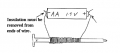
Next, insert a nail made of iron into the center of the coil.

1715955030488.png

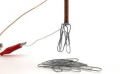
This is a classic experiment usually demonstrated in high school physics on the subject of electromagnetism. We have created an electromagnet. The iron nail has a magnetic property called permeability which concentrates the magnetic field within the nail. We can demonstrate this by being able to pickup small ferromagnetic objects such as paper clips.

1715955519976.png

Also, we have increased the inductance of the coil.

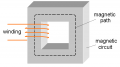
Imagine that we were able to bend the nail so as to create a continuous magnetic core.

1715955844179.png

The induced magnetic field is now constrained within the magnetic core. Hence, this does not work as an electromagnet.
In a perfect world, no portion of the magnetic field is lost. The total magnetic field induces a current back into the winding.
The value of the induced current equals the value of the original current. In other words, the net current flowing is zero. (Note that this only happens with AC, when the field is changing.)

Another way of looking at this, the alternating current creates kinetic energy in the form or an alternating magnetic field trapped within the magnetic core.

1715957358904.png


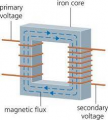
We can now add a secondary winding to the core and thus create a transformer.

If no current is taken from the secondary winding, the current in the primary winding is zero.
When current is extracted from the secondary winding, energy is extracted from the magnetic field. This causes an imbalance at the primary winding and thus the current in the primary winding has to increase from zero.

In a perfect world, if the transformer is 100% efficient, the power extracted at the secondary winding is equal to the power delivered into the primary winding.

In other words,

Vp x Ip = Vs x Is

Where Vp and Ip are the voltage and current in the primary winding and Vs and Is are the voltage and current in the secondary winding.
 

Thread Starter

trem

Joined Jul 14, 2011
8
Wow..... Thank you for that big effort.
I appreciate it.
I am just learning this stuff... obviously

Youtube videos are great for starts, but they can only explain so much in 15 minutes.
They give you the impression that a coil is saying No-No-No to AC
I was thinking the average iron core coil was offering Thousands of Ohms resistance to AC, and then wondering how the induction could ever, really, get going in a tranny.

Anyway........ i see it all much better now.
Thanks Again To All :)
 

MisterBill2

Joined Jan 23, 2018
27,211
The videos will present some actions without any background or a correct explanation, because that would mean that the presenter would need to understand the theory wel enough to explain it accurately. OR the whole demonstration might be faked.
Current flowing thru a resistance loses energy But not all of the energy.
Current flowing thru an inductor also suffers a reduction , but not complete. So the light bulb will still have curremt passing thru. So it would light some.
 

Ian0

Joined Aug 7, 2020
13,099
I was thinking the average iron core coil was offering Thousands of Ohms resistance to AC, and then wondering how the induction could ever, really, get going in a tranny.
I measured the primary magnetising inductance of a 1.6VA toroid at 750H.
235kΩ at 50Hz
 

Ian0

Joined Aug 7, 2020
13,099
My only real experience is with Tube-Audio.
4-6-8H is typical at 60Hz. for what i see
750 sounds like a ton :)
Magnetising current has to decrease as transformer sizes decrease. So inductance has to increase.
Tiny transformers, therefore, have huge primary inductances.
 
Top