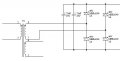
I have a Graetz bridge rectifier that shows a significant drop in transformer Q (pins 2-3) when the diodes are heated above 120 F. Any idea what the diodes are doing that would cause this? Should I switch to SiC?
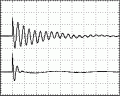
Q is a property all reactive parts have - transformer, choke, capacitor, whatever. It stands for Quality. Look up Q factor on Wikipedia for an excellent in-depth description. The 120° F is case temperature. What I'm doing is analyzing the Q of the transformer with a device that counts ring cycles. If scoped, it would look something like the following. The upper signal is a higher Q than the lower one.
Q is a property all reactive parts have - transformer, choke, capacitor, whatever. It stands for Quality. Look up Q factor on Wikipedia for an excellent in-depth description. The 120° F is case temperature. What I'm doing is analyzing the Q of the transformer with a device that counts ring cycles. If scoped, it would look something like the following. The upper signal is a higher Q than the lower one. View attachment 317672
I know how to calculate the Q of an inductor. Show me the calculation for the transformer, that is what I've never seen before. In particular, what frequency would you use?
Sound like you need to use diodes that are not suitable for the environment even though all P-N junction devices are temperature sensitive.
I remember seeing a demonstration of that in class where a transistor was sprayed with freeze spray and it caused the transistor to loose gain.
Since high temperature is the issue. I recommend changing the diodes to 6A10 as their operating temperature range is -85 to +175C according to the datasheet I pulled up.
It looks like the transformer rings when the diodes are cool and not when they are hot. (interesting)
I don't see how that effects ....... something other than RF noise.
Is this a 60hz problem or a 200khz switching power supply problem?
I've double checked my transformer resources and there is literally no mention of Q in any of it. So maybe it exists and has some relevance, but I am unable to confirm such an assertion. So, I'm calling BS on the notion that Q has any relevance when it comes to transformers.
We know what Q is, but Q is normally only of interest for frequency determining circuits, such as filters.
I don't see why you would want to know that for a power transformer(?).
We know what Q is, but Q is normally only of interest for frequency determining circuits, such as filters.
I don't see why you would want to know that for a power transformer(?).
Exactly. I never said I did not know what Q was, I just said I was unfamiliar with its use in conjunction with a transformer. The TS needs to show us why it might be relevant.
One more thing. With respect to the original question, oscillation at resonance and ringing are two entirely different things. It would be a mistake to conflate them.
The small transformer(s) are driven from a 30kHz source (voltage & waveform not yet known) derived from an XA2C128 CPLD. The problem is occasionally a transformer will fail. They are wound with 20g enamel wire on what looks like a powdered iron core. The enamel appears to sometimes be burning off leaving shorted turns. I'm trying to find out why. At first I thought maybe something funky was happening with the source power. By serendipitous discovery, the Q variation phenomena was found leading me to wonder if the rectifiers are causing the transformer problem. This circuit is used in an automotive environment (Tesla Roadster) where heat can get relatively high. I’m seeing evidence of the phenomena as low as 45C. The design and components are from 2005-6. If it was still in production, I'm thinking some changes/improvements would have been made. The engineers who designed this thing have long ago moved on so it's left to me. I would try other rectifiers but they need to be SMD (DO-214AC package). I haven’t yet found an SiC packaged that way.
Again, how is this Q measured, how is this Q calculated and what kind of variation are you observing?
Better yet how would you propose to ensure that it does not vary by more than a certain amount?
If this is real, then I think it has absolutely NOTHING to do with enamel faults. I think it is more likely that you are at sea and being pressured by management to come up with an explanation. Nothing frustrates them like wasting time on a hypothesis that does not pan out.
I am using a Blue Ring Tester from Anatek (https://anatekinstruments.com/produ...q-meter-full-kit-for-self-assembly-artest_kit). Not sure what you mean by “If this is real.” "NOTHING to do with enamel faults"? Tell me what you think would happen to the power supply performance if the enamel insulation burned off of the transformer windings? As to being at sea and pressured by management and wasting time on a hypothesis, that made me laugh after it made me groan. I’m starting to feel like Rodney Dangerfield. How are things in Elbonia?
The ringing he's seeing on the scope is likely from fast edge generated energy reflections during diode switching reverse recovery time (pretty short for a typical Schottky type). I'm thinking that level of edge energy decreases with heating increasing the switching time as reverse saturation current increases causing a net increase in voltage drop across the device. The transformer 'Q' doesn't change, the amount of ring energy changes.
One inductor company some time ago "Coilcraft" designed a comparison analysis software tool with that gave the engineer a variety of choices for their specific application. Other companies developed software and simulation as the race for more power conversion efficiency became popular. I am not sure exactly how it worked but it was fun and worked very well.
A look at the Coilcraft paper. It gives a few outlines in the scheme to choose the best inductor or at least finding some top choices.
Q and thermal core loss at a given resonance not being everything like power factor adjustment but significant. doc1287_inductor_specifications.pdf (coilcraft.com)
I am using a Blue Ring Tester from Anatek (https://anatekinstruments.com/produ...q-meter-full-kit-for-self-assembly-artest_kit). Not sure what you mean by “If this is real.” "NOTHING to do with enamel faults"? Tell me what you think would happen to the power supply performance if the enamel insulation burned off of the transformer windings? As to being at sea and pressured by management and wasting time on a hypothesis, that made me laugh after it made me groan. I’m starting to feel like Rodney Dangerfield. How are things in Elbonia?
I’ll try one more time as clear as I know how. I am looking at the primary winding of a transformer with a previously described tester. This tester generates a fast pulse of an unknown period at an amplitude of up to 600mv. It then stops the pulse and then examines the ring cycles resulting from that pulse. Normally there are lots (relative term here) of ring cycles on the board I’m testing. The other day a serendipitous discovery was made. We found that heating the rectifiers above 45C caused the rings to be greatly diminished. My original question was “Any idea what the diodes are doing that would cause this? “ My hope was to find an alternative rectifier that doesn’t exhibit this effect (at least up to around 55C). That’s why I asked if I should switch to SiC. Why do I care? Because with a number of these devices the transformers have failed with burned out windings. Maybe there is cause & effect. Maybe not.
I shouldn’t have initially called it a Q test. I should have said ring test. The maker of the tester calls it a Ring Tester for High Q Inductive components. I work two jobs so I don’t have much time to be as careful in my wording as I’d like. Sloppy on my part.
As for being at sea and pressured by management, I am that management and the only pressure is that which I apply to myself.
Ringing happens in a circuit without damping. In a circuit with inductance, capacitance and resistance the damping comes from resistance. In a circuit with a transformer, changes in impedance in the secondary are reflected in the primary. What the diodes are doing maybe contained in the datasheet or can be measured. The question you are asking is essentially: "how does the impedance of the diode change with rising temperature". I still don't think any of this is related to the failure of the enamel coating. I'm not really a materials guy so you'll have to find someone with a different skill set to answer that question.

 Facebook
 Google
 GitHub
 Linkedin