I'm looking for a very specific type of pressure sensor.

Thread Starter

Vannila_Creamsicle

Joined Feb 3, 2025
5
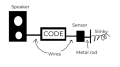
I need a sensor that can detect a relatively small amount of force because what I'm building includes a slinky, it would be nice if I could connect it to some sort of a rod, so I could connect that to a sheet of plywood, and then in turn connect that to a slinky. It also needs to be able to send its output directly into a computer so that I can record the pressure as some form of wave. Thanks!
Here's an overly simplified sketch of what it needs to do > Screenshot 2025-02-03 4.06.28 PM.png
 

Thread Starter

Vannila_Creamsicle

Joined Feb 3, 2025
5
Is this supposed to be a DIY Spring-Reverb ?

Please don't make us guess.
.
.
.
Basically, if you hold one end of a spring, or in this case, a slinky, and move it back and forth, it sends a wave to the other end. When this wave hits the sensor, it is detected, translated into a sound wave, and played through a speaker. So to answer your question, it is the worlds first playable slinky.
 

LowQCab

Joined Nov 6, 2012
5,101
Do not expect ANY Bass-Frequencies from this Slinky-Spring.

Obtain a small cheap Speaker,
cut-away the Paper-Cone with a Razor-Blade,
face the Speaker downward and hang it from it's Magnet,
glue a disc with a hook on it directly to the Voice-Coil of the Speaker.
Don't get any Glue between the Voice-Coil and the Magnetic-Gap.
Avoid weight, keep everything as light as possible,
the Voice-Coil-Suspension can only hold-up a few ounces of weight.

The Speaker will not have very much Voltage-Output,
so it will require a very High-Gain-Microphone, or Guitar-Pre-Amplifier.

There is no "Code" involved, this is 100% Analog-Audio.

A cheap, used, Practice-Guitar-Amplifier from a Pawn-Shop will probably work just fine.
.
.
.
 

LowQCab

Joined Nov 6, 2012
5,101
High-Frequency "noises" will repeatedly run from end to end on the Spring.
This technique has been used for almost ~100-years to build "Spring-Reverb" units into Guitar-Amplifiers.

So far, in this particular project, there has been no mention of an "Eciter-Coil" though,
so I think the TS plans on making "mechanical-noises" first, before he figures-out what he's got to play with.
.
.
.
 

MisterBill2

Joined Jan 23, 2018
27,164
All of the previous suggestions can work, but for a linear frequency response extending down to ZERO, the TS will need to create an optical sensor. Since the movement is quite small, a mirror moved by the end of the slinky, deflecting a light beam from an LED onto a photo-transistor can provide the most sensitive pickup, with a much greater amplitude, and a quite linear response.
Of course, the DC power for both the LED and the sensor will need to be well filtered and regulated.
 

Ya’akov

Joined Jan 27, 2019
10,226
There’s always a microphone. I would try a cheap condenser capsule type, covering the aperture and mechanically linking the slinky to the case.
 

MisterBill2

Joined Jan 23, 2018
27,164
Most microphones response does not go down to zero. THAT is why I propose an optical displacement sensor. It would have a flat response down to zero frequency. That could benefit the application.
As an added benefit, the same signal could be applied to a Moog Music synthesizer.
 

Ya’akov

Joined Jan 27, 2019
10,226
Most microphones response does not go down to zero. THAT is why I propose an optical displacement sensor. It would have a flat response down to zero frequency. That could benefit the application.
As an added benefit, the same signal could be applied to a Moog Music synthesizer.
I don’t see the need for response down to zero given the goal is an audible signal. The microphone will cover the audible range, and will be a simple proof of concept to check this is worth doing at all.
 

MisterBill2

Joined Jan 23, 2018
27,164
Certainly for direct audio the response does not need to go down to zero. But connected to a synthesizer it would. AND the optical system can provide a greater sensitivity and a higher output than other schemes. And it will probably be simpler and more durable. At least that is a possibility.
 

MisterBill2

Joined Jan 23, 2018
27,164
If you can find one, an older crystal phono cartridge would serve as a simple and cheap pickup that would deliver enough voltage to work with a guitar amplifier. Just solder a short piece of stiff wire to the slinky near the end and put the wire into the cartridge needle chuck and tighten it. About as simple as it could be.
 
Top