Ignition coils?

cork_ie

Joined Oct 8, 2011
428
Having read through your posts, the easiest , and cheapest way to solve your problem is to forget about the magneto generator coil. If you supply the coils with a 12V power source and use the existing points and commutator to ground each coil in turn, this will solve your problem. You may have to replace all 6 coils or alternatively use 3 "wasted spark type coils" You must use standard ignition coils. Modern low inductance coils are not suitable . Thankfully standard 3-4 Amp primary current , ignition coils are still widely available.

In order to prolong the life of the commutator in your magneto it might be worth considering using transistors to drive the coils , a simple type of transistor assisted ignition will suffice. There are lots of links online on how to do this.
 

crutschow

Joined Mar 14, 2008
38,507
My old Triumph kick-start motorcycle had a battery ignition, but you could turn the ignition to the emergency position if the battery were dead. That would convert 1 coil of the ignition to a poor-man's magneto system where the generator directly provided the coil current, bypassing the battery and allowing 1 cylinder to start the engine.
As soon as the engine started you returned the switch to the normal position where the generator would now supply the current to the battery and ignition.
 

crutschow

Joined Mar 14, 2008
38,507
Having read through your posts, the easiest , and cheapest way to solve your problem is to forget about the magneto generator coil. If you supply the coils with a 12V power source and use the existing points and commutator to ground each coil in turn, this will solve your problem. You may have to replace all 6 coils or alternatively use 3 "wasted spark type coils" You must use standard ignition coils. Modern low inductance coils are not suitable . Thankfully standard 3-4 Amp primary current , ignition coils are still widely available.

In order to prolong the life of the commutator in your magneto it might be worth considering using transistors to drive the coils , a simple type of transistor assisted ignition will suffice. There are lots of links online on how to do this.
Sounds interesting but I question if each coil will be grounded long enough to build up the current sufficiently in the coil inductance. Normally the points are grounded between sparks in a battery ignition but that wouldn't be the case here.
 

shortbus

Joined Sep 30, 2009
10,050
First thing I'd try is a coil from an old points style motor like a Briggs or Tecumseh. They are correct for a magneto type ignition. But in the long run being a machinist and fabricator I'd end up adapting a distributor from a 6 cylinder car engine to the drive shaft of the engines magneto.
 

ian field

Joined Oct 27, 2012
6,536
The condenser is just to prevent arcing across the points, it's not to store energy for the spark.
The spark energy is provided by the inductive energy from the current in the coil.
In the Kettering system, the main function of the capacitor is to slow down the back emf rise time so the points part fast enough to quench the arc - that arc would otherwise take a huge chunk out of the energy that reaches the plug gap,

There may be a small element of the capacitor resonating the LT inductance and producing some ringing.

As for magnetos and energy-transfer, I have no idea what the capacitor does.
 

crutschow

Joined Mar 14, 2008
38,507
In the Kettering system, the main function of the capacitor is to slow down the back emf rise time so the points part fast enough to quench the arc - that arc would otherwise take a huge chunk out of the energy that reaches the plug gap,
.....................................
As for magnetos and energy-transfer, I have no idea what the capacitor does.
It has the same purpose as in the Kettering system.
The only difference is that the primary coil current is provided by the magneto, not the battery.
 

ian field

Joined Oct 27, 2012
6,536
It has the same purpose as in the Kettering system.
The only difference is that the primary coil current is provided by the magneto, not the battery.
One of the ignition systems I've worked on in the past sparked when the points closed.

Can't remember whether it even had a capacitor - but its difficult to see what purpose it served if it had!
 

crutschow

Joined Mar 14, 2008
38,507
One of the ignition systems I've worked on in the past sparked when the points closed.

Can't remember whether it even had a capacitor - but its difficult to see what purpose it served if it had!
That's a odd ignition. Wonder how it worked. :confused:

A capacitor could be used to suppress any arcing from contact bounce.
 

debe

Joined Sep 21, 2010
1,419
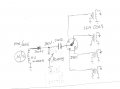
Mike what you describe is a most unusual Ignition system. Could it be a crude CDI system using points to switch the condencer across the ignition coils (CDI systems usualy use a SCR to do that from a trigger coil) Have drawn a diagram of how it could have been done. Its just a thaught;
 

Attachments

ian field

Joined Oct 27, 2012
6,536
That's a odd ignition. Wonder how it worked. :confused:

A capacitor could be used to suppress any arcing from contact bounce.
As yet I've never read anywhere near a satisfactory explanation of how it works, so far only articles written by motorcycle engineers who pretty much learned as much as they had to about electrics.

What I do know from having taken a few apart is; the generator coil, the points and the LT coil are all in parallel, and I know from having set the timing on a few, that the plug sparks as the points close.

Obviously the flywheel magnet must be timed for maximum lines of flux cutting the coil at the timing point, so the voltage across the LT coil is at its peak when the points short it out - my best guess is that shorting the LT coil at maximum voltage causes a large recirculating current in the LT winding, that energy has to go somewhere and the HT winding is right next to it.

Some time ago I read about a new EMP weapon developed by the US military - its sort of a ctross between energy-transfer and CDI, but with a shaped charge explosive in between.

Its actually quite simple in principle - a thick helical conductor in conical form is the inductor/antenna. That assembly is surrounded by the shaped charge which collapses the coil in on itself, at exactly the same instant of detonation, a big fat capacitor is discharged into the coil.

Obviously not as big as the EMP from a nuke, or as fast rise time, but its sufficient to damage the enemy's electronic communications.
 

crutschow

Joined Mar 14, 2008
38,507
As yet I've never read anywhere near a satisfactory explanation of how it works, so far only articles written by motorcycle engineers who pretty much learned as much as they had to about electrics.

What I do know from having taken a few apart is; the generator coil, the points and the LT coil are all in parallel, and I know from having set the timing on a few, that the plug sparks as the points close.
..................
All the descriptions of magneto (and magneto energy transfer systems) I can find discuss the opening of points as generating the spark, so I'm really puzzled as to why any system would use an opposite approach. :confused:
Have you seen a description of this anywhere?
Are you certain it sparks when the points close? How did you determine this?
 

ian field

Joined Oct 27, 2012
6,536
All the descriptions of magneto (and magneto energy transfer systems) I can find discuss the opening of points as generating the spark, so I'm really puzzled as to why any system would use an opposite approach. :confused:
Have you seen a description of this anywhere?
Are you certain it sparks when the points close? How did you determine this?
As I just stated - I've yet to see a satisfactory technical article that explains it.

An experience I'll never forget is having to walk everywhere for about a week because I mucked up the timing on a 70cc step-through I was using at the time, I too was convinced that the points should open at the timing mark, and couldn't understand why the slots in the stator plate weren't long enough to rotate it to where that would happen - it didn't help that the IGN winding on the generator wasn't developing a peak at that point either.

The wear & tear on my shoes eventually ended when someone pointed out that its supposed to fire when the points close - since then I've just taken it on good faith that its the way things are.

Now, whenever I service an enclosed flywheel/points ignition, I verify before doing any adjustments which sense the points work in.

My favourite method is to put a headlamp bulb in series with the rough DC from a battery charger and connect it to the ignition wire coming out of the flywheel unit. When the points are closed they short out the coil and the bulb lights full brightness, when the points are open, some of the voltage is dropped across the coil and the bulb dims - also when the points are open, the rough DC flowing through the coil makes the rotor/magnet assembly hum - that also makes it easy to confirm that the magnet pole is at the best angular position to produce a peak in the coil when the points close.
 
One of the ignition systems I've worked on in the past sparked when the points closed
This is very interesting inasmuch as, owing, of course, to coil inductance, DI[primary]/DT will be rather low at and following closure --- IOW, as per post #32, the 'kettering' ignition paradigm is not of 'flyback' topology -- Thus one wonders if it is merely an implementation of forward transformation?

Genuinely intrigued
HP:)
 

ian field

Joined Oct 27, 2012
6,536
This is very interesting inasmuch as, owing, of course, to coil inductance, DI[primary]/DT will be rather low at and following closure --- IOW, as per post #32, the 'kettering' ignition paradigm is not of 'flyback' topology -- Thus one wonders if it is merely an implementation of forward transformation?

Genuinely intrigued
HP:)
Forward transformation would be the case if the points were closed immediately prior to the timing point, the magnet pole would be passing the stator pole, but since the stator, points and LT coil are all in parallel - it would short that peak until the points opened, that would produce a step rise in voltage across the LT winding which would be forward transformed to the HT winding. It wouldn't, and I can confirm doesn't produce enough voltage for a spark.

As I've mentioned a couple of times already, I've yet to find a satisfactory technical article that explains how it works - the name; "energy-transfer" seems to be the clue, my best guess is that when the points close and short the LT winding, the lines of flux try to collapse but instead, generate a large recirculating current in the LT winding - that is what gets transformed in the HT winding.

At the end of the day, the stator winding puts a similar amount of energy into the LT inductance as you would expect in the Kettering type, when the points close and short it out - that energy has to go somewhere, it doesn't just disappear.

By the 80s, most of the size of bike that would have had energy-transfer were getting flywheel CDI instead, they have a high voltage winding on the stator that charges the CDI module to about 350V ish, AFAIK: that type never had points, there was usually a reluctor pickup mounted close to the circumference of the rotor, then there'd be a couple of pips standing proud to bring the magnetic field to the pickup pole.

Some of the flywheel CDI bikes I've owned in the past got scrapped because they got too rusty - energy-transfer is from the dim and distant past, so its not surprising that a few people have never heard of it.
 
my best guess is that when the points close and short the LT winding, the lines of flux try to collapse but instead, generate a large recirculating current in the LT winding - that is what gets transformed in the HT winding.
Transformed forced-snubber action, as it were? -- Interesting concept...

OBTW do you know of an (on-line) reference providing a schematic of such a system? --- Annoyingly my searches have led only to 'standard' (i.e. 'flyback') designs...

Many thanks in advance!:)

Best regards
HP
 
Last edited:

debe

Joined Sep 21, 2010
1,419
Mike L, you are probably asking on the wrong Forums. Try Smokestack. Its an American forum on older Engines Generators & Magnetos. your more likely to get an answer there as theres a whealth of information.
 

Thread Starter

MikeML

Joined Oct 2, 2009
5,444
Here is an update:

The engine in question is used to drive a pump for irrigation. The rough running (missing) happened on startup this spring after it had been sitting all winter. It turns out that the bad coil diagnosis was incorrect. I got the engine running smoothly by redoing the diagnosis, and finding the real culprit...

The problem manifest as a miss under load. The miss was intermittent to the ear (i.e. you can hear it). This was confirmed by using an inductive timing light as a spark indicator. There are six hv coils mounted on the top of the engine. It is easy to move the timing light inductive pick-up from one spark wire to the next. Initially, only cylinder #5 exhibited the occasional missing spark, which is where idea that the coil was breaking down internally came from. As I said, these coils are made from unobtainium, so getting a replacement is problematic.

After installing new plugs with no improvement, I repeated the timing light trick test, and this time I found that two of the cylinders (#1 and #5) were occasionally misfiring. I then swapped the coils on cyl#5 &6, thinking that the problem would follow a bad coil, but the misfire remained on cylinder #5, meaning that it was not the coil. The occasional misfire on cyl#1 also made me realize that two coil failures were very unlikely, so to go look at the only other thing where the problem could be: the magneto.

I took it apart, and sure enough, the magneto guts looked a lot like the innards of a normal Kettering automotive distributor. It has the rotor on the rotating shaft with the six cam lobes, the points that are opened by the high points on the cam, the "metal clad condensor" (capacitor), and different from an automotive distributor, the primary coil is inside the magneto.

Having owned several Volkswagen beetles as a youth, the problem was instantly obvious. The points were badly pitted, and were barely opening. I really need to replace them, but to get the engine running, I filed down the points to make two smooth, parallel faces, I reinstalled the points, set the gap to 0.025", and put the magneto back together.

The engine now runs smoothly as it did before. In hindsight, it turns out that the two cylinders that were misfiring are cam lobe neighbors, meaning that they are sequential in the firing order. This indicates a slight eccentricity in the cam rotation, so that side of the cam wasn't quite opening the points. Eventually, a third cylinder would have begun misfiring...

Sometimes you have to think about what you are doing when troubleshooting...
 

alfacliff

Joined Dec 13, 2013
2,458
That's a odd ignition. Wonder how it worked. :confused:

A capacitor could be used to suppress any arcing from contact bounce.
I have tried to test motorcycle ignition coils, and if you dont use the capacitor, there is a very weak spark. my 74 alfa also uses a point type ignition, and does the same way, without the capacitor, or a bad one, the spark is very weak. the older yamaha 650"s used a 35 volt magneto with two seperate coils, before 76 or so. after that they went to a wasted spark magneto and coil system.
 
Top