Facebook
 Google
 GitHub
 Linkedin

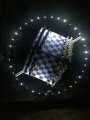
I want to create a chess board that detects where each piece is located. Existing technology from DGT uses small coils and capacitors, but this solution apparently does not work when metal is involved. My chess pieces have a small magnet at the bottom as they are going to be used on a 3-dimensional chess cube. Any ideas on what type of technology to use to make this work would be very welcome. I have looked at RFID but that will not allow the precision I need. Distance between the piece and the sensor would be a couple of millimeters, with metal and magnet between them.
I need to distinguish between black and white pieces and 6 types of pieces, i.e. 12 in total. Also I would need to combine the identification of pieces on each field with a sensor that tells me if a player is touching a piece. If some pressure is required to detect this that would be acceptable. I guess I need to combine several technologies here but if there is one approach that would handle both requirements (touching and identification of the piece) that would be ideal.
Once the identification / location and sensing which piece is being touched are known and transformed into digital signals, a micro processor can handle calculation of target fields that can be reached, making small LEDs on each of those fields light up.
I need to distinguish between black and white pieces and 6 types of pieces, i.e. 12 in total. Also I would need to combine the identification of pieces on each field with a sensor that tells me if a player is touching a piece. If some pressure is required to detect this that would be acceptable. I guess I need to combine several technologies here but if there is one approach that would handle both requirements (touching and identification of the piece) that would be ideal.
Once the identification / location and sensing which piece is being touched are known and transformed into digital signals, a micro processor can handle calculation of target fields that can be reached, making small LEDs on each of those fields light up.