Identifying a few parts on this schematic

Thread Starter

Load2010

Joined Jul 31, 2017
27
So, 4N35 is an optocoupler. My only problem is that it appears in the schematic that there's an LED inside the optocoupler? I looked this one up and I don't see any hint of one sticking out. Can someone please explain?
 

Attachments

matsik

Joined Jan 30, 2009
2
U generally refers to an IC which can be looked up with a search, the Q usually refers to an inductor, but in this case as mentioned, appears to be a relay coil where it would be the custom to label it R(#) normally.
Edit: Make that RL =relay.
Max.
in my experience, Q is usually a transistor of some type. and L reference for inductors..
 

wayneh

Joined Sep 9, 2010
18,119
The LED emitter opto coupler is inside the IC together with the light cell 'transistor' receiver. just a 6 pin device.
Max.
Ditto. Some optocouplers are 4-pin devices, this one has 6 pins. As noted, both discrete components are hidden inside the package just as they are for other ICs.
 

ronsoy2

Joined Sep 25, 2013
71
U generally refers to an IC which can be looked up with a search, the Q usually refers to an inductor, but in this case as mentioned, appears to be a relay coil where it would be the custom to label it R(#) normally.
Edit: Make that RL =relay.
Max.
Most of the time I have seen Q refer to a transistor.
 

dl324

Joined Mar 30, 2015
18,362
If you are referring to the entire device, it is an opto-coupler. In other words, an optically isolated switch. Turn on the LED in the device and the transistor conducts.
Non sequitur... I didn't refer to any optocoupler in that post (#10). It was about editing the schematic in an image editor...
 

mikewax

Joined Apr 11, 2016
230

Thread Starter

Load2010

Joined Jul 31, 2017
27
Hello,

In your schematic the buzzer will do nothing, no matter the optocoupler is activated or not.
The output of the optocoupler has no power for the buzzer.

The following pages carry some info on the opto coupler:
http://www.electronics-tutorials.ws/blog/optocoupler.html
http://www.nutsvolts.com/magazine/article/optocoupler-circuits

Bertus
The buzzer isn't actually a buzzer, the person just used it as a stand in. The buzzer is actually meant to stand in for the electric lighter.
 
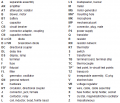
Hello everyone. I'm rather new to this, and I've never seen a few parts on this schematic. I searched through sparkfuns guide on schematic symbols, but couldn't find what these few were. I pointed them out with black arrows, but I'll also describe part of what I'm talking about. I haven't been able to figure out why some ends are red while other are highlighted in green. The other pieces I can't seem to find. I assume that the red is supposed to connect with red, except that there are multiples and they don't have matching numbers.

Much appreciated,
J
4n35: is an optocoupler
The red lines are open (no connections)
L1: is a choke with an adjustable firite core
Usally found in a shilded can with a hole in the top to. access the core. Ground the can and attach the ends. of the coil to your Circuit.
Then using a plastic (non conducting) screw driver. adjust to the uH needed.

4N35 = Optocoupler

The other one is possibly a relay coil. Would that make sense?
 
Last edited by a moderator:

ebeowulf17

Joined Aug 12, 2014
3,307
it's a freewheel doide. https://en.wikipedia.org/wiki/Flyback_diode whenever you run a current through a coil you gotta have a diode there because when you turn that current off, the coil produces an inductive "kick" that must be dissipated. that's how spark plugs work. http://www.chegg.com/homework-help/...tion-engine-generating-asmall-white--q1178057
... Unless that coil is being driven with AC voltage, in which case the diode will present a short in parallel with the coil on every other half cycle!

Of course, in the context of this schematic you're right, but I thought I should mention the AC problem so that our thread starter doesn't get the wrong idea for future projects.
 

Thread Starter

Load2010

Joined Jul 31, 2017
27
... Unless that coil is being driven with AC voltage, in which case the diode will present a short in parallel with the coil on every other half cycle!

Of course, in the context of this schematic you're right, but I thought I should mention the AC problem so that our thread starter doesn't get the wrong idea for future projects.
Thank you, that's good to know
 

Thread Starter

Load2010

Joined Jul 31, 2017
27
Top