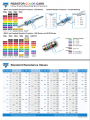
Identify E12 and E24 standard resistors by looking at color codes

MrChips

Joined Oct 2, 2009
34,886
if resistor is E12 (10%) and 4th band is gold( 5%) then what is the actual value of 100 Ohms resistor

the E12 standard says value of 100 Ohms resistor 90 to 110 then what is the 5%
That is a confusing question.

If the 4th band is gold (5%) then the value very likely is one from the E24 chart, but does not have to be.
A 100Ω 5% resistor has a value of 100Ω with ±5% tolerance.

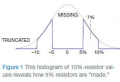
In today's manufacturing process, resistors are made with tight process control. They are not measured and selected. Hence the statistical distribution fits a bell curve. The probability of finding a resistance value that deviates from its nominal value diminishes as the value moves away from the nominal value.
 

WBahn

Joined Mar 31, 2012
32,930
if resistor is E12 (10%) and 4th band is gold( 5%) then what is the actual value of 100 Ohms resistor

the E12 standard says value of 100 Ohms resistor 90 to 110 then what is the 5%
E12 does NOT determine the tolerance. It is merely a sequence of preferred resistor values recommended for resistors having a tolerance of 10%.

The tolerance band on resistor is what tells you what the tolerance of THAT resistor is.
 

Thread Starter

micropad

Joined Dec 24, 2011
109
No, you're misunderstanding.
For example, you can get a 100 Ohm resistor in any of the E standard ranges from E12 onwards, as you can for a 120 Ohm resistor, because it falls within the 10% or better tolerance. But you can't get a 110 Ohm resistor in the E12 range, only in the E24 or higher ranges, because it would fall within 5% or better of the other 2 resistors. And so on up the tolerance scale.
Ok Thanks everyone
Then every resistor in E12 series can be represented using 4 bands including tolerance but E24 series can have both 4band and 5 band colors because to show 110ohms we should have 5 bands

Am I correct
 

sarahMCML

Joined May 11, 2019
699
Ok Thanks everyone
Then every resistor in E12 series can be represented using 4 bands including tolerance but E24 series can have both 4band and 5 band colors because to show 110ohms we should have 5 bands

Am I correct
No, but it will have a gold, or better, tolerance band because it is E24 or better. I have many E24 resistors with just 4 bands, including 110 Ohms!
 

MrChips

Joined Oct 2, 2009
34,886
E12, E24, E48, E96, E192 are just standard values.
A resistor manufacturer is not compelled to use these values.
For example, a manufacturer might choose to make a 500Ω resistor for a perfectly valid reason and put a gold (5%) tolerance band on it.
 

WBahn

Joined Mar 31, 2012
32,930
Ok Thanks everyone
Then every resistor in E12 series can be represented using 4 bands including tolerance but E24 series can have both 4band and 5 band colors because to show 110ohms we should have 5 bands

Am I correct
Nope.

Brown-Brown-Brown-Gold = 110 Ω 5% tolerance.

The first two bands tell you the value of the first two digits. The third band tells you how many zeroes to add (or, more appropriately, what power of ten to multiply the first two digits by).
 

Lo_volt

Joined Apr 3, 2014
373
@micropad, don't let yourself get lost in the classification of resistors as E12 or E24. In circuit design you must look at how a resistor is used and why it has the value suggested. Certain circuits demand tightly toleranced resistors. Other circuits don't. In either case, it's the circuit that determines the tolerance. Once the tolerance is known, then it's a matter of choosing a resistor. If that value of resistor with the necessary tolerance falls into E12 classification that's fine. If it falls only in the E24 class, so be it. It really doesn't matter for circuit design which class it's in.

I will note that E12 resistors tend to be lower cost because of the looser tolerance. If you are designing a board for mass production, it's wise to use lower cost parts.
 

MrChips

Joined Oct 2, 2009
34,886
That is only partially true. If you are mass producing a product and require repeatable performance then you may be compelled to specify tight tolerances such as 1% components.

There have been occasions when I needed repeatable results and 1% components were not available at a reasonable price. The solution then was to purchase components with broader tolerance, e.g. 10% which were readily available at lower cost and to hand select the ones that measured to be less than 1% deviation.
 

WBahn

Joined Mar 31, 2012
32,930
That is only partially true. If you are mass producing a product and require repeatable performance then you may be compelled to specify tight tolerances such as 1% components.
As Lo_volt stated, the circuit determines the tolerance needed. If the circuit needs 1% tolerance resistors, then that's what is needed.

There have been occasions when I needed repeatable results and 1% components were not available at a reasonable price. The solution then was to purchase components with broader tolerance, e.g. 10% which were readily available at lower cost and to hand select the ones that measured to be less than 1% deviation.
I can't help but wonder to what degree that could have ended up being a false savings.

How many 10% resistors did you have to buy for each one you found that was within 1%? Unless you had a use for all of those rejected resistors, that could put you in the hole right there?

How much was the person doing the hand selecting getting paid, all benefits and other factors taken into account? How many acceptable resistors did they have to identify per hour to just break even?

Depending on what era this was, even those resistors that measured within 1% might have been marked as a looser tolerance because they came from a batch that had unacceptable tempos for 1% resistors.

Of course, go back far enough and if you bought a bunch of 10% resistors, you would find very few that were within 5% because those would have already been sorted out and sold as 5% resistors.
 

MrChips

Joined Oct 2, 2009
34,886
Of course, go back far enough and if you bought a bunch of 10% resistors, you would find very few that were within 5% because those would have already been sorted out and sold as 5% resistors.
If the 5% resistors were removed from the 10% lot, the distribution of the remaining 10% lot would look like this.

1691196159057.png

The circuits would have bimodal characteristics.
 

MrChips

Joined Oct 2, 2009
34,886
I can't help but wonder to what degree that could have ended up being a false savings.

How many 10% resistors did you have to buy for each one you found that was within 1%? Unless you had a use for all of those rejected resistors, that could put you in the hole right there?

How much was the person doing the hand selecting getting paid, all benefits and other factors taken into account? How many acceptable resistors did they have to identify per hour to just break even?

Depending on what era this was, even those resistors that measured within 1% might have been marked as a looser tolerance because they came from a batch that had unacceptable tempos for 1% resistors.

Of course, go back far enough and if you bought a bunch of 10% resistors, you would find very few that were within 5% because those would have already been sorted out and sold as 5% resistors.
I never said that the component was a resistor.
 

WBahn

Joined Mar 31, 2012
32,930
If the 5% resistors were removed from the 10% lot, the distribution of the remaining 10% lot would look like this.

View attachment 299893

The circuits would have bimodal characteristics.
Yep. But so what? If someone is using a 10% resistor in their design, they are (or should be) claiming that each resistor used can be randomly chosen from anywhere within those limits and the circuit will still function within spec. Said another way, it should be impossible for a malicious actor to deliberately choose resistors that are within the allowed tolerance and produce a product that is not within spec.
 

WBahn

Joined Mar 31, 2012
32,930
I never said that the component was a resistor.
True -- that was an inference based on context. But the point remains -- there are costs associated with purchasing broader tolerance components and binning them. Those costs have to be weighed against the savings.
 

MrChips

Joined Oct 2, 2009
34,886
Yep. But so what? If someone is using a 10% resistor in their design, they are (or should be) claiming that each resistor used can be randomly chosen from anywhere within those limits and the circuit will still function within spec. Said another way, it should be impossible for a malicious actor to deliberately choose resistors that are within the allowed tolerance and produce a product that is not within spec.
Imagine an amplifier where the voltage gain of unity is determined by R2/R1.
With resistors not sorted, the statistical probability of getting the nominal gain of 1 is high.
With 10% resistors with 5% resistors removed, the probability of a trimodal distribution is very high. Amplifier gains would have distributions centered around 0.8, 1, and 1.2.
 

WBahn

Joined Mar 31, 2012
32,930
Imagine an amplifier where the voltage gain of unity is determined by R2/R1.
With resistors not sorted, the statistical probability of getting the nominal gain of 1 is high.
With 10% resistors with 5% resistors removed, the probability of a trimodal distribution is very high. Amplifier gains would have distributions centered around 0.8, 1, and 1.2.
And if that result is not acceptable, then you shouldn't be using 10% resistors, period.
 

Lo_volt

Joined Apr 3, 2014
373
If the 5% resistors were removed from the 10% lot, the distribution of the remaining 10% lot would look like this.

View attachment 299893

The circuits would have bimodal characteristics.
I had a coworker who claimed to have come upon this type of situation. He had on hand a plentiful amount of 10% resistors but needed better than 10%. As he sorted through the package of resistors, he found that there were none that were within that +/-5% range.
 

BobTPH

Joined Jun 5, 2013
11,557
I had a coworker who claimed to have come upon this type of situation. He had on hand a plentiful amount of 10% resistors but needed better than 10%. As he sorted through the package of resistors, he found that there were none that were within that +/-5% range.
That is because the manufacturer sorted those out and sold them as 5%.
 

WBahn

Joined Mar 31, 2012
32,930
Back in, oh, 1988 or so, one of the early labs we did in the circuits class I took was for each person to measure one hundred resistors, some were 5%, some 10%, and some 20%, and put the information in a text file. These were then collected by the instructor and combined and given back to us, at which point we have to plot a histogram of the results. From this is was very clear that they had selected out the various tolerance groups. The mean of each tolerance group was also not particularly close to the nominal value (nor to each other, indicating that the resistors likely had not come from the same run). The 20% batch also showed that it was not chosen from anything resembling a normal distribution, which we ascribed to the outliers from the adjacent resistor values getting folded into this group, making it clearly more likely that, if you picked a 20% resistor, you were actually quite likely to get a value that was pretty close to the upper or lower limit.
 
Top