Ideas for hydrogen fusion

nsaspook

Joined Aug 27, 2009
16,333
I think Tokamak type reactors are way too large, inefficient, and expensive to ever be really practical.
The ITER Tokamak research system being built in France is a very expensive boondoggle, that will likely die at some point, when better techniques for fusion power are developed.
I agree but we have lots of experience with Tokamak type reactors as possible grid level generators with a good understanding of possible showstoppers and a realistic timeframe of at least 30 years with any type of commercial prototype power station including the ALT fusion devices. Many think Lerner’s LPP and the Lockheed performances arguments are overoptimistic predictions. That much energy in a small space will find ways to escape in ways we can't currently imagine.

https://www.nextbigfuture.com/2017/04/rough-estimate-of-chances-and-timeline.html

http://www.world-nuclear-news.org/NN-Tokamak-Energy-turns-on-ST40-fusion-reactor-28041701.html
 
Last edited:

WBahn

Joined Mar 31, 2012
32,896
Nope, covered by my disclaimer: "unless we're talking about solar power". ;)


The materials used for fusion are in a stable state. This is a problem! Extracting energy from a low entropy system requires energy and that energy must exceed the output. Star formation skirts the issue by exploiting the fact that gravitational force is constant. It is, in a sense, free.

The precursors of fission, in contrast, are already in an unstable state. Just need to raise the energy levels of the atoms high enough to initiate a reaction.

A good analogy is the conundrum of using water as a fuel for engines. Since water is essentially burned hydrogen (and thus a stable, low entropy system) it has to be separated by some means before being used as such which of course requires energy, more energy in fact than the recombination of its parts can produce! Now if you already have the separated components (think rocket fuel tanks) then sure, you can produce lots of energy, but that's just ignoring the fact that at some point in the whole process work had to be performed in order to take it from a low to high entropy state.

Here on Earth there just isn't anything comparable to the massive pressures "freely" available within the interior of stars, so unless we discover some completely new principle that would allow us to achieve that, fusion will probably always remain just out of reach...
Your analogy isn't very good. In the case of water, you add energy to dissociate it and it is THAT energy that you release when it is burned. You, of course, have a net loss because of the inefficiency of the dissociation process.

That is not the case with fusion of light nuclei. The energy that you release upon fusing them does NOT come from the energy you used to initiate the fusion process.
 

BR-549

Joined Sep 22, 2013
4,931
I would truly like to see them control plasma and succeed. But they are having trouble with the circuit. It is not following the math sim. AND the problem is not the "wall effects". It's the wrong math. It's been the wrong math since the get-go.

Portable energy is the real demand.

I think there is a much easier way to generate power. All that is needed is (1)a fast switch.......or a method of turning the angle of a field at a ridiculously fast rate. It shouldn't take much power.....it just needs to be quick.

A fast switch would be so valuable for so many other endeavors......it should be a top priority.

With the right orientation and frequency.....we should be able to make anti matter on the desktop.
If we could (2)rectify the product.......we have the perfect electric power source. There would be no particle radiation or products. Fuel would be H2 gas.

So...a fast switch.....and a RF(light, x-ray and gamma) rectifier(two shells perhaps, one for +, one for-).........and we're set.
 

crutschow

Joined Mar 14, 2008
38,536
Here's another interesting approach where, instead of trying to create a very high temperature plasma similar to conditions inside the sun to induce fusion, they use just two lasers to drive protons into a lower temperature boron plasma to generate boron-proton fusion.
Apparently if the proton is accelerated to about 600-700 KEV energy, there's a high probability that it will cause fusion when it strikes a boron nucleus.
Each fusion releases alpha particles with 8.7MEV of total energy so that's a theoretical energy gain of about 12.
 

Glenn Holland

Joined Dec 26, 2014
703
I believe the state of the art process is to aim multiple lasers (possibly several 100 beams) at a cluster of deuterium (or tritium) nuclei and raise the temperature up to millions of Kelvins. That will provide a transient fusion rather than a continuous reaction. Assuming that continuous fusion can be achieved, Problem # 2 is how to control and and vary the power. Then Problem # 3 is how to convert the energy into electric power.

Magnetohydrodynamics is the most efficient option because it uses a "direct drive" principle where hot plasma from the fusion reaction is forced through a magnetic field and the current is taken off by electrodes.
 

nsaspook

Joined Aug 27, 2009
16,333
Magnetohydrodynamics is the most efficient option because it uses a "direct drive" principle where hot plasma from the fusion reaction is forced through a magnetic field and the current is taken off by electrodes.
The most efficient option is usually not the most practical especially in early fusion plants. We have a very large industrial base for thermal energy capture using existing fossil and fusion technologies with steam and turbines. Neutrons can be also captured in jackets, the kinetic energy extracted for electric power generation and with the correct neutron absorber create fusion fuel.
 

Thread Starter

Motanache

Joined Mar 2, 2015
652
Each fusion releases alpha particles with 8.7MEV of total energy so that's a theoretical energy gain of about 12.
And how do you convert this energy into electricity (electric energy)?

When alpha particle is born,it "runs" at a very high speed.
How do you transform this into electricity (with high efficiency)?
In the hypothetical context that alpha particles are very few in comparison to the number of atoms in the wall they hit.
Electrically charged particles will not travel more than 5 cm through the air.

Ziegler SRIM.
 

crutschow

Joined Mar 14, 2008
38,536
And how do you convert this energy into electricity (electric energy)?
It's a charged particle moving at high speed.
You can captured a significant part of the energy by passing the particles through an electrical coil.
In the hypothetical context that alpha particles are very few in comparison to the number of atoms in the wall they hit.
There is no wall involved in the process.
Everything is in a plasma state
Electrically charged particles will not travel more than 5 cm through the air.
Obviously the reaction would take place in a near vacuum.
 

Thread Starter

Motanache

Joined Mar 2, 2015
652
As the reaction between two hydrogen nuclei to be produced, the two nuclei must not be far from each other.

But how do they approach each other if both are positively charged?
They reject with Coulomb forces:

(I know there are simple things which we all know)
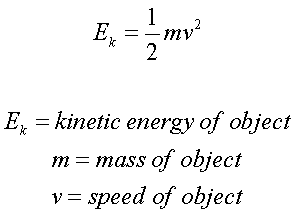
The energy that a hydrogen nucleus has to have to generate the fusion reaction it can be easily calculated using classic mechanics:
Taking into account the repulsion force, it must have the energy to approach another nucleus under a minimum distance.

I have noticed that you will refer only to ITER where it is sought to bring the plasma to a very high temperature and pressure.

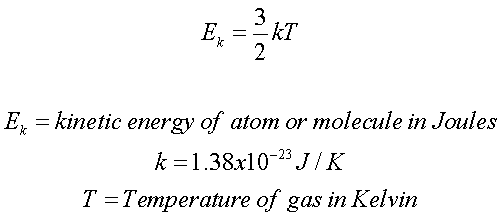
With temperature increases, the thermal speed increases:


They forget to say it's an average speed.
 

Thread Starter

Motanache

Joined Mar 2, 2015
652
But we can produce the fusion reaction in many ways:
1.


Negative hydronic ions accelerate between potential mass (0V) and high voltage (+10MV): E=eU
Here they hit a foil where they lose the electrons and become positive.
Becoming positive is repulsed by the +10MV terminal that has so far attracted them.

These protons can generate fusion experimts.
But the plant consumes more energy than you can get with a proton beam with beam current of 1mA (i=q/t).


The part with red HV is the high voltage source that is electronics (is with capacitor diode multiplication cells).
How energy this machine use and what energy you can get using a 1mA proton beam form fusion reaction ?

2.
Attempts to shield the repulsion forces between 2 hydros.
miuons were used
 
Top