Idea on gluing back plastic

Thread Starter

Yami

Joined Jan 18, 2016
354
I got two oscilloscopes which has got the plastic rod which connects to the "on" button snapped off. The button is also plastic. Now to put it back together I was thinking of using something like epoxy, which should be strong enough. But then I thought if the unit has to be serviced again it would be a nightmare to take it apart.
I thought of using hot glue instead. Is that a good idea? Considering that the oscilloscopes get quite hot when its on, using another kind of glue would not work right? and also hot glue should be quite easy to remove when it comes to opening the unit.

Appreciate your advice and ideas
Thanks in advance.
 

MisterBill2

Joined Jan 23, 2018
27,519
I am trying to imagine how a plastic rod, not part of the switch, is utilized. OR perhaps the rod is a part of the switch. If the scope can be opened without removing the rod then there is no issue, and the solution is a permanent glue.If the rod somehow needs to be disconnected to open the scope for service then the answer is different. Are you able to send a picture of the assembly with the rod broken?
The glue that I have found to be the best is the original "Gorilla Glue", not that super-glue that has the gorilla logo attached to it. The original glue that reacts with moisture to form a foam that sticks very ell and is quite hard.
 

Thread Starter

Yami

Joined Jan 18, 2016
354
Ah, I haven't got a photo at the moment. Will take a snapshot when I get into the workshop tomorrow. The rod comes from the front panel to the back of the unit where the power supply board is, the switch is on the power supply board.
In the original design the rod is easily removable. To remove any board the rod needs to be taken out first as it obstructs almost all the boards.
 

MrChips

Joined Oct 2, 2009
34,812
Make and model of the oscilloscope would help.
I have two scopes with missing power button. I made replacement buttons out of pieces of plastic.
I understand that your situation calls for a longer push rod. I would suggest seeing if you can fabricate a push rod with strong material such as aluminum covered with insulating material.
 

MisterBill2

Joined Jan 23, 2018
27,519
PLEASE do not use an aluminum rod, even if insulated it can cause a problem. Use a wooden dowel rod instead. If the push button is on the circuit board then you will need something to support the rod and keep it aligned with the pushbutton, unless there already is such in place. One desperate alternative is to solder a jumper wire across the switch connections and just plug the scope in when you need to use it. Crude, but very effective, unless it is a battery powered scope.
 

jpanhalt

Joined Jan 18, 2008
11,087
If it is like an older Tek scope, I would either drill a hole down the center of both pieces and use a piece of steel wire (music wire probably) as an internal fixation. If well cleaned, CA glue will work well. HOWEVER, CA will cause some acrylic plastics to disintegrate in time. Since the force is only to push, any safe-on-plastic glue would perhaps be preferred out of caution.

If you can't drill it, then thin wall tubing (e.g., brass or soda straw) can form a split over the break and may also work depending on the clearances needed to disassemble.

Finally, a lathe would be first choice for drilling. If not available, try to mount the plastic in the chuck of a drill press and mount the drill bit in a piece of wood on the base.
 

spinnaker

Joined Oct 29, 2009
7,830
Another idea is just to replace the existing switch with a toggle switch that is mounted on the outside of the case somewhere and connected with a pair of wires. Assuming you can get to the existing switch to unsolder it.
 

Thread Starter

Yami

Joined Jan 18, 2016
354
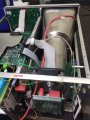
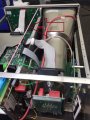
Here is a photo I had on my phone. In this unit the rod is not broken off. But the photo doesn't show the actual rod so I drew one in to illustrate how it connects to the front panel.
Note where the rod snapped off is from the actual switch (the white bit at the end of the switch). I've circled it in the photo.
The model of the oscilloscope is HAMEG 1008
IMG_9827.JPG

rod.jpg
 

jpanhalt

Joined Jan 18, 2008
11,087
Yep, that's what I thought it might be like. My advice is the same.

If it is push on/push off, then the internal fixation would be my first choice. If it is twist on/twist off, then the external splint would be my first choice.
 

MrChips

Joined Oct 2, 2009
34,812
PLEASE do not use an aluminum rod, even if insulated it can cause a problem. Use a wooden dowel rod instead. If the push button is on the circuit board then you will need something to support the rod and keep it aligned with the pushbutton, unless there already is such in place. One desperate alternative is to solder a jumper wire across the switch connections and just plug the scope in when you need to use it. Crude, but very effective, unless it is a battery powered scope.
No need to jumper the switch connections. Just leave the switch in the ON position.
 

MisterBill2

Joined Jan 23, 2018
27,519
OK now! The photo explains everything. If you use a piece of wooden dowel rod you can use a section of soft rubber tubing or hose to couple the end of the rod to the switch. It can pull apart whenever it has to be removed for servicing, and then put back when the servicing is done. Cheap, easy, and safe, and besides that, mostly biodegradable!And the dowel can be simple to work with, as well.
 

dl324

Joined Mar 30, 2015
18,328
Tek used all sorts of fiberglass rods and linkages in their equipment. Kite shops will have all sorts of rods that will be less expensive than rods from electronic supply places.
 

wayneh

Joined Sep 9, 2010
18,104
Second on the wooden dowel. There are many potential ways to connect it to the plastic of the switch. The tubing idea is probably easiest if you can find the right tubing or heat-shrink. Or you could pierce a hole in the wood and bend some wire around the switch and thru that hole.
 

Reloadron

Joined Jan 15, 2015
7,889
Depending on your location? Fiberglass Rod Stock is generally easy to find, strong and easy to work with and use adhesives with. The link is to McMaster Carr Supply in the US but it can be found in most home improvement stores or hardware stores. Under $4.00 USD buys about a 5' section of 1/8" Dia., maybe you can find smaller sections. Obviously you want the round stock. The link will get you there.

Ron
 
Top