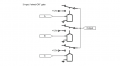
Whichever of A, B or C are active, 12V (or in your case 220V) will connect to the output.
So 220V should go to all COMMON pins of the relays, and all NO contact should go to the output.
If multiple activators are active (A and B for example) in the same time, it will be no problem.
Whichever of A, B or C are active, 12V (or in your case 220V) will connect to the output.
So 220V should go to all COMMON pins of the relays, and all NO contact should go to the output.
If multiple activators are active (A and B for example) in the same time, it will be no problem.
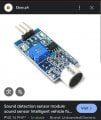
well.. relays they might be different models depending on what activates them. We need to check the output signal of the motion sensor and of the sound sensor, so it would be best if you share those part numbers.
well.. relays they might be different models depending on what activates them. We need to check the output signal of the motion sensor and of the sound sensor, so it would be best if you share those part numbers.
They both operate on 5V.
Do you have experience with Arduino? It would make your design a lot more flexible (you would be easily able to filter false reads, add delays if needed and similar).
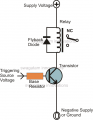
If not, you can always connect the sensors directly to the relays, only I would recommend using this circuit:
This protects your sensor from whatever is happening at the other end.
So both sensors though transistors on the coils of the relays (in parallel with diodes), and on the other side of the relays, two commons directly to 220V, and two NO contacts to wherever you want them to activate. Just make sure that your relays support enough current for the thing you want to supply with 220V.
I have a little experience with Arduino, but our professor only requires sensors and relays. That’s why I don’t understand why she doesn’t use Arduino.
If it is some kind of school project it would be doable without Arduino. If you want to actually install it and use it in everyday life, as mentioned, you might want to have some control over false triggers, rapid burst of triggers, maybe add delays and stuff like that.

 Facebook
 Google
 GitHub
 Linkedin

 they might be different models depending on what activates them. We need to check the output signal of the motion sensor and of the sound sensor, so it would be best if you share those part numbers.