An opamp could be used to 'close the loop' around a secondary voltage amp with a 50 V output capability?
Of course with the feedback attenuated to meet the opamp voltage limitations?
Devil is in the details:
What kind of gain and offset accuracy is required?
What is the load?
What bandwidth?
An opamp could be used to 'close the loop' around a secondary voltage amp with a 50 V output capability?
Of course with the feedback attenuated to meet the opamp voltage limitations?
Devil is in the details:
What kind of gain and offset accuracy is required?
What is the load?
What bandwidth?
Neither the input nor output can swing to the negative supply rail so you will need to use a split rail supply, say ±10V.
Then you can connect your input to the non-inverting input and set the gain to 5V/20mV, or 250. For instance, from the inverting input connect a 1k resistor to 0V and a 249k resistor to the output.
As said above, the 741 output cannot go all the way to the supply voltage. If you supply with -15 to +15 volts, it can only output a range of -14 to +14 (into a big value resistor like 10k and more). If you drop down the load to 1k or so, the output can only cover the range of -13 to +13. Worse as the load gets smaller - check the specs for max current.
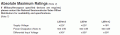
NOTE! The input offset voltage is 1 - 5 mV or, in your case 5 to 20% error. You will need to trim the OP amp. See DATASHEET for instructions.
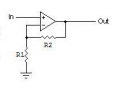
You can use the circuit below. Keep R2 under 20k (arbitrary choice for bias current dependent low offset voltage). Gain = 1 + (R2/R1) http://www.eecs.tufts.edu/~dsculley/tutorial/opamps/opamps2.html
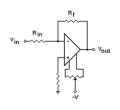
Per GopherT use a 10K or 20K as shown above to adjust the offset and per AlbertHall remember to use + and - power supplies and you should be good to go.
It can be done with power rails of +9 V and -9 V. The LM741 does not work well close to power rails. For a reliable +5 V out you need +V of about +9 V. With an input close to ground you need the negative power to be negative, not ground.
Or use a better op amp.
The LM741 is used in learning exercises because it has all the defects of a bad op amp. It is a good example of a bad example.
Yes, it's very good for teaching op amp frequency response limits, input and output voltage limits with respect to the power supply voltage, the effect of amplifier offsets, etc.
Truly a good bad-example.

 Facebook
 Google
 GitHub
 Linkedin