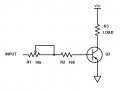
Ib current for transistor saturation

MrChips

Joined Oct 2, 2009
34,824
Design by trial and error:

NPN base drive.jpg

You want to know the effects of the base resistor?
Do it by experimentation. But know your limits. What is the minimum and maximum allowable values?

R1 is a variable resistor, 0 to 10 kΩ.
R2 is 100 to 200 Ω to prevent blowing the transistor.
R3 is your load.

Adjust R1 until you achieve your desired behaviour. Then measure the value of R1.
 

Thread Starter

Homebrew1964

Joined Nov 22, 2024
208
Design by trial and error:

View attachment 365795

You want to know the effects of the base resistor?
Do it by experimentation. But know your limits. What is the minimum and maximum allowable values?

R1 is a variable resistor, 0 to 10 kΩ.
R2 is 100 to 200 Ω to prevent blowing the transistor.
R3 is your load.

Adjust R1 until you achieve your desired behaviour. Then measure the value of R1.
Thank you Mr Chips
 

LvW

Joined Jun 13, 2013
2,030
Design by trial and error:
You want to know the effects of the base resistor?
....................
Do it by experimentation. But know your limits. What is the minimum and maximum allowable values?
.................
Adjust R1 until you achieve your desired behaviour. Then measure the value of R1.
...and then?
Suppose the measurement result is R = 278 ohms. What, then, is the benefit of this information?
 

WBahn

Joined Mar 31, 2012
32,874
Then I would select the nearest available value
But would you choose the nearest smaller value, the nearest larger value, or just the nearest value regardless of whether it was larger or smaller?

To make that decision, you need to have an understanding of the significance of using a smaller versus larger value and the ability to decide whether it matters -- sometimes it doesn't, and sometimes its pretty important that you get it right.
 

dl324

Joined Mar 30, 2015
18,333
I gave up on the formula's and just faffed around with different values untill the circuit worked as desired lol
But that won't necessarily work for other temperatures or transistors. The datasheet gives values that are guaranteed for all operating conditions and devices.
 

MrChips

Joined Oct 2, 2009
34,824
TS, admittedly, does not like doing math. So we introduce doing by experiment and measurement, and then compare it with the math.

Suppose R1 is measured to be 278 ohms. Then we add R2 (let us suppose is 100 ohms). The net base resistor is 378 ohms.

Suppose the math gives (5 V - 0.8 V) / 6 mA = 700 Ω

Now we try to understand the effects of both values. The lower value puts the transistor deeper into saturation.
Try both values and measure the collector voltage with respect to ground.
Furthermore, measure VBE and VCB for both base resistor values. Formulate your own conclusions.
 
Top