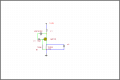
I think this oscillator should work but it does not

Thread Starter

Arjune

Joined Jan 6, 2018
354
I don't know why this circuit doesn't work. Maybe it needs a Schmitt trigger inverter. Maybe the breadboard capacitance is too much. I can assume that the truth is false. test1.png
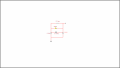
I was hoping the circuit would oscillate at 16 megahertz. I don't have an oscilloscope to check the waveform but I rectified the output with a diode and 2 capacitors to see if there was DC showing if there was oscillation but no DC. One capacitor was to isolate the output and the other capacitor was to filter the DC from the diode in between.

MOD EDIT: Removed link to website.
 
Last edited by a moderator:

ebp

Joined Feb 8, 2018
2,332
A CD4049 is nowhere near fast enough if powered with 5 volts. It might work at 15 volts but would likely overdrive the crystal. HC or AC devices should work.

47/2 pF is heavy loading for a 16 MHz crystal. Typically it would be around 1/2 that, but the crystal spec's should be checked.

some useful references:
http://www.ti.com/lit/an/szza043/szza043.pdf
https://www.onsemi.com/pub/Collateral/AND8053-D.PDF
https://www.fairchildsemi.com/application-notes/AN/AN-118.pdf
http://www.crystek.com/documents/appnotes/pierce-gateintroduction.pdf
 

AlbertHall

Joined Jun 4, 2014
12,625
A CD4049 is nowhere near fast enough if powered with 5 volts. It might work at 15 volts but would likely overdrive the crystal. HC or AC devices should work.

47/2 pF is heavy loading for a 16 MHz crystal. Typically it would be around 1/2 that, but the crystal spec's should be checked.

some useful references:
http://www.ti.com/lit/an/szza043/szza043.pdf
https://www.onsemi.com/pub/Collateral/AND8053-D.PDF
https://www.fairchildsemi.com/application-notes/AN/AN-118.pdf
http://www.crystek.com/documents/appnotes/pierce-gateintroduction.pdf
If all that fails tell it that it is supposed to be an amplifier. That'll make it oscillate.
 

danadak

Joined Mar 10, 2018
4,057
Even your DMM probes could add enough C to kill the oscillation. Decouple
that with a 1 - 2 pF cap in series with probe. This is a fly by seat of your
pants approach w/o having a scope, signal level will be very low. Do you have
a shortwave receiver you could tune to 16 Mhz ? If it runs you could tune to a
harmonic up in FM band, say 6'th, 96 Mhz.......

Some ref material -

http://www.ti.com/lit/an/szza043/szza043.pdf

http://www.analog.com/media/en/technical-documentation/application-notes/an12fa.pdf

Regards, Dana.
 

danadak

Joined Mar 10, 2018
4,057
If you do not have a scope, these are free if you have a PC.
Low frequency however, but still useful. Include spectrum
analyzer, function generator.


You can start with a PC sound card based scope for free. Will give you basically
audio range scope, spectrum analyzer, and function generator all using your
PC sound card.


https://www.zeitnitz.eu/scope_en


http://www.zelscope.com/


http://www.ledametrix.com/oscope/


http://www.virtins.com/downloads.shtml


But first build a simple circuit to protect sound card inputs so you do not
ruin from transients, overvoltage. Google "protect sound card input".


For example http://makezine.com/projects/sound-card-oscilloscope/


Sound card impedance bridge -


http://www.marucchi.it/ZRLC_web/ZRLC/Steber_An_LMS_Impedance_Bridge.pdf


http://www.sillanumsoft.org/ZRLC.htm


Regards, Dana.
 

Janis59

Joined Aug 21, 2017
1,894
RE:<<You can start with a PC sound card based scope for free>>
Any sound-card scope are unable to get anything over the 22 kHz.
 

danadak

Joined Mar 10, 2018
4,057
Yes, thats why I pointed that out, its "Low frequency", but still useful
to many who have nothing but a PC.

Regards, Dana.
 

Thread Starter

Arjune

Joined Jan 6, 2018
354
A CD4049 is nowhere near fast enough if powered with 5 volts. It might work at 15 volts but would likely overdrive the crystal. HC or AC devices should work.

47/2 pF is heavy loading for a 16 MHz crystal. Typically it would be around 1/2 that, but the crystal spec's should be checked.

some useful references:
http://www.ti.com/lit/an/szza043/szza043.pdf
https://www.onsemi.com/pub/Collateral/AND8053-D.PDF
https://www.fairchildsemi.com/application-notes/AN/AN-118.pdf
http://www.crystek.com/documents/appnotes/pierce-gateintroduction.pdf
I didn't realize the 4049 could not oscillate at 16 megacycles and it had to be lower. I guess I have to buy lower frequency crystals. I'm thinking I want a circuit that will produce one pulse per second so I have to divide the crystal frequency with counters. Can you tell me if the four pin "can" active Crystal oscillator has an output that is the peak of the supply voltage?
 

ebp

Joined Feb 8, 2018
2,332
Can you tell me if the four pin "can" active Crystal oscillator has an output that is the peak of the supply voltage?
I'm not quite sure what you mean here. Many such crystal oscillators have CMOS-compatible outputs, so you get peak-to-peak voltage, as a square wave, nearly equal to the full supply voltage. I don't know if types that will run at more than 5 volts are common.

If you want one pulse per second, using a 32 768 Hz crystal of the type commonly used in digital watches and clocks and real-time clocks for computers might be worth considering since you just need to divide by 2^15. I think there may actually be a IC in the 4000 series (and possibly in HC) that has the oscillator and divider all in one - you just connect the crystal and the capacitors - but that is only a vague memory that may be wrong. I think some of the real time clock chips for computers also have a one pulse per second output.

If you want an extremely accurate one pulse per second clock you can get it from an inexpensive GPS receiver module. Of course this has several issues that could make it completely unsuitable.
 

Thread Starter

Arjune

Joined Jan 6, 2018
354
If all that fails tell it that it is supposed to be an amplifier. That'll make it oscillate.
Maybe IT (spirit) will talk back to me. I would like to identify IT. Maybe I could tell IT that the reality of truth is unreliable or illogical. Thanks.
 

Thread Starter

Arjune

Joined Jan 6, 2018
354
Yes EBP, I meant peak to peak output voltage. You're right, they might not make 15 volt CMOS output active Crystal oscillators but TTL (5v). Anyhow I am glad the output is equal to the supply rail.
 

Thread Starter

Arjune

Joined Jan 6, 2018
354
The attached mpf 102 circuit works but I don't know the peak to peak voltage at output. I tested it with an FM radio tuned to the 96 MHz harmonic of 16 MHz. I think the choke is at least 1 mH and the capacitor C 2 is at least .001 uF.
crystal osc 16 mhz.png
 

Thread Starter

Arjune

Joined Jan 6, 2018
354
The circuit is oscillating but how do I know if the output swings to V+ and ground. I want to divide the output with CMOS flip-flops or a counter chip. The DC output is like 200mV less than V+ (power is 5v and I can raise it) and when I measure that with my multimeter it still oscillates so the load does not stop oscillation. I can't measure the AC signal. I get the harmonic signal on 96 MHz FM band. Anyhow I think 16 megahertz is too fast for the flip flops.
 

AlbertHall

Joined Jun 4, 2014
12,625
If you want 1Hz output why are you starting at 16MHz?
Why not a nice low power of 2 which would be easy to divide down to 1Hz?
Like a very available and cheap 32kHz crystal.
 

Thread Starter

Arjune

Joined Jan 6, 2018
354
If you want 1Hz output why are you starting at 16MHz?
Why not a nice low power of 2 which would be easy to divide down to 1Hz?
Like a very available and cheap 32kHz crystal.
I guess you're right. I just wanted to put my 16 MHz crystals to use. I ordered some 32 khz crystals from eBay. It sure was a wonderful feeling to get the 16 MHz crystals to oscillate with the FET. It seems like adhering to the limits of knowledge with the truth of reality disabled the spirit.
 

Thread Starter

Arjune

Joined Jan 6, 2018
354
My logic probe indicated that pulses were coming out of the output and I assumed it could drive CMOS logic which have a high impedance input that can handle 16 megahertz.
 

Thread Starter

Arjune

Joined Jan 6, 2018
354
My logic probe detected pulses so I connected the 16 MHz output of the fet oscillator to a CD 4013 d-type flip-flop and it was clocking it.
 
Top