I need help with an audio amplifier.

Audioguru

Joined Dec 20, 2007
11,248
I had a car where the factory-installed stereo used 2 ohm speakers for gobs of power. Only the 10" subwoofer had an amplifier with its power supply voltage boosted.

Don't forget that a bridged amplifier uses an amplifier at each of the two speaker wires so that the voltage across the speaker is almost doubled then the current in the speaker is also almost doubled resulting in almost 4 times the power of a single ordinary amplifier feeding the same speaker. I think all factory-installed and many after-market ordinary car radios use bridged amplifiers and 4 ohm speakers.
 

Thread Starter

ConstructionK88

Joined Jul 25, 2018
282
And what you just wrote doesn't make any sense.
A class-AB amplifier doesn't increase the voltage beyond what is supplied by the power supply.
If the power supply delivers 12V then 12V is the max voltage you can get (assuming we are not employing a boost converter).
You increase the current by decreasing the resistance of the load.
My apologies. I mean to say my ab amp was only as loud as my phone driving the speaker alone. I didn't check the voltage drop but it was being driven by 12volts and it was hardly audible.
 

MrChips

Joined Oct 2, 2009
34,829
My apologies. I mean to say my ab amp was only as loud as my phone driving the speaker alone. I didn't check the voltage drop but it was being driven by 12volts and it was hardly audible.
Still doesn't make any sense. You are comparing apples and oranges.
A phone produces sound via an internal speaker. They use a class-D amplifier.

What voltage drop are you attempting to check?

A 12V single-ended amplifier driving a 4Ω speaker would be capable of delivering 4W if designed properly.
A bridged amplifier would deliver 15W.
 

Thread Starter

ConstructionK88

Joined Jul 25, 2018
282
Still doesn't make any sense. You are comparing apples and oranges.
A phone produces sound via an internal speaker. They use a class-D amplifier.

What voltage drop are you attempting to check?

A 12V single-ended amplifier driving a 4Ω speaker would be capable of delivering 4W if designed properly.
A bridged amplifier would deliver 15W.
Damn still trying to learn here. The ab amp I built(exactly to specs)is barely functioning more than a complex sound muffler. That is where I'm at a loss. It was rated at I believe 3-5watts output but I'd say it's less than my phones auxiliary jack output..
 

Audioguru

Joined Dec 20, 2007
11,248
Damn still trying to learn here. The ab amp I built(exactly to specs)is barely functioning more than a complex sound muffler. That is where I'm at a loss. It was rated at I believe 3-5watts output but I'd say it's less than my phones auxiliary jack output..
What impedance is the speaker you tried with the amplifier that was powered with 12V?
Did you post the schematic of this amplifier, in which post number?
 

Audioguru

Joined Dec 20, 2007
11,248
I looked back at old posts and in Post #50 you show the schematic of a "popularly posted ab amplifier" that used low power but high current gain tiny transistors and you built it.
In post #52 I analysed it and discovered errors that caused its output to be only 0.26W into 8 ohms when it was powered from 12VDC. I fixed the errors but its transistors were overloaded if the output was higher than only 0.44W into 8 ohms.

Then you showed the photo of that amplifier built with completely different transistors so of course it didn't work properly since most of its resistors must be changed to work with the new transistors (the powerful but low current gain TIP ones).

Simple arithmetic:
For 4W into 8 ohms then a single half-decent amplifier must have a 19VDC power supply. When this amplifier is powered with only 12VDC then its output power is only 1.26W. If this amplifier is doubled to make a bridged amplifier then the output power is close to 5W. If the speaker is changed to 4 ohms then the bridged output power is close to 10W.
 

Thread Starter

ConstructionK88

Joined Jul 25, 2018
282
Which circuit is that?
SG
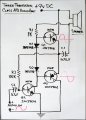
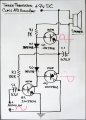
Tis this one. The only difference is im using tip41c/42c. I did try with c1815 and an a933, not complementary pairs but close enough that it still should be be audible from more than 3 inches away. As a matter of fact there was no change in volume. Sounded nice though.

What impedance is the speaker you tried with the amplifier that was powered with 12V?
Did you post the schematic of this amplifier, in which post number?
I used a 4ohm(car audio), 8ohm(car audio), and a 32ohm(primary tester for its small size,old tv). There are way to many posts to shuffle through. Clearly I should have learned faster.
 

Attachments

Last edited by a moderator:
I am no where near the expert your other helpers are, but I do know a lot about finding mistakes in wiring circuits because I have made so many of them. If you have the time, let me walk you through a few things to double check.

How heavy is your four ohm speaker? How large is it. I assume it is just the speaker frame, not in a box--right?
If it is reasonably heavy--more than a few ounces and at least 4 inches across, that's the one to use. Otherwise use your 8 ohm one.

How do you connect the phone to the amp? The hot wire should go to a fairly large capacitor which then goes to the high end of a potentiometer. Nearly any pot salvaged from an old radio or TV ought to work, but tell us anything you know about it. The low end of the pot goes to ground. The middle terminal of the pot goes to the input of your amp. With the pot turned all the way counter-clockwise there should be no sound out of the amp. The sound level should increase as you turn the pot clockwise.

If you have neglected this input stage that may well be the source of your problems.

Try what I have said and get back to us. You have a reachable goal.
 

Thread Starter

ConstructionK88

Joined Jul 25, 2018
282
I looked back at old posts and in Post #50 you show the schematic of a "popularly posted ab amplifier" that used low power but high current gain tiny transistors and you built it.
In post #52 I analysed it and discovered errors that caused its output to be only 0.26W into 8 ohms when it was powered from 12VDC. I fixed the errors but its transistors were overloaded if the output was higher than only 0.44W into 8 ohms.

Then you showed the photo of that amplifier built with completely different transistors so of course it didn't work properly since most of its resistors must be changed to work with the new transistors (the powerful but low current gain TIP ones).

Simple arithmetic:
For 4W into 8 ohms then a single half-decent amplifier must have a 19VDC power supply. When this amplifier is powered with only 12VDC then its output power is only 1.26W. If this amplifier is doubled to make a bridged amplifier then the output power is close to 5W. If the speaker is changed to 4 ohms then the bridged output power is close to 10W.
Thank you for the clarification. I assume at best 1.26 watts is my max even changing out the transistor's with only the 1. Out of curiosity what would be the best I could get of of my tip pairs? Should I just get something else? That would be fine if my tip has no real hope of going over 5watts. I will swap out the resistors when I'm off work. Do you happen to know where I could locate a decent ab class amp schematic that doesn't require a large number of parts that my tip or another common pairing would work? 5-10watts is enough for me but if it does more I won't complain.

I am no where near the expert your other helpers are, but I do know a lot about finding mistakes in wiring circuits because I have made so many of them. If you have the time, let me walk you through a few things to double check.

How heavy is your four ohm speaker? How large is it. I assume it is just the speaker frame, not in a box--right?
If it is reasonably heavy--more than a few ounces and at least 4 inches across, that's the one to use. Otherwise use your 8 ohm one.

How do you connect the phone to the amp? The hot wire should go to a fairly large capacitor which then goes to the high end of a potentiometer. Nearly any pot salvaged from an old radio or TV ought to work, but tell us anything you know about it. The low end of the pot goes to ground. The middle terminal of the pot goes to the input of your amp. With the pot turned all the way counter-clockwise there should be no sound out of the amp. The sound level should increase as you turn the pot clockwise.

If you have neglected this input stage that may well be the source of your problems.

Try what I have said and get back to us. You have a reachable goal.
Audioguru informed me that my tip pairing needed different resistors than what's in the diagram. The inputs are correct and the speakers are 6inch. The 32ohm is a 4x2 from an old television, which has the loudest, clearest sound oddly.
 
Last edited by a moderator:

sghioto

Joined Dec 31, 2017
8,634
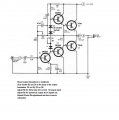
I gave you circuit to use the TIP41 and 42 back in post #110 that has been constructed, tested and operation verified.
Using a 4 ohm load: 2 watts at 12 volts, 5 watts at 18 volts.
SG
EEE Lil Tiger mod.png
 

Audioguru

Joined Dec 20, 2007
11,248
Audioguru informed me that my tip pairing needed different resistors than what's in the diagram. The inputs are correct and the speakers are 6inch. The 32ohm is a 4x2 from an old television, which has the loudest, clearest sound oddly.
It is not odd that you used the resistors for little transistors that have a current gain of 200 but used the TIP transistors that have a current gain of only 20. So the TIP transistors with the wrong resistors work best with the speaker that has a very high impedance.

An electronic circuit has every part calculated to work well with all the other parts.

Why do you ask, "What would be the best I could get of my tip pairs?" We told you many times:
1) High power supply voltage.
2) Low impedance speaker.
3) A driver to the output transistors providing enough current.
5) Bridging two amplifiers for almost 4 times the power.
6) Cooling the output transistors if they are working hard.
 
If this amp is designed for a 4-8 ohm speaker and he connects a 16 ohm one doesn't the efficiency of the amp decrease? If the efficiency decreases, might it not decrease enough to minimize clipping?

The amp is apparently being fed directly by a phone. It is my understanding that phones use class D outputs.

It seems likely that the full output of the phone would over-drive any of the various amp configurations mentioned.

Or not, as my moniker says, I'm a novice.
 

Audioguru

Joined Dec 20, 2007
11,248
An audio amplifier has an extremely low output impedance to damp the resonances of a speaker. Then the output AC voltage level does not change if the load changes from 4 ohms to infinity. A 16 ohm speaker draws half the current of an 8 ohm speaker that draws half the current of a 4 ohm speaker.

The class-D output of a phone is probably filtered into audio frequencies.
Surely the phone has a volume control to avoid over driving anything??
 

Thread Starter

ConstructionK88

Joined Jul 25, 2018
282
I gave you circuit to use the TIP41 and 42 back in post #110 that has been constructed, tested and operation verified.
Using a 4 ohm load: 2 watts at 12 volts, 5 watts at 18 volts.
SG
View attachment 157701
Yes I see that and thank you but how do I "check" the values I set on the pots?

It is not odd that you used the resistors for little transistors that have a current gain of 200 but used the TIP transistors that have a current gain of only 20. So the TIP transistors with the wrong resistors work best with the speaker that has a very high impedance.

An electronic circuit has every part calculated to work well with all the other parts.

Why do you ask, "What would be the best I could get of my tip pairs?" We told you many times:
1) High power supply voltage.
2) Low impedance speaker.
3) A driver to the output transistors providing enough current.
5) Bridging two amplifiers for almost 4 times the power.
6) Cooling the output transistors if they are working hard.
Then that's what I'll do. Thank you. I'll probably have to bridge them if that's the best way to help with heat.
 
Last edited by a moderator:

Thread Starter

ConstructionK88

Joined Jul 25, 2018
282
An audio amplifier has an extremely low output impedance to damp the resonances of a speaker. Then the output AC voltage level does not change if the load changes from 4 ohms to infinity. A 16 ohm speaker draws half the current of an 8 ohm speaker that draws half the current of a 4 ohm speaker.

The class-D output of a phone is probably filtered into audio frequencies.
Surely the phone has a volume control to avoid over driving anything??
Now I understand speaker impedance better. And certainly. It's a note4. That was my intention of using a Bluetooth input since it work's essentially the same as my phones volume adjust, just wirelessly. However that has been my issue of clean output and dB/volume. My phone overdrive at a very low output. About halfway and the distortion makes everything unrecognizable.
 

Audioguru

Joined Dec 20, 2007
11,248
Then that's what I'll do. Thank you. I'll probably have to bridge them if that's the best way to help with heat.
Bridging two amplifiers doubles the current, doubles the voltage swing across the speaker and almost quadruples the total amount of heating
because the output power is almost 4 times as much as a single ordinary amplifier that drives the same speaker.

A class-D amplifier reduces the amount of heating a lot because each output transistor is only dissipating any heat when it is briefly switching: Fully turned on with no voltage across it. Or fully turned off with no current in it.
 
Top