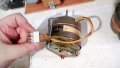
I tried with only 1uF and the motor didnt start but it locked itself and can not move at all. Its very strong as a break this way.
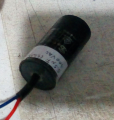
Then I tried the big black 5uF capacitor from earlier tests and it start excellent. That capacitor have some burned marks on it because is a scrap capacitor. A bit too big for my taste but is doing the job.
Im wondering now... If there is a way to make an independent 70V power supply for each motor?
I'm dreaming too high, right? I was thinking on a voltage regulator, a more powerful one if possible. Or a SMPS? Something cheaper than a transformer.
What you will do in my case? The motors are very lazy by themselves but it will be nice to have a power source for each, as a challenge in itself. I've always dream for the complete package for them.
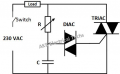
Will a triac circuit be just enough for driving such a motor?
Instead of the potentiometer, a fixed value resistor, setting to 70 V for powering the Load (my motor in this case).
Im trying to do what you tell me as much as I can understand you.
I hear you, that you said I should not put the capacitor across the supply power pins.
And also you mentioned that the bigger resistance coil should have that capacitor over it...
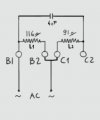
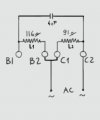
so I draw this new version, is this closer to what you trying to say to me? View attachment 264987
That is still totally wrong.
You have the two windings in series, the way I showed you could not be simpler, you do not need to change any of the B1,B2,C1,C2 connections, as shown in your #30.
Just connect power and add the cap.
It could not be simpler??
You have the two windings in series, the way I showed you could not be simpler, you do not need to change any of the B1,B2,C1,C2 connections, as shown in your #30.
Just connect power and add the cap.
It could not be simpler??
In my defense, I am not dealing with motors every day, so I dont know everything about them.
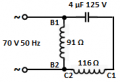
After a good night sleep, I revisit the circuit diagram you showed me, because you told me in your last message it was still NOT good. This time I ignored the notations, but looked only on the circuit itself and I think this new circuit is exactly as in your circuit:
I also test it, first at 35V then at 70V and it worked !
I could even hear the motor noise in this configuration, and I could not hold the rotor, it was spinning with a lot more force than before. I believe this is the right configuration. Now, I am very pleased with the motor speed and increased torque ! Now is better !
Next, lets make a dedicated 70VAC power supply for each motor ! Eh? Challenging? What do you say?
Thank you very much for sticking with me, mister @MaxHeadRoom !
I recently repaired a similar 120VAC fan motor.
The windings are wired as per @vu2nan in post #18.
The series capacitor is 3μF/250V.
This is not a starting capacitor. It is to create a phase shift between the current in the two windings.
Thank you mister @MrChips for confirming that is correct what I did there.
The real tests also confirmed the rotor resist much more stronger now than with my earlier windings.
Again, Im not doing this thing every day. I do have some general knowledge but im not that good.
I am actually very glad they are working and not burned. I was afraid I was stupid to test them "unconventionally", in my youth.
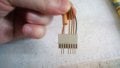
I have 1 more motor to test and this one is having 6 wires on it. I am thinking to open it up like I did with the other one. IF I can !!! Because it will tell a lot what kind of motor type is and it seems to be very important to know. From outside, I have absolutely no clue what type of motor may be. It might be a stepper motor... hmmm and also I have no idea where I got him from. His history is dark and questionable. This one is still a russian motor from soviet era. Dont ask me more than that, but until 1989 we had a lot of russian goodies imported and commercially available but extremely expensive and not that affordable by the common people-comparative to today market. They were more like an exposition of products than a real market. You had to sell your skin to buy a product like that. And I was the smart guy to dismantle them off, in my youth. So much for respect. Haha.
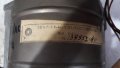
So this one is at 80V with 50Hz written very small on its original label.
I dont have any coil resistance draw for it at all. I should start by measuring that I guess, right?
So, my question for you is how to make this puppy work?
In my defense, I am not dealing with motors every day, so I dont know everything about them.
After a good night sleep, I revisit the circuit diagram you showed me, because you told me in your last message it was still NOT good. This time I ignored the notations, but looked only on the circuit itself and I think this new circuit is exactly as in your circuit: View attachment 265032
I also test it, first at 35V then at 70V and it worked !
I could even hear the motor noise in this configuration, and I could not hold the rotor, it was spinning with a lot more force than before. I believe this is the right configuration. Now, I am very pleased with the motor speed and increased torque ! Now is better !
Next, lets make a dedicated 70VAC power supply for each motor ! Eh? Challenging? What do you say?
Thank you very much for sticking with me, mister @MaxHeadRoom !
I concur with what Max says. The run winding should be the one with the lower resistance. Start-Run capacitor is correct.
The winding with the larger resistance is called the Start Winding. The one across AC mains is the Run Winding.
With the other motor, measure the resistance between the leads as Max suggested.
I just made the test and I dont see a visible change - torque or speed. It appears by my eye-o-meter they run the same.
The only difference is the rotation sens. Left to right and right to left if switched between B1 and C2. Good to know !
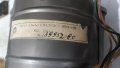
It appears it is made in 1990 ! I told you is old as I am. Haha.
There is a faint and very small 80B which is russian for 80V - that much I know by myself.

 Facebook
 Google
 GitHub
 Linkedin