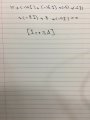
I Need Help, How To Find Vab ?

MrChips

Joined Oct 2, 2009
34,807
No.

The equation will look something like this:

12 + (-10*I) + (-15*I) + (-5) + .... etc. = 0

It would be best to label your resistors R1, R2, etc.

Hence

12 - I*R1 - I*R2 - 5 + ... etc. = 0
 

WBahn

Joined Mar 31, 2012
32,823
The "normal" way to work this problem would be to use KVL to find the total current (which is basically a more explicit version of summing up the voltages from the sources and dividing by the sum of the resistances). Then, with the total current, you walk around part of the loop from Point B to Point A adding up the voltage drops along the way.

If you REALLY need to use KVL more directly (to satisfy the requirements of the homework), then you set up two loops -- a left hand loop that goes (clockwise for argument's sake) until it gets to point B and then drops down to point A (with the voltage drop along that path being Vab) and then a second loop that starts in the right half and when it gets to point B jumps up to point A (with a voltage drop along that path being -Vab). You now have two equations in two unknowns (Vab and I).

 

MrChips

Joined Oct 2, 2009
34,807
Ok. Now that you have a value for the loop current I, you can use KVL and go around the loop using Vab (i.e. stop when you get to nodes a and b).

You can do this two ways.
Do it both ways and show that you have the same answer.
 

Thread Starter

Abdullah Al-Baldawi

Joined Dec 3, 2018
24
Ok. Now that you have a value for the loop current I, you can use KVL and go around the loop using Vab (i.e. stop when you get to Va and Vb).

You can do this two ways.
Do it both ways and show that you have the same answer.
I did not understand, could you help me as you helped me extract the current
 

MrChips

Joined Oct 2, 2009
34,807
I know it was difficult to explain in words.

Look at the original circuit diagram.


Draw a dividing vertical line down nodes a and b.
Separate the diagram into two halves, a left side and a right side.

I will apply KVL to the left side for you. You do the same for the right side. Look at your own solution you wrote for guidance.

12 + (-I*R1) + (-Vab) + (-I*R5) = 0
 

Thread Starter

Abdullah Al-Baldawi

Joined Dec 3, 2018
24
I know it was difficult to explain in words.

Look at the original circuit diagram.


Draw a dividing vertical line down nodes a and b.
Separate the diagram into two halves, a left side and a right side.

I will apply KVL to the left side for you. You do the same for the right side. Look at your own solution you wrote for guidance.

12 + (-I*R1) + (-Vab) + (-I*R5) = 0
 

Attachments

Top