It may be. Different colours of LEDs have different forward voltage drops. Try the LED in your button on 3V with a 47R resistor in line and see if it lights.is it possible to do this with 3v instead of 5v?


This button would typically only be lit for one hour once a week maximum, how long do you think a single CR2032 would last in this scenario?Can you read the breakout box input status on your application software to see if it reads the switch correctly?
And if you have a spare USB socket, that could be used to supply the +5V. A couple of CR2032 batteries will not last long.
For a test, connect your multi meter, (on mA) between the GND and a breakout box input to measure the current an operated switch draws. If the current is low, a Germanium diode could be used as i has a lower forward voltage drop so the input will be closer to GND when on.
Another test could be to wire a variable resistor between the input and gnd, then measure the max voltage across it when the input is read as on. That wau it tells you how much headroom you have.
Good question. I had some old 2032's that I wanted to fully discharge. I don't know exactly what their power level was but I connected some superbright white LED's to them and let them burn 24/7. It took a couple weeks for them to visibly dim. So dividing that into hours and assuming two weeks (14 days) 14 x 24 = 336 days. Almost a whole year. But these were already depleted garage door opener fobs. Brand new - I have no idea how long they'll last. You COULD set up a test with a new CR2032 and a superbright LED and see how long it runs until the brightness is lacking. But you may find yourself waiting a month for it to go dead. But yeah, you can replace the 5V phone charger with a single coin cell battery.This button would typically only be lit for one hour once a week maximum, how long do you think a single CR2032 would last in this scenario?
Thank you.Good question. I had some old 2032's that I wanted to fully discharge. I don't know exactly what their power level was but I connected some superbright white LED's to them and let them burn 24/7. It took a couple weeks for them to visibly dim. So dividing that into hours and assuming two weeks (14 days) 14 x 24 = 336 days. Almost a whole year. But these were already depleted garage door opener fobs. Brand new - I have no idea how long they'll last. You COULD set up a test with a new CR2032 and a superbright LED and see how long it runs until the brightness is lacking. But you may find yourself waiting a month for it to go dead. But yeah, you can replace the 5V phone charger with a single coin cell battery.
They also make CR2450's which are a lot bigger and will last - obviously - longer.
CR2450's sound great, I'm going to look for dimensions and add it in the CAD to see how it fits. Thanks for the tip.Good question. I had some old 2032's that I wanted to fully discharge. I don't know exactly what their power level was but I connected some superbright white LED's to them and let them burn 24/7. It took a couple weeks for them to visibly dim. So dividing that into hours and assuming two weeks (14 days) 14 x 24 = 336 days. Almost a whole year. But these were already depleted garage door opener fobs. Brand new - I have no idea how long they'll last. You COULD set up a test with a new CR2032 and a superbright LED and see how long it runs until the brightness is lacking. But you may find yourself waiting a month for it to go dead. But yeah, you can replace the 5V phone charger with a single coin cell battery.
They also make CR2450's which are a lot bigger and will last - obviously - longer.
It's your project. Don't apologize. You get to decide what goes into it and what doesn't.Thats why I keep insisting on the batteries, I'm sorry.
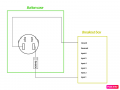
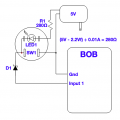
So, if I switch to a 3v battery all I need is a 80 ohm resistor and a diode? If thats correct I just need to find the appropriate components, I would need help choosing the right ones.OK, I'm making some assumptions here, but Input 1 likely has a pull-up resistor internally. When Input 1 is pulled to ground BOB reads it as a closure. Hence, SW1 will pull Input 1 low. The LED is subsequently powered from an old cell phone charger outputting 5V probably at some current anywhere from 200 mA to 700 mA (typical, but may vary). D1 is a Schottky diode because it has a lower Vf than a regular diode. The diode prevents the 5V from the charger reaching input 1. If Input 1 is high at 2V then back feeding it with 5V might be harmful so the diode will be needed. Since I'm not versed in Schottky diodes I'll let someone else recommend a good candidate for this situation. Could just be a simple 1N914 signal diode for all I know. But not likely. Anyway, here's my latest iteration of a solution to your problem:
View attachment 317466


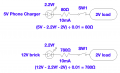
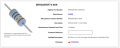
Ditching the resistor sounds great, less cost, less labor and less trouble. I'm giving it a go, if something goes wrong I'll reconsider. I have to wrap up this project.When I depleted my old used CR2032's I didn't use a resistor. I just let the LED's burn. And they never burned out. As I hear it - the 2032 has internal resistance and isn't capable of much current. Unless you want to control brightness you might not need a resistor. HOWEVER the LED inside the switch is touted as a 2.2Vf whereas my SuperBright White LED was 3Vf. So assuming you use a 3V battery (and for sake of argument we'll ignore the internal resistance of the battery) with a 2.2Vf LED you have 800mV (0.8V) to dissipate. ASSUMING you want 10mA. 800 ÷ 10 does in fact equal 80Ω. So, yes, 80Ω would be right. But the resistor you mention is 2 watt whereas you'd only need ( 3V x 0.01A = ) 30mW. A 1/8W resistor would be a whole lot smaller than a 2W resistor and is good to handle 125mW. Far above the 30mW you'd need.
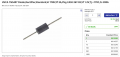
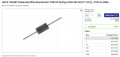
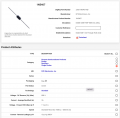
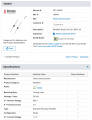
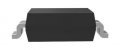
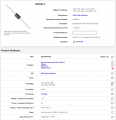
As for the diode, the zener, I don't know if I trust that data sheet. It claims a 1mV forward voltage drop and I've never heard of such a low Vf. I'm hoping others will speak up and offer suggestions. I know they've already offered their opinions and I'm not one to say they are wrong; they collectively know a whole lot more than me. So I can't say for sure the 1N5407 would be the right choice. The two reasons for having it there is to prevent back-feeding voltage into BOB and in keeping the Vf as low as possible so as to not interfere with BOB's operation.


I read this:1Vf might be too high. And for a Schottky diode I'd think that must be extremely high. You'd be better off with a small signal diode. I don't have time to look up different diodes right now. That's why I hope someone else can chime in and say something from a solid knowledge base.


Will do, thanks uncle Tony. And thank you to everyone else that lent me a hand. I'll get back to let you guys know if it works.Albertoinbox Great job of researching your components. You have far more drive than I do. A 0.3Vf sounds like a good choice. If the cost is not prohibitive then it's worth testing out on your BOB. Y'know what they say in Australia; "Bob's your uncle." Though I have no idea what that means.