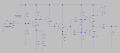
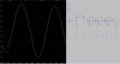
I recreated the circuit according to the following diagram (I changed the bias of stage 1 because I didn't have a 20kΩ) and thus I changed RE1 to get the desired current such that Vc1 = Vcc/2.
Edited:
I had forgotten to connect the smartphone ground to my circuit ground, never mind about the striked message below:
Without the input connected, I hear a noise that sounds like a sin, and the frequency gradually increases forever. I used a cap in parallel with the power supply as well, but nothing changed. Also, the two power transistors Q4 and Q5 are getting very hot and I can smell them (they still haven't been destroyed), but I'm pretty sure I built the circuit correctly. VB4 is about 6V and Vb5 about 5V, they have a 0.7V difference from LTSpice.OP but I'm using the BD135 & BD136 instead in the real application.
Without the input connected, I hear a noise that sounds like a sin, and the frequency gradually increases forever. I used a cap in parallel with the power supply as well, but nothing changed.
Maybe you built the circuit on a solderless breadboard that has too much capacitance between the rows of contacts and the wires all over the place. Then the circuit oscillates and maybe the connections are intermittent. The unshielded wiring causes electrical hum pickup.
Your diodes have no part number so they might be the wrong type instead of silicon.
The transistors might have their 3 pins mixed up.
Maybe you built the circuit on a solderless breadboard that has too much capacitance between the rows of contacts and the wires all over the place. Then the circuit oscillates and maybe the connections are intermittent. The unshielded wiring causes electrical hum pickup.
Your diodes have no part number so they might be the wrong type instead of silicon.
The transistors might have their 3 pins mixed up.
Wait, it actually sounds pretty great. This vibrating sound does not get amplified. In matter of fact, you can only hear it by putting your ear really close to the speaker.
I'm uploading a video right now, I will post it shortly.
It wasn't a gain drop, a notification came to my phone and when that happens the phone automatically lowers the output to zero.
Finally, I managed to make it after 2 years and completely understand what I'm doing! @Jony130 might remember me, he answered almost in every post that I made over the last 2 years.
Many thanks for your patience, Behzad Razavi for his Electronics 1 & Electronics 2 YouTube series, to my professor who gave me some advice when I said to him I'm ready to give up, and to Adel Sedra for his excellent book.
I've got the basics, now I need experience and probably I must read The Art Of Electronics.
This noise (vibrating sound) is normal, because you have a ground loop and lack of supply rail filter, so the noise from the mains voltage is normal.
As for the burning smell. It's probably Q3 because you have decreased RE3 resistor to 47R. So you increased the current thus, the power dissipation in Q3 also increased.
And the push-pull stage.
I vote to bring back R4 to 220R instead of two diodes and RE3 to 100R.
Also the C1 and C2 polarity. The plus side of capacitors (longer leads) should point towards the push-pull stage.
So you join the army? Or maybe you have mandatory military service in Greece? I also spent a year in the army back in 2004. Best of luck in your Military Service.
So you join the army? Or maybe you have mandatory military service in Greece? I also spent a year in the army back in 2004. Best of luck in your Military Service.
It's an obligation here in Greece, you can not avoid it. Every male under the age of 18 (or older in my case if you are a University student). It's 8 months for me because I chose to serve in Cyprus (we are allies) where they are in need of more soldiers so they offer some benefits like shorter time and a small salary as well (normally we don't get paid).
Probably it's because of the paralleled load (Speaker plus 4 LEDs with their series resistors) right?
I changed the load in LTspice to 1Ω and the current reached 1.5A (9Watts heat dissipation from the power amps). The breadboard says it can handle 2 Amps.
Edited:
I've also thought of making some out-of-phase outputs for the LEDs, so they do not blink at the same time (a more awesome effect). But I can't think how to do it.
It's really hard to keep them out of phase with high pass filters, and when I'm adding the LEDs they get paralleled with the filter resistances, lowering them, thus messing with their frequency response and cutting out frequencies.
Yes, the average power dissipation in a single transistor of the output stage will be around P = (0.5Vcc^2)/RL = 0.45W.
Your transistors will have a terminal resistance between the junction and the ambient equal to RThja = 100 °C/W (without heatsink).
This means that the output transistor junction will have almost 50°C (0.42W * 100 °C/W) higher temperature than the ambient temperature.
This is why your breadboard will try to meltdown, and this calculation does not take into account the load caused by the diodes.

 Facebook
 Google
 GitHub
 Linkedin