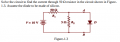
It depends on your assumption for the forward voltage drop of the diode. Every diode that you ever see, besides all the ones that you won't, will have a slightly different value for the forward voltage drop. Can you show your work?
A silicon diode has a range of voltages. At 200mA a 1N4001 has a forward voltage of 0.8V and a 1N4148 has a little more than 1V.
The question probably assumes 0.7V which is wrong at the high current.
It depends on your assumption for the forward voltage drop of the diode. Every diode that you ever see, besides all the ones that you won't, will have a slightly different value for the forward voltage drop. Can you show your work?
A silicon diode has a range of voltages. At 200mA a 1N4001 has a forward voltage of 0.8V and a 1N4148 has a little more than 1V.
The question probably assumes 0.7V which is wrong at the high current.
The question is also pretty clearly aimed at the very early days of a circuits course in which virtually everything has highly idealized behaviors so that the focus is on the analysis techniques.
Plus, even assuming a 0.7 V drop, why compare that to the voltage drop that two particular diodes have at 200 mA since this diode, at a fixed 0.7 V, is only going to have less than a quarter of that?
You did not allow for any current to go through the diode. KCL says some must go through the resistor and some must go through the diode. If V(A,B) is over 900 mV that diode is going to be on HARD!
This is probably not the answer being sought. The choice of component values makes it so that there are a couple of answers that result from using the wrong approach that are pretty close to the answer you get from using the correct approach. Need to see your work to know which category yours falls into.
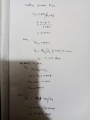
Ah, I see you posted your work while I was writing my last response.
Let's take a step back and consider how a diode behaves.
What is your understanding of how the voltage and current through a silicon diode are related based on what you've learned so far?
Based on your solution, what is the voltage across the diode? What is the current through the diode? Do these agree with your understanding of how a diode behaves?
Also, I think you would actually best be served by walking us through how you understand you should approach these kinds of problems in general. It seems like there's some holes there, so now is a good time to plug them.
For some insight consider what happens for R2 being 0.05Ω, 0.5Ω, 5Ω, and 50Ω. If R2 is very small there will not be enough voltage for the diode to conduct, and the current through the diode will be so close to zero that it can be removed from consideration. If R2 is equal to R1 there will be a gread deal of excess voltage to turn the diode on. Once the diode is on the voltage is limited (clamped) to some value in the range of approximately 600-740 mV depending on the particular diode that you have chosen and the amount of current going through it. The arithmetic mean value is 670 mV so let us use that value. Then:
This must be understood as an approximate answer based on the assumption that we know the forward drop of the diode. We also know that this forward drop will be different for different instances of the same diode and for different values of the forward current through the diode. Precise answers are just not achievable.
@Papabravo: Please avoid providing step by step solutions to a student's homework. It almost completely defeats the purpose. They have almost certainly seen similar problems worked by someone else in the text, in examples, and in lecture. Seeing yet one more problem worked by someone else is unlikely to suddenly fill in the gaps that exist. That will probably only happen as they struggle to work through a problem on their own with only hints and suggestions as to how to proceed past the current sticking point. What will likely happen by feeding them everything is that they will think they understand it, they will get credit for work that isn't their own, and then they will get reamed on the exam when they discover that seeing yet another problem worked by someone else didn't really address the gaps in their understanding.
@Papabravo: Please avoid providing step by step solutions to a student's homework. It almost completely defeats the purpose. They have almost certainly seen similar problems worked by someone else in the text, in examples, and in lecture. Seeing yet one more problem worked by someone else is unlikely to suddenly fill in the gaps that exist. That will probably only happen as they struggle to work through a problem on their own with only hints and suggestions as to how to proceed past the current sticking point. What will likely happen by feeding them everything is that they will think they understand it, they will get credit for work that isn't their own, and then they will get reamed on the exam when they discover that seeing yet another problem worked by someone else didn't really address the gaps in their understanding.
Maybe your view is accurate, but maybe you are assuming facts not in evidence. There is evidence that people abandon this site when they meet too much resistance. We'll see what happens.
Maybe your view is accurate, but maybe you are assuming facts not in evidence. There is evidence that people abandon this site when they meet too much resistance. We'll see what happens.
Maybe you are making an assumption as well. Perhaps those abandoning the site wouldn’t find it of benefit in any case. Other than getting an answer without understanding and subsequently failing.

 Facebook
 Google
 GitHub
 Linkedin