I HATE patches

MrSoftware

Joined Oct 29, 2013
2,273
For prototypes, maybe. But I wouldn't trust it for production.
If something needs a whole lot of rework for production, hopefully they would spin a new rev of the board. I know the real world doesn't always work that way though. I would think magnet wire and maybe a little conformal coating should be fine for most cases.
 

Tonyr1084

Joined Sep 24, 2015
9,744
Screenshot 2024-10-05 at 1.04.53 PM.png
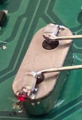
Looks like caps to me. Five sided foil on each end of the component is a good indicator it's a cap. Resistors have only 3 faces foiled. Also, it looks like Dead Bug construction. This is the bottom of the crystal. And it also looks like the outboard ends of what I believe is caps are soldered to the crystal housing. No telling what's going on under the crystal.
 

Tonyr1084

Joined Sep 24, 2015
9,744
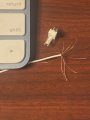
For even finer wire for patching you can take stranded wire and unwind the strands. Off hand I don't know how small those strands can be but I know I've seen some pretty fine wire in something like an 18 gauge stranded wire. There may be several strands making up the overall gauge.
 

Tonyr1084

Joined Sep 24, 2015
9,744
While I don't know what gauge this wire is, I'm guessing it's either 18 or 20 gauge and it has nine strands. And that's an Apple Keyboard. Of course these wires are not insulated. But I don't think we're discussing ways to use fine wire jumpers.
IMG_4488.jpg
 

Thread Starter

cmartinez

Joined Jan 17, 2007
8,765
While I don't know what gauge this wire is, I'm guessing it's either 18 or 20 gauge and it has nine strands. And that's an Apple Keyboard. Of course these wires are not insulated. But I don't think we're discussing ways to use fine wire jumpers.
View attachment 333090
That looks more like a 34 or 36 gauge to me.

EDIT: Oh, I see now that they're strands of a 20 or 18 gauge.
 
Last edited:

MisterBill2

Joined Jan 23, 2018
27,528
It is always good to know how much current will flow thru whatever patch one puts on a circuit board. Not every trace is a CMOSgate input.
 

Tonyr1084

Joined Sep 24, 2015
9,744
after additional examination, it looks to me like the small red spot on the one solder connection is probably a QC inspector's mark.
While that may be possible, having spent over 40 years in the Quality side of manufacturing I've only seen red Gliptol as either a tamper indicator such as when a pot is trimmed then marked with a flakable red mark across the wiper and the housing to indicate tampering or as a torque stripe. I've seen red arrows many at times. But if an inspector was indicating a bad solder joint an arrow would be the preferred method. Also, a red paint would interfere with reflowing the solder. So I disagree with you on it being an inspection mark. But I also respect your opinion. Certainly a valid possibility. One other possibility of the red substance; it could be the adhesive they use to hold a component in place during reflow soldering.
 

MisterBill2

Joined Jan 23, 2018
27,528
While that may be possible, having spent over 40 years in the Quality side of manufacturing I've only seen red Gliptol as either a tamper indicator such as when a pot is trimmed then marked with a flakable red mark across the wiper and the housing to indicate tampering or as a torque stripe. I've seen red arrows many at times. But if an inspector was indicating a bad solder joint an arrow would be the preferred method. Also, a red paint would interfere with reflowing the solder. So I disagree with you on it being an inspection mark. But I also respect your opinion. Certainly a valid possibility. One other possibility of the red substance; it could be the adhesive they use to hold a component in place during reflow soldering.
It is extremely unlikely that the "patch" shown so well in post #8 would be subject to reflow soldering. It looks much more like a post-solder reflow patch. It would never have been done in a reflow system.
 

Thread Starter

cmartinez

Joined Jan 17, 2007
8,765
This one's a real abomination. And it's so tiny in size that it's not practical to use an insulated wire. The wire shown in the pic is one of seven filaments belonging to a 28 awg wire.

1739926369052.png

And I still have "a few" more hundred patches like this one to go ... :( ... stupid stupid stupid x "a few" hundred times .... but I'm grateful I found a workaround.
 

nsaspook

Joined Aug 27, 2009
16,326
This one's a real abomination. And it's so tiny in size that it's not practical to use an insulated wire. The wire shown in the pic is one of seven filaments belonging to a 28 awg wire.


And I still have "a few" more hundred patches like this one to go ... :( ... stupid stupid stupid x "a few" hundred times .... but I'm grateful I found a workaround.
You are supposed to keep the cut-off through-hole leads for this. ;)
 

nsaspook

Joined Aug 27, 2009
16,326

Ya’akov

Joined Jan 27, 2019
10,235
Are you putting solder mask on them?

Also, not to tell someone who is solving the problem how to do it while I sit back with my iron at room temperature, but...

I would route the jumper so it goes straight from the pin at 90° to the transistor, then make a right angle bend at the end to reach the pin. I would also 3D print a gig to make the jumpers to speed it up and keep it consistent.

I would also suggest—if you don't already have some—to get a pair of these ceramic jaw tweezers (the angled ones in particular). They don't bend, they handle high heat with no problems, and they are entirely non-magnetic which, depending on the wire you are dealing with, might be important.

1739956314471.png
Of course, you should feel free to ignore my shouts from the peanut gallery (an idiom that might not translate, I don't know...) and curse me under your breath as you struggle with the wires while I watch and critique your approach. Maybe it can take your mind off the frustrating tedium...
 
Top