Arghhh... I Hate 0402 components!

Thread Starter

SamR

Joined Mar 19, 2019
5,470
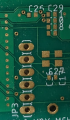
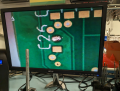
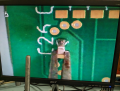
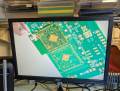
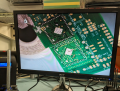
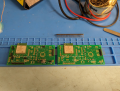
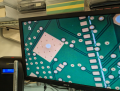
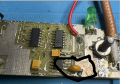
After over half a dozen 0402 10nF capacitors went flying off into never never land, I finally got one installed. Only to test it and find that the solder shorted it. In frustration, I put a standard through hole cap in its stead. Damn good thing I had room or I'd be screaming loud enough for everyone to hear!
1702758985328.png

Getting signal now out of the SA555 so on to troubleshooting the rest of the circuit!
 

Irving

Joined Jan 30, 2016
4,995
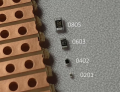
Why are you using 0402 for hand soldering??? 0805 is reckoned to be the smallest you can easily hand solder. I only use 0402 and 0201, & reluctantly if I have to, with a stencil, solder paste and a reflow oven or my DIY hotplate!
 

Thread Starter

SamR

Joined Mar 19, 2019
5,470
I didn't design this board! I'm just trying to put it together and the designer thinks nothing of using 0402 parts! I agree, I can handle 0805 and up well enough. I can't even see 0402s without wearing a magnifying visor.
 

nsaspook

Joined Aug 27, 2009
16,249
I didn't design this board! I'm just trying to put it together and the designer thinks nothing of using 0402 parts! I agree, I can handle 0805 and up well enough. I can't even see 0402s without wearing a magnifying visor.
I only use 0402 parts on boards designed for hand soldering on RF bypasses and components that need the smallest loop path.
1702766575504.png
No reason to use that tiny of a part of the PCB you posted. Malpractice IMO. ;)
 

WBahn

Joined Mar 31, 2012
32,702
I've done nearly all my PCB soldering under a binocular microscope with a good Metcal for years -- I got them real cheap when TRW went out of business in the Springs and if I've got them, there's no point not to use them. Even working with 0201 isn't super bad. But I would probably be screaming, too, if I had to do anything smaller than 0603 without them.
 

Thread Starter

SamR

Joined Mar 19, 2019
5,470
I have the Elmo "Scope" but I guess I really need to talk to my doctor about "Essential Tremor". I never had perfect eye-hand coordination but the tremor doesn't help at all. If I wasn't so far into this project already, I'd probably redesign the board. But there are only 3 0402s on the board and they are in place now albeit the cap now being a stubbed on through hole. The other 2 are resistors and test fine. The timer is working so now I have to get the CD4013 and CD74HC4066 switching. I did tin the board but maybe not enough so I added solder to the traces but still getting some high resistance between points that shouldn't be there so maybe some resoldering is still needed. Anyway, I've vented my rant over 0402 frustrations...
 

nsaspook

Joined Aug 27, 2009
16,249
I've done nearly all my PCB soldering under a binocular microscope with a good Metcal for years -- I got them real cheap when TRW went out of business in the Springs and if I've got them, there's no point not to use them. Even working with 0201 isn't super bad. But I would probably be screaming, too, if I had to do anything smaller than 0603 without them.
I've got all the equipment and the soldering skills, I just have better things to do than to tweeter 0402 parts on a board that doesn't really need them. These are 0402 10pf EMI filter caps on signal lines from the WFI chip.
1702796195150.png
1702796217622.png

It's a lot more fun to install devices that need precision soldering.
1702796316712.png
Solder wash and ball up solder pads on the board and device.
1702796340241.png
Flux the balls, flip it over and align.
1702796368886.png
Heat gun the board and module until the solder pulls the device flat and into place.

For larger device ground pads I like to add a plated hole to make sure there's a good solder connection that's easy to solder from the back side.
1702796724747.png
1702796778275.png
 

Ya’akov

Joined Jan 27, 2019
10,226
For hand soldering 0402 components, sticky tacky* flux is your friend. Sometimes, hot air is as well, if the component density is not too high. A nice covering of sticky tacky flux can make using hot air on even dense boards possible. It will just reflow the other components so long as you cover the area where the hot air will be heating.

It’s like magic when the components slide themselves into place on the pads. I never get tired of that little dance.

*I said "sticky", my excuse is that I am still recovering from COVID I've been coughing with short periods of rest in between. Precisely, the best I've found is AMETCH NC-599-V3-TF (or AMTECH NC-599-ASM-TF [old formula]), but I would recommend against AMTECH NC-599-V2-TF which is a different formulation with a number of negative attributes.
 
Last edited:

Thread Starter

SamR

Joined Mar 19, 2019
5,470
I used copious amounts of rosin flux that had dried a bit and gone very tacky to help hold them in place. My big problem is trying to hold it in place to solder it. I use self-closing tweezers with semi-fine ceramic prongs but the darn things keep popping out and going who knows where. Between that and my hand tremors it gets very frustrating. Haven't tried hot air yet. The timer is putting out a very short negative pulse but the 180k resistor is not reading correctly so I'm going to have to replace it and might just stub in a 1/4W through hole. Also, the CD4013 is not flip flopping and the signal seems to be going to ground and pulling high current. It idles @14mA but hits the 20mA current limit and pulls down the voltage every time the timer triggers. I ran it up to 40mA and it was still pulling it down so something is wrong. Putting together a breadboard circuit now to do some testing.

EDIT: The breadboarded ckt is flip flopping so it looks like the CD4013 is fried. I get a negative pulse from the 555 every 3.1sec and it is driving the 4013 on the breadboard. Ah well...
 
Last edited:

Ya’akov

Joined Jan 27, 2019
10,226
I used copious amounts of rosin flux that had dried a bit and gone very tacky to help hold them in place. My big problem is trying to hold it in place to solder it. I use self-closing tweezers with semi-fine ceramic prongs but the darn things keep popping out and going who knows where. Between that and my hand tremors it gets very frustrating. Haven't tried hot air yet. The timer is putting out a very short negative pulse but the 180k resistor is not reading correctly so I'm going to have to replace it and might just stub in a 1/4W through hole. Also, the CD4013 is not flip flopping and the signal seems to be going to ground and pulling high current. It idles @14mA but hits the 20mA current limit and pulls down the voltage every time the timer triggers. I ran it up to 40mA and it was still pulling it down so something is wrong. Putting together a breadboard circuit now to do some testing.

EDIT: The breadboarded ckt is flip flopping so it looks like the CD4013 is fried. I get a negative pulse from the 555 every 3.1sec and it is driving the 4013 on the breadboard. Ah well...
The tacky¹ flux² I am talking about is made for rework. You only have to position the component over the cleaned or newly tinned pads and apply heat. The natural surface tension of the solder literally pulls the component onto the pad. You basically have the part embedded in the flux, and while hot air is more "hands off" it works with an iron after just a little practice.

I searched YouTube for a nice visual but couldn't find anything that wasn't part of much larger video. If I can get catch a break from coughing I will try to post something for you.

1. I said "sticky", my excuse is that I am still recovering from COVID I've been coughing with short periods of rest in between.
2. The link is to AMTECH NC-599-V3-TF flux, this is the latest formula. You will also fine AMTECH NC-599-V2-TF listed, you don't want that. The V3 flux is an update of NC-599-ASM-TF which has several advantages over the V2 formula. It is less volatile with a better shelf life, it has a UV tracer in it if you want to check cleaning, and it can be used for both Sn/Pb and well as RoHS compliant alloys while V2 can't be used with lead free.
 

BobTPH

Joined Jun 5, 2013
11,463
I solder them this:

Melt a tiny layer (mound) of solder on one pad.

Holding the component with tweezers, slide it into position across the other pad, while melting the solder in the first pad with the iron.

Remove the soldering iron and the component should stick to the pad with solder.

Let it cool a bit.

Now solder the other pad.

Let it cool, then solder the first pad.
 

nsaspook

Joined Aug 27, 2009
16,249
I solder them this:

Melt a tiny layer (mound) of solder on one pad.

Holding the component with tweezers, slide it into position across the other pad, while melting the solder in the first pad with the iron.

Remove the soldering iron and the component should stick to the pad with solder.

Let it cool a bit.

Now solder the other pad.

Let it cool, then solder the first pad.
That's my technique too for hand soldering.

If you know that board is going an assembly house, then go for broke on the tiny parts they have and use for auto-placement.
1702829007827.png
In comparison to normal 0.1" stripboard

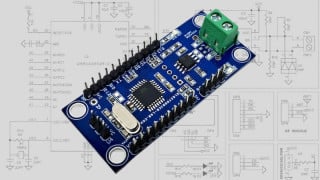
I design the vast majority of my (prototype/diy) boards with easy build-ability and repair-ability/rework in mind (building without paste, stencil and can use less precise solder skills/tools) for a somewhat older technical person. Unless there is a 'real' size or RF constrain I seldom use 0402 or smaller parts and I like to space the digital devices, 0805 (and/or 1206) parts for easy solder placement and normally only use 0603 LEDs for power and signal indicators.

If you need to hand solder 0805 or smaller parts I might be a good idea to slightly modify the default footprint in your design tool. Some of the defaults are horrible because the solder pads are larger than the IPC 7351 PCB footprint standard.

https://www.worthingtonassembly.com...g-with-a-manufacturer-the-best-0402-footprint
 

nsaspook

Joined Aug 27, 2009
16,249
Critique: move the silkscreen off the pads, and tent your vias.
Yes (already done, make it pretty after you know it works), and yes (won't be done). It's a $5 dollar for 5 JCL prototype special with extra for gold ENIG finish plating, those gold plated vias are fine for the application.
1702832375560.png
First board specifications.
 
Last edited:

Wolframore

Joined Jan 21, 2019
2,619
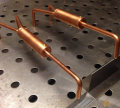
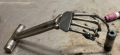
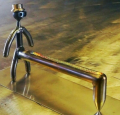
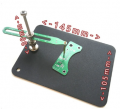
Make a couple of tools like (but smaller) this to hold down the tiny passives while you solder - use stainless bicycle spokes and solder some brass for weights. You can solder stainless steel but need an aggressive flux with phosphoric acid. Perhaps you can drill and tap.

It's called a welders third hand -
1702998369747.png
They come in various forms:
1702998989831.png

1702999124586.png

1702999019314.png
 

Thread Starter

SamR

Joined Mar 19, 2019
5,470
I finished the board and it is flip flopping on the bench. The schematic had the darn LEDs in backwards and I didn't catch it and had to redo them. But, when I shoehorned it into its enclosure things went wonky so I'm still working on it...

@Wolframore that would certainly help. With my tremors trying to hold it in place with fine pin bent tweezers doesn't work for me. Even if I'm just hold it down in place with the tweezers on top of the component. I brace my hand as much as I can to reduce the tremors but... I'll avoid 0402s as much as possible from now on.
 
Last edited:
Top