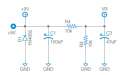
I blew a 1N4148 diode?!?

Thread Starter

rpschultz

Joined Nov 23, 2022
808
How does one blow a diode? Apparently, I did. I measured 1/2V across a new one in continuity/diode checking mode. But then the one I blew was open in both directions. Not sure how I did it. This is a polarity protection diode on a 9V guitar pedal circuit. Typical 9v supplies put out 9.3-9.6vdc.
 

Thread Starter

rpschultz

Joined Nov 23, 2022
808
Hmmm. The LED came on every so briefly when I turned on the PS, that's when it blew. I must have had something shorted on my bench - causing over current? Oh well. I replaced it and all is well. Thanks.
 

MisterBill2

Joined Jan 23, 2018
27,159
I would not use a small signal diode as a reverse polarity protection diode because it wouold fail open with just a bit too much forward current. A 1N4001 is good for an amp and in that aspect is a much better choice. Plus, it is physically more rugged, and easier to see the markings..
 

Reloadron

Joined Jan 15, 2015
7,850
How does one blow a diode? Apparently, I did. I measured 1/2V across a new one in continuity/diode checking mode. But then the one I blew was open in both directions. Not sure how I did it. This is a polarity protection diode on a 9V guitar pedal circuit. Typical 9v supplies put out 9.3-9.6vdc.
Diodes like the 1N4148 or 1N914 are small signal fast switching diodes. The 1N4148 is a poor choice for a reverse polarity protection where a diode like the 1N4000 series would be a better choice. This is the data sheet for the 1N4148 diode. Diodes cook from excessive current and as mentioned exceeding breakdown voltage. In a reverse polarity scheme the diode goes into conduction and after about 500 mA the diode is toast.

Ron
 

Thread Starter

rpschultz

Joined Nov 23, 2022
808
I’m learning. I’ve always used a 1N4001 in my own circuits that I design, probably from suggestions on this forum. But when I build circuits designed by other people, I just blindly follow their schematic. Now at least I understand those a bit better.
 

MisterBill2

Joined Jan 23, 2018
27,159
I advise at least trying to understand a circuit before building it, both for the learning part and also for catching errors that happen in creating the drawing. Even good printers make an occasional mistake. AND, some ideas just will not work.
 

Thread Starter

rpschultz

Joined Nov 23, 2022
808
Well I understand the circuit, knew it was a polarity protection diode. Just didn’t understand the difference between 1N4148 and 1N4001.
 

BobTPH

Joined Jun 5, 2013
11,463
Continuous is for a steady DC current.
Average is for a rectified sine-wave.
Thanks!

If is 150 mA
If(av) is 300 mA

So, since it is conducting only half the time, the RMS current during the half cycle could be 600 mA? Or is it 300 mA averaged over the half cycle, giving you the same 150 mA averaged over the full cycle?
 

crutschow

Joined Mar 14, 2008
38,316
A diode's dissipation is only slightly proportional to the RMS current, since its forward drop is logarithmic with current, with a small ohmic component.
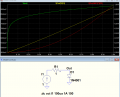
Below is the sim of a diode and resistor dissipation for the same current:
You can see that the resistor dissipation (red curve) follows the expected RMS (current-squared) value, while the diode dissipation (yellow curve) is close to linear.

1705850499520.png

This from a Toshiba paper:
IF(AV) is the maximum average current of a half sine wave (with a conduction angle of 180°) with the utility frequency (50 Hz or 60 Hz) that a diode can conduct at the specified temperature or the average forward current of a rectangular wave that a diode can conduct under the specified conditions.
 
Last edited:

Thread Starter

rpschultz

Joined Nov 23, 2022
808
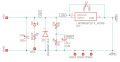
I've noticed 2 different ways polarity protection is done in guitar pedal circuits. The circuit referenced in post #1 is a reverb from Scientific Guitarist, it uses a 1N4148 diode across the rails, acting as a short if the polarity is wrong, and blocking the short if hooked up correctly. Seems to me if someone hooks it up wrong, you could spin up a lot of current in that loop accidentally. ?!?

1705852484787.png

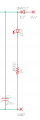
One of the circuits I designed has a 1N4001 inline with the 9v. Before I incorporated this into the PCB, I used the 1N4001 to connect the 9v jack directly to the PCB.

1705853002504.png

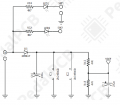
I often buy PCB's from pedalpcb.com and aionfx.com, guitar pedal pcb's. I've built over a dozen pedals from pcb's like this, sourcing my own parts and designing, building my own enclosure, etc. 1N5817's are very (extremely) common for this purpose. Here is a PPCB circuit called Paragon, which is a clone of a well known guitar pedal called The King of Tone. The polarity protection diode is in series like the one I designed. PPCB appears to almost exclusively use a 5817 in series like this for all their designs.

1705853395025.png

Aion also uses the 5817 a lot, but here is an older circuit (Blueshift Boss DC-2 Chorus) that I built that uses a 1N4002 across the rails.

1705853660124.png

It seems like the 1n400x is more similar to the 1n5817 than the 1n4148, but I am a rookie in this regard and appreciate all the comments here.
 

sghioto

Joined Dec 31, 2017
8,633
Seems to me if someone hooks it up wrong, you could spin up a lot of current in that loop accidentally. ?!?
It will and the protection is only good if the the diode shorts out. If it opens then the circuit is no longer protected.
They used that reversed biased diode scheme a lot in CB radios I recall. The diode would short out and blow the 2 amp in line fuse but sometimes if the fuse was too large it would burn open a trace on the pc board and render the protection useless.
 

crutschow

Joined Mar 14, 2008
38,316
For minimum forward voltage drop, you can use an N-MOSFET in series with the input power, source to power supply, gate to ground, and drain to circuit, to protect the circuit from reverse voltage application.
The forward drop is just the MOSFET on-resistance times the circuit current.
 
Top