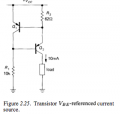
How will this circuit work...

Thread Starter

Himanshoo

Joined Apr 3, 2015
265
I got two queries...regarding this circuit....

1.Would the voltage across R2 always supposed to be Vbe_Q1 no matter what Vcc is?

2.In order to eliminate early effect in transistor Q2..is it necessary for Vce_Q1 to remain always constant ?
 

Attachments

Jony130

Joined Feb 17, 2009
5,598
1.Would the voltage across R2 always supposed to be Vbe_Q1 no matter what Vcc is?
R2 voltage will always be equal to Vbe_Q1. As so Vcc the circuit need Vcc >> 2Vbe to operate as current source.

2.In order to eliminate early effect in transistor Q2..is it necessary for Vce_Q1 to remain always constant ?
No, Vce2 need to be constant.
In this circuit Vce_Q1 is already kept constant by VbeQ2.
Vce_Q1 = 2Vbe
 
Last edited:

Thread Starter

Himanshoo

Joined Apr 3, 2015
265
R2 voltage will always be equal to Vbe_Q1. As so Vcc the circuit need Vcc >> 2Vbe to operate as current source.


No, Vce2 need to be constant.
In this circuit Vce_Q1 is already kept constant by VbeQ2.
Vce_Q1 = 2Vbe
can we say that a constant Vce_Q1 maintains a constant Vb_Q2 which further makes Vbe_Q2 constant..
 

Thread Starter

Himanshoo

Joined Apr 3, 2015
265
Until the temperature changes by even a fraction of a degree C which effects the collector current.

This is a pretty crummy current-source.
If we want to add temparature dependency to this circuit then how can we modify the circuit...?
 

Thread Starter

Himanshoo

Joined Apr 3, 2015
265
No modification needed: it's already temperature-dependent, with an output current tempco of approx. -35 microamps per degree C.
I'll like to correct myself....
what if ..if we want circuit to be temparature independent....what could be the modifications then..?
 

OBW0549

Joined Mar 2, 2015
3,566
I'll like to correct myself....
what if ..if we want circuit to be temparature independent....what could be the modifications then..?
If you want a current source which is stable over temperature it would be best to start over with a completely different approach; if you Google "precision constant current source" you will see many possibilities.

The Vbe-referenced constant-current source has its uses: it's fine for biasing Zener diodes when the input supply voltage varies over a wide range, or for driving low-power LEDs under the same conditions; and that same two-transistor topology with an emitter resistor is sometimes used to provide current limiting in DC power supply designs and to protect power audio amplifiers from output short circuits. But beyond that, as MikeML commented it does a rather poor job as a constant current source.
 

WBahn

Joined Mar 31, 2012
32,828
R2 voltage will always be equal to Vbe_Q1. As so Vcc the circuit need Vcc >> 2Vbe to operate as current source.


No, Vce2 need to be constant.
In this circuit Vce_Q1 is already kept constant by VbeQ2.
Vce_Q1 = 2Vbe
How can Vce2 be made to be constant. Ve2 is fixed at about one diode drop below the upper rail. If Vce2 is held constant, that means that Vc2 is fixed relative to the lower rail, which means that the voltage across the load is fixed, which means that the current through the load will be inversely proportional to the load resistance. Not what you want in a current source.
 

WBahn

Joined Mar 31, 2012
32,828
Until the temperature changes by even a fraction of a degree C which effects the collector current.

This is a pretty crummy current-source.
Since R2 is connected across the base-emitter junction of Q1, how is it possible for the voltage across R2 to be anything OTHER than Vbe_Q1?
 

WBahn

Joined Mar 31, 2012
32,828
I'll like to correct myself....
what if ..if we want circuit to be temparature independent....what could be the modifications then..?
To answer that question, you need to first consider what is "good enough" to be considered "temperature independent". Do you mean that if you change the temperature by 100°C that the current doesn't change at all? Not even by 1 picoamp? If it changes by 1% over that extreme a temperature swing would that be considered sufficiently independent of temperature?
 

WBahn

Joined Mar 31, 2012
32,828
I got two queries...regarding this circuit....

1.Would the voltage across R2 always supposed to be Vbe_Q1 no matter what Vcc is?
By definition, the voltage across R2 will always be equal to Vbe_Q1 for the simple reason that R2 is connected directly across the base-emitter junction of Q1, so (ignoring the voltage drops in the connecting wires), they HAVE to have the same voltage across them.
Now, the real question is whether that voltage itself is constant and the answer is no. It will vary with Vcc and it will vary with temperature (as well as varying with the type of transistor and with the exact transistor that happens to be in that circuit). The second, even more "real" question is whether that voltage is constant enough for your purposes.


2.In order to eliminate early effect in transistor Q2..is it necessary for Vce_Q1 to remain always constant ?
Yes and no. It's not that Vce_Q1 needs to remain constant in and of itself. What needs to remain constant is the voltage across R2. Ignoring temperature affects for the moment, that means that we need the voltage at the base of Q2 to be constant. THIS is what then dictates that we want Vce_Q2 to be constant.

Your Vbe_Q2 is going to change by about -2.2mV/°C. That difference is going to appear across R2 and be manifested as a change of about (-2mV/°C)/(62Ω)=35.5μA/°C.

That represents 0.35% of your nominal current per degree Celsius. Thus you would expect your output to change by 1% for roughly every 3°C of temperature change. That may or may not be good enough for your purposes.
 

Thread Starter

Himanshoo

Joined Apr 3, 2015
265
By definition, the voltage across R2 will always be equal to Vbe_Q1 for the simple reason that R2 is connected directly across the base-emitter junction of Q1, so (ignoring the voltage drops in the connecting wires), they HAVE to have the same voltage across them.
Now, the real question is whether that voltage itself is constant and the answer is no. It will vary with Vcc and it will vary with temperature (as well as varying with the type of transistor and with the exact transistor that happens to be in that circuit). The second, even more "real" question is whether that voltage is constant enough for your purposes.


Yes and no. It's not that Vce_Q1 needs to remain constant in and of itself. What needs to remain constant is the voltage across R2. Ignoring temperature affects for the moment, that means that we need the voltage at the base of Q2 to be constant. THIS is what then dictates that we want Vce_Q2 to be constant.

Your Vbe_Q2 is going to change by about -2.2mV/°C. That difference is going to appear across R2 and be manifested as a change of about (-2mV/°C)/(62Ω)=35.5μA/°C.

That represents 0.35% of your nominal current per degree Celsius. Thus you would expect your output to change by 1% for roughly every 3°C of temperature change. That may or may not be good enough for your purposes.
Does output current( I load) depends on supply voltage..??
Well i think that it should and should not..
*It should because with increasing the power supply voltage current flow in Q1 increases which increase the voltage drop at the base emitter junction of Q1 to some extent..as I-V curve of diode is exponential.
Any change in Vbe_Q1 changes Iload.
*It should not because the exponential increase in voltage across base emitter junction is not significant..
 

OBW0549

Joined Mar 2, 2015
3,566
Does output current( I load) depends on supply voltage..??
Yes. The current will vary somewhat with changes in supply voltage.

Well i think that it should and should not..
*It should because with increasing the power supply voltage current flow in Q1 increases which increase the voltage drop at the base emitter junction of Q1 to some extent..as I-V curve of diode is exponential.
Any change in Vbe_Q1 changes Iload.
*It should not because the exponential increase in voltage across base emitter junction is not significant..
I think to end your confusion, and to keep yourself from going 'round and 'round in endless circles, it's important that you abandon this kind of "either/or", "all-or-nothing" thinking and realize that in any electronic circuit, everything affects everything else. ALWAYS.

The only question is, how much? Some effects are major; some are minor; some are minuscule; and some are so small as to exist only in theory, being unmeasurable by any practical means.

In the case of this circuit, Iout will vary slightly with changes in Vcc, primarily because as Vcc increases Q1 has to conduct more to take up the extra current going through R1, and that in turn means that Q1's base-emitter voltage has to increase slightly, meaning more output current.

Always ask, "How much effect is there?", rather than "Is there an effect, or not?"
 

Thread Starter

Himanshoo

Joined Apr 3, 2015
265
No we cannot say that. Because Vce_Q1 = VbeQ1+VbeQ2, therefore Vce_Q1 will vary along with Vbe.
What about load variation ....if load changes then it will affect Vce_Q2..which will further changes Vbe_Q2..and hence according to relation --->Vce_Q1 = VbeQ1+VbeQ2 ..if Vbe_Q2 gets affected it will change Vce_Q1....but this change in Vce_Q1 should be in opposite direction of change in Vce_Q2 in order to compensate a change in Vce_Q2 to make it relatively constant for constant current source operation..
am i right?
 

MikeML

Joined Oct 2, 2009
5,444
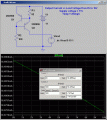
Let's see what LTSpice and its transistor models say:

First, here is the variation in output current vs load voltage:
196i.gif
Note that the change is 0.7uA per V out of a nominal 10.48mA; not bad...
__________________________________________________________

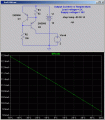
Now for the bad news. Here is the variation of output current vs temperature:
196t.gif
If this circuit is used as a constant-current source LED driver, it automatically reduces LED current at high temperatures, preventing thermal runaway...
__________________________________________________________

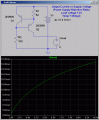
Here is the Power Supply Rejection Ratio (Variation of output current vs supply voltage):
196p.gif
Not horrible, but not too good, either...

ps. I guess that is really not technically PSSR, it is actually transconductance
 
Last edited:
Top