How wide is the river?

BR-549

Joined Sep 22, 2013
4,931
How far did the boat travel for intersection on way over? 720m. Now start form the other shore and come back....you will intersect 720m from that other shore. AND at that point you are 400 meters to original starting shore.

Edit: I would be scarred to death to see an academic solution.
 
Last edited:

WBahn

Joined Mar 31, 2012
32,890
I can't figure out how boat a can leave west bank....intersect at 720 m.................Hit east bank...which is the OTHER side.......then only intersect 400 m from the OTHER side????????????? I could understand being 400 m from the near side..........but not the other side.

Is this length contraction?

near and other are bad words.
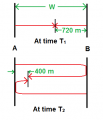
For heaven's sake, draw a picture!

Boats.png
We have Bank A and Bank B.

Let's arbitrarily, and without loss of generality, declare that the faster boat, Boat A, leaves from Bank A. Since the Boat A is traveling faster than Boat B, it will reach the midpoint first, hence when the two boats meet at time T1, they will be closer to Bank B. Therefore Bank B is the "nearer" bank to the crossing point and Bank A is the "other" bank. They are perfectly reasonable labels.

At a later time T2, each boat has reached the opposite shore, waited 10 minutes, and departed for their respective shores of origin but cross again.

The distances that the respective boats travel after time T1 are

(W - 720 m) = Va·T1
720 m = Vb·T1

We can eliminate T1 by taking the ratio of the two equations:

(W - 720 m) / (720 m) = Va / Vb

The distances that the respective boats travel after time T2 are

(W + (W - 400 m)) = Va·T2
(W + 400 m) = Vb·T2

We can eliminate T2 by taking the ratio of the two equations:

(W + (W - 400 m)) / (W + 400 m) = Va / Vb

Since the speeds are constant, the ratios of them are constant, hence

(W - 720 m) / (720 m) = (W + (W - 400 m)) / (W + 400 m)

Cross multiplying yields

(W - 720 m) · (W + 400 m) = (2·W - 400 m) · (720 m)

Multiply out

W² + (400 m)·W - (720 m)·W - (720 m)·(400 m) = 2·W·(720 m) - (400 m)·(720 m)

Bring everything to one side

W² - (2·720 m + 720 m - 400 m)·W = 0

W² - (1,760 m)·W = 0

Divide by W, which we know is not equal to zero.

W - 1,760 m = 0

Solve for W

W = 1,760 m
 

WBahn

Joined Mar 31, 2012
32,890
I get 1760m too.
We assume there is no river current.
Also the 10 minute turn-around is a distraction, right?;)
Yes and no.

You can imagine a case where the faster boat gets to the other shore, waits, heads back, and overtakes the slower boat before it finishes its first crossing of the river. But the problem says that they "cross" again, which argues against one overtaking the other, but that's debatable. More strongly, however, the problem says that both boats wait for ten minutes before coming back and then cross again. It's pretty hard -- but not impossible -- to interpret the problem wording as not requiring both boats to have completed their 10 minute layovers, in which case it becomes a distraction. More to the point, if the 10 minutes value does matter, then there isn't enough information to solve the problem because now the crossing points are no longer timescale-invariant.
 

BR-549

Joined Sep 22, 2013
4,931
720 m is the travel intersection length on boat A. On the second crossing the problem tells you that you are 400 m from shore at that intersection. That 400 m is the travel intersection length of boat B. A+B=W
 

WBahn

Joined Mar 31, 2012
32,890
720 m is the travel intersection length on boat A. On the second crossing the problem tells you that you are 400 m from shore at that intersection. That 400 m is the travel intersection length of boat B. A+B=W
Please draw a picture that supports this fantasy.
 

BR-549

Joined Sep 22, 2013
4,931
Seriously? Ok. Draw a west bank vertical line. 6 inches to the right draw a east bank vertical line.

Cut a 6" strip of paper that will connect the banks. Cut the strip 1 inch from east bank. Mark the short piece X. Cause we don't know the length yet. Mark the long piece 720. Now take the 720 and place it on east bank going west. The problem says that from this intersection(which is the tip of paper) it is 400 m from shore. So 400 is length of small paper(boat).

The 720 and the 400 boats always have same intersection length.
 

WBahn

Joined Mar 31, 2012
32,890
Seriously? Ok. Draw a west bank vertical line. 6 inches to the right draw a east bank vertical line.

Cut a 6" strip of paper that will connect the banks. Cut the strip 1 inch from east bank. Mark the short piece X. Cause we don't know the length yet. Mark the long piece 720.
Why are you marking the LONG piece as 720 m? The problem very clearly states that 720 m is the SHORTER distance for the first crossing.

Now take the 720 and place it on east bank going west. The problem says that from this intersection(which is the tip of paper) it is 400 m from shore. So 400 is length of small paper(boat).

The 720 and the 400 boats always have same intersection length.
This is just pure babble. There is NOTHING about the first crossing that has ANYTHING to do with the second crossing. They are separate and independent events.
 

BR-549

Joined Sep 22, 2013
4,931
"The problem very clearly states that 720 m is the SHORTER distance for the first crossing."

I don't read that. It doesn't say that 720 m is the short length. 720 m to nearest shore, not the farthest shore. The nearest shore is the starting reference....the other shore is the farthest shore. If the 720 m is to the far shore........when I intersect going back....I would need to be 720 m from returning shore too. But it's not.......at return intersection, it is only 400 m.

Both boat intersection lengths are constant. This does not mean the intersection location is.
 

Thread Starter

Hymie

Joined Mar 30, 2018
1,347
WBahn has calculated the correct answer using derived mathematical formula (from the information in the question) – well done.

But a simpler, logical solution is obtained through analysis of the problem thus:-

When the boats first cross, between them they have travelled the width of the river; when they each reach their opposing shore, their combined travelled distance will be twice the width of the river – and when they cross for a second time, their combined travelled distance will be three times the width of the river.

So when the boats cross for the second time, the total distance travelled by each boat will be three times the distance travelled when they first met.

The slower boat had travelled 720 metres at the first meeting, so its total travelled distance is 720 metres x 3 = 2160 metres. At the second crossing, the slower boat has traversed the river once, plus a distance of 400 metres – so the width of the river is 2160 – 400 = 1760 metres.

As MrChips says, the 10 minute turn-around in the question is irrelevant.
 
Last edited:

BR-549

Joined Sep 22, 2013
4,931
Listen closely please. I get in boat A and stop when we intersect with boat B. Boat B says he has come 750 m. from his shore. WBahn version.

Now continue to opposite shore. Head back now to intersect boat B again on return trip. He will tell you that he has come 720 m. from his shore again. His intersection length...and my intersection length Never vary.

But in the problem......boat B does not tell me. The 720 m. has to be one of the boat lengths. But B boat tells me the distance to next shore was only 400 m. from intersection. This means that his first intersection distance was 400 m. also. That means the 720 m figure given has to be boat A distance, not boat B distance.


Does that make any sense?
 
Last edited:

Thread Starter

Hymie

Joined Mar 30, 2018
1,347
Listen closely please. I get in boat A and stop when we intersect with boat B. Boat B says he has come 750 m. from his shore. WBahn version.

Now continue to opposite shore. Head back now to intersect boat B again on return trip. He will tell you that he has come 720 m. from his shore again. His intersection length...and my intersection length Never vary.

But in the problem......boat B does not tell me. The 720 m. has to be one of the boat lengths. But B boat tells me the distance to next shore was only 400 m. from intersection. This means that his first intersection distance was 400 m. also. That means the 720 m figure given has to be boat A distance, not boat B distance.


Does that make any sense?
No.
It should be abundantly clear from the diagram in Wban’s post #22 – where the crossings are occurring in relation to the river banks/shores.
 

BR-549

Joined Sep 22, 2013
4,931
There are no curves and there is no time in this problem. It's two constant straight line segments for crying out loud.

You got to be kidding.
 

MrChips

Joined Oct 2, 2009
34,829
Suppose the speed of the faster boat is Va and that of the slower boat is Vb.
Let us assume that there is no time delay in the turn-around.
If Va is twice Vb, the fast boat will get back at the same time when the slow boat just completes the first crossing, i.e. there is no overtaking and there is no second passing.

I suspect the 10-minute delay was added to suggest that the slow boat was allowed extra time to begin its return crossing. However, by stating that the boats "cross" a second time and not "pass" suggests that there is no overtaking. Hence the 10-minute turn-around is irrelevant.

W = width of river
Va = speed of one boat
Vb = speed of second boat
t1 = time of first meetup
t2 = time of second meetup

The combined speed of the two boats = Va + Vb
Time of 1st meetup = t1 = W / (Va + Vb)

If we ignore the 10-minute turnaround delay:
Time of 2nd meetup = t2 = 3W / (Va + Vb)

Hence t1/t2 = 1/3

At 1st meet up, distance travelled by fast boat is
Va x t1 = W - 720

Distance travelled by slow boat is
Vb x t1 = 720

(Va - Vb) x t1 = W - 720 - 720 = W - 1440

At the second meetup,
total distance travelled by fast boat is
Va x t2 = 2W - 400

total distance travelled by slow boat is
Vb x t2 = W + 400

(Va - Vb) x t2 = 2W - 400 - (W + 400) = W - 800

t1 / t2 = (W - 1440) / (W - 800)

From previous equation, t1 / t2 = 1/3
Hence,

(W - 1440) / (W - 800) = 1 / 3
3W - 4320 = W - 800
2W = 3520
W = 1760
 

WBahn

Joined Mar 31, 2012
32,890
Listen closely please. I get in boat A and stop when we intersect with boat B. Boat B says he has come 750 m. from his shore. WBahn version.

Now continue to opposite shore. Head back now to intersect boat B again on return trip. He will tell you that he has come 720 m. from his shore again.
And WHY would he say such a thing!

Supposed I left Los Angeles to go to the New York and back and you left New Work to go to Los Angeles and back. We cross paths in Denver. Now we carry on. I get to New York and staying for a day, and then head home. You get to Los Angeles and stay for a day and then head home. We cross paths again in Chicago. Are you really going to claim that you are still in Denver!
 

WBahn

Joined Mar 31, 2012
32,890
There are no curves and there is no time in this problem. It's two constant straight line segments for crying out loud.

You got to be kidding.
The curves are only there to show the distinct segments in each direction. Draw them on top of one another if you want to.
 
Top