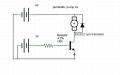
The microcontroller provides only 3mA. The datasheet of the transistor gives different ß (or h how they call it) for different Ic current and with 10V.
But the microcontroller only supplys 3.3V so I don't know which value for ß I can use to calculate.
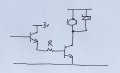
Using this circuit, the first transistor you don't need even to think about its Hfe. The current it takes from the processor will be small enough.
The second transistor is being operated as a switch, so refer to the "saturation characteristics" in the datasheet, and you will see that Ib will be Ic/10.
R will then be (3.3V-0.6V-0.6V)/Ib
If so, the micro is going to struggle to provide the 20mA drive. I would therefore suggest (in the absence of a suitable low-threshold FET) an emitter follower to drive the output transistor - with its collector connected to 3V, rather than a darlington which would have a higher voltage drop.
You need Ib=1c/10 in the main transistor, which is 20mA for a 200mA load.
The emitter follower is in its linear mode, so its Hfe will be closer to the datasheet value of 75.
so it requires 20mA/75 to give 20mA output, that's 266uA.
But Vce is not 10V as in the datasheet, so its gain will be somewhat less, but your micro pin can probably supply 4mA, so it would have to be a lot less than 75 to cause a problem. The actual value is unpredictable, you just have to take the worst value and make sure it is good enough.
Bearing in mind that the base current also contributes to the emitter current, the gain only has to be better than 1.5, and you can be sure it will manage that.
The 1/10 rule is a engineering tool that is guaranteed to work the first time, since you are so close to the range you could audition a transistor and see if it works. There is a good chance it will. Just be prepared for the possibility it won't.

 Facebook
 Google
 GitHub
 Linkedin