How to Trigger a 555 monostable With opamp output Edges

Thread Starter

bleedfeed

Joined May 21, 2025
1
I am trying to trigger a 555 timer using a daylight detector. For daylight detector I planned using a comparator with a potentiometer and a photoresistor. I will be comparing the voltage difference and comparator would turn on or off depending on the amount of light photoresistor gets. The problem I have is I need to run a 555 timer in monostable mode with the output from the comparator. When the comparator output turns off 555 timer should be triggered, and when the comparator turns back on, the 555 timer should be triggered again. The problem is I dont know how to generate a Pulse to trigger the 555.
 

Ian0

Joined Aug 7, 2020
13,097
You can do this with a 555, if you must.
But a 74HC221 would do the job a lot better. It has edge triggered inputs and each monostable (there are two in the IC) can be triggered by a negative or a positive going edge.
So connect a negative trigger from one and a positive trigger from the other to the output of the comparator, then OR the two monostable outputs.
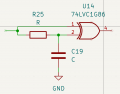
If you must use a 555, then you need a dual edge detector on the output of the comparator to trigger the 555.
Screenshot from 2025-05-21 20-47-03.png
 

Jerry-Hat-Trick

Joined Aug 31, 2022
775
The problem I have is I need to run a 555 timer in monostable mode with the output from the comparator.
May I ask, what is the 555 output actually doing? From what you decribe, the output of the 555 will not allow you to distinguish between falling and rising light levels. Also, with light levels varying during daylight, one might expect frequent triggers around the set point which could be mitigated if required with some hysteresis.
 

crutschow

Joined Mar 14, 2008
38,316
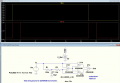
Here's the LTspice sim of a XOR circuit configured to generate an output pulse (red trace) on the leading and trailing edges of an input pulse (yellow trace):

The XOR circuit is formed from a CMOS quad Schmitt-trigger NAND-gate package to avoid any oscillations from the slow rise/fall of the RC circuit voltage.
The pulse-width is determined by the R1C1 time-constant.

R3 is just to protect the inputs from possible excess input current from the capacitor if power is removed while the capacitor is charged.

1747944117069.png
 
Last edited:

sghioto

Joined Dec 31, 2017
8,633
When the comparator output turns off 555 timer should be triggered, and when the comparator turns back on, the 555 timer should be triggered again. The problem is I dont know how to generate a Pulse to trigger the 555.
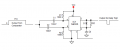
If you must use a 555 this circuit works.
May need to invert the output depending on requirements.
Ct and Rt determine the time delay when triggered.
1748741725233.png


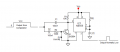
More conventional configuration with the output normally LOW.
1748740220109.png
 
Last edited:

MisterBill2

Joined Jan 23, 2018
27,164
I am trying to trigger a 555 timer using a daylight detector. For daylight detector I planned using a comparator with a potentiometer and a photoresistor. I will be comparing the voltage difference and comparator would turn on or off depending on the amount of light photoresistor gets. The problem I have is I need to run a 555 timer in monostable mode with the output from the comparator. When the comparator output turns off 555 timer should be triggered, and when the comparator turns back on, the 555 timer should be triggered again. The problem is I dont know how to generate a Pulse to trigger the 555.
I was going to suggest a CD4049 hex inverter string with a capacitor in series with a diode to deliver a positive pulse on the rising edge, which would be on successive inverters driven by whatever is producing the pulses. OR use a CD40106 schmitt inverter to give square edges.
BUT it makes more sense to use a logic device made to trigger with either rising or falling levels That would be a MC14528 or MC14538 Dual "one-shot" I have used those quite successfully when triggered by analog levels. BUT some brands work much better than others.
BUT also consider that adding some hysteresis to the comparator circuit will assure a solid state change without oscillation.
 
Top