How to stop Tip122 from getting hot

crutschow

Joined Mar 14, 2008
38,529
Using a three terminal regulator will produce the same heat as the TIP.
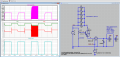
If I understand post #25 correctly, the excess heat was from the circuit oscillating.
The regulator heat from the current for two 12V relays is likely in the neighborhood of a watt, so it should be mounted on a small heat-sink.
 

ElectricSpidey

Joined Dec 2, 2017
3,335
I agree, but the current needed by the relays was never stated and "hot" is a relative term.

Also there is no way to know if the sim represents the actual circuit, so I was simply suggesting a way to make the original circuit work, as I have used follower circuits a great deal over the years without any problems.
 

Papabravo

Joined Feb 24, 2006
22,084
I agree, but the current needed by the relays was never stated and "hot" is a relative term.

Also there is no way to know if the sim represents the actual circuit, ...
I agree since I have no idea what the actual parameters of the relay are. It is however a great deal easier to see what is going on, assuming that I have rendered the original circuit accurately. My "REED SWITCH" might also going a bit faster than relay contacts can actually work.
 

sagor

Joined Mar 10, 2019
1,050
Most reed switches will NOT handle much current, usually a lot less that what those relays may be taking. Without specializations of the relays and reed switch, no one can say if your circuit will even work for a period of time.
 

ElectricSpidey

Joined Dec 2, 2017
3,335
The circuit looks correct, but the reed on and off times are a bit extreme, I'd like to see the sim run with longer times to see if those oscillations settle.

Also, with 40 ohm coils that puts the wattage near 7 watts without any oscillations.
 
Last edited:

Thread Starter

Don_Fila

Joined Nov 26, 2021
172
Most reed switches will NOT handle much current, usually a lot less that what those relays may be taking. Without specializations of the relays and reed switch, no one can say if your circuit will even work for a period of time.
20220129_170237.jpg
 

Thread Starter

Don_Fila

Joined Nov 26, 2021
172
The circuit looks correct, but the reed on and off times are a bit extreme, I'd like to see the sim run with longer times to see if those oscillations settle.

Also, with 40 ohm coils that puts the wattage near 7 watts without any oscillations.
Please I don't really understand this statement
 

ElectricSpidey

Joined Dec 2, 2017
3,335
Please I don't really understand this statement
The sim in post #25 is showing high wattage on the transistor, but I believe it's because of the relay value chosen and not the oscillations. If you notice the peaks are never above the expected wattage at steady state. (except for a very short spike)

Also the sim is running too fast to see if the oscillations ever subside.
 

Papabravo

Joined Feb 24, 2006
22,084
The circuit looks correct, but the reed on and off times are a bit extreme, I'd like to see the sim run with longer times to see if those oscillations settle.

Also, with 40 ohm coils that puts the wattage near 7 watts without any oscillations.
Here is a strange result. Double the resistance, decrease the switching frequency, increase the rise and fall times, give the coil more inductance and SOMETIMES it oscillates and sometimes it doesn't.

1643476736777.png
 

crutschow

Joined Mar 14, 2008
38,529
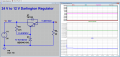
Below is the LTspice simulation of an LM317 regulator controlled by the reed relay.
The ON voltage is a nominal 12.1V (red trace) and the OFF voltage is about 1.3V, which will draw a small current through the relay coils, but that will not turn on the relays or leave them on.
The reed relay current (blue trace) is only about 9mA, so the relay should last for its rated number of operations.

1643483602518.png
 
Last edited:

Papabravo

Joined Feb 24, 2006
22,084
What will be the value of the resistor and Zener diode?
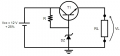
The TIP122 is not an ordinary transistor it is a Darlington pair as indicate in the simulation schematic. A disadvantage of the Darlington pair in this application is the higher Vce drop of 2-4 Volts depending on the current draw. The Vbe drop will be on the order of 1.4 Volts instead of the usual 0.7 Volt drop for a normal NPN transistor.
You want Ve (the voltage at the emitter) to be ≈ +12 volts. So adding 1.4 volts to that the Zener diode should be in the neighborhood of 14 Volts because they don't come in 0.5 volt steps. So if Vb (the voltage on the base) is 14 volts and the diode needs about 20 mA (typical Zener current) and we'll allow 1 for 1 mA of base current, you compute (24-14)/(0.021) ≈ 476 Ω, and the closest 1% value is 475 Ω. Give me a few minutes and I'll give you a schematic.

1643484186191.png

I(R1) is the current thru R1 which splits into Zener current and base current. the drop across U1 is 25 - 11.66 ≈ 12.34 Volts
AFAIK there don't seem to be any simulation modules for a 14V Zener. I could make one, but you probably won't be able to buy one. Still 11.66 V is pretty close to 12 volts.
 
Last edited:

sagor

Joined Mar 10, 2019
1,050
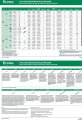
Well, nice table of reed switches, but you still don't answer the questions, what reed switch are you using, and what relays are you using. What is the current draw through each relay? It is possible your reed switch will handle the relay current, but no one knows that for sure since you have not given specifications for the relays.
Regardless, any heat from the transistor will have to be dissipated via some heatsink. Putting the relays in series is a possible solution, with no elaborate circuit required except your reed switch, assuming it is rated to handle the relay current.
 

crutschow

Joined Mar 14, 2008
38,529
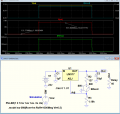
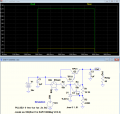
Here's a variation on Papabravo's circuit that uses a programmable TL431 reference instead of a Zener, which has feedback from R1 and R3 to more accurately regulate the output voltage (which is not really needed for this application, of course).
I didn't have the model for the TIP122 Darlington, so I used used two BJTs to emulate it.
I also included the reed relay to control the output from 0V to 12V, which carries less than 2mA when ON.

1643487786759.png
 

panic mode

Joined Oct 10, 2011
5,002
what a fascinating story this became ;-)

pair of 40 ohm coils are equivalent to a single 20 Ohm value which at 12V means current draw is 0.6A or 600mA so you may want to pick reed switch and regulator that are rated for 1A or more.

anyway, as stated before, reducing 24V to 12V using linear regulator is always going to result in heat proportional to output current and voltage drop across regulator.

therefore if the heat is the problem and you have to power 12V circuit from 24V source, using switching regulator is a way to go. just replace 7812 regulator with switching version such as VX78012-1000 or similar.
 
Last edited:

Papabravo

Joined Feb 24, 2006
22,084
It seems like the TS was trying to use parts on hand, rather than succumbing to the need to go out and spend actual money. He would have come around to that view eventually just like we all did at the beginning when constantly being presented with superior alternatives. Such is the evolution of expertise. One of my first design and build projects was a +5V supply, with a Zener and 2N3055. Fortunately I never had to power a CPU made from MSI TTL parts.
 
Top