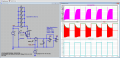
Well here it is. As you can see the TIP122 does not seem to be regulating much of anything which is hardly a surprise since there is no feedback. Top trace in pink shows the power dissipation which climbs from 0 to 6.7 watts in less than a millisecond, The dark trace in red means you have created a high frequency oscillator. I had to guess at the relay specifications, and if you have better information I'd be glad to update the simulation. Notice also how V(c), the collector voltage sags when the reed switch turns on and V(e) the emitter voltage bounces up and down between 0 and 16 volts. This is not what voltage regulation looks like.
Well here it is. As you can see the TIP122 does not seem to be regulating much of anything which is hardly a surprise since there is no feedback. Top trace in pink shows the power dissipation which climbs from 0 to 6.7 watts in less than a millisecond, The dark trace in red means you have created a high frequency oscillator. I had to guess at the relay specifications, and if you have better information I'd be glad to update the simulation. Notice also how V(c), the collector voltage sags when the reed switch turns on and V(e) the emitter voltage bounces up and down between 0 and 16 volts. This is not what voltage regulation looks like.
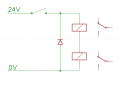
It you can put both 12Vdc relay coils in series to the 24Vdc supply, that would be the simplest, as no voltage regulator would be required.
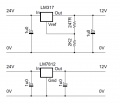
If you need the two relay coils in parallel, a very simple linear regulator could be made using the common LM317 regulator and two resistors.
A more efficient way to get 12V, is to chop the 24Vdc with a 50% duty-cycle signal (e.g. 20kHz) to give an average of 12Vdc to the relay coils, with high efficiency and little dissipation in the transistor.
This signal could be generated with a 555 astable oscillator, or other simple relaxation oscillator.
It you can put both 12Vdc relay coils in series to the 24Vdc supply, that would be the simplest, as no voltage regulator would be required.
If you need the two relay coils in parallel, a very simple linear regulator could be made using the common LM317 regulator and two resistors.
A more efficient way to get 12V, is to chop the 24Vdc with a 50% duty-cycle signal (e.g. 20kHz) to give an average of 12Vdc to the relay coils, with high efficiency and little dissipation in the transistor.
This signal could be generated with a 555 astable oscillator, or other simple relaxation oscillator.
Wait a moment, what do you intend to do? You asked for a drawing showing how to hook up the relays and when you saw it you said it is not what you want to do. If you know what you want to do you can ask for help doing it and you will probably obtain excellent help, but I don't think this group is into playing guessing games.
It might be helpful If I point out that, at least the way I interpret it, the example of series connected relays in post #29 is only that -how to connect two relays in series. In your case in place of the mechanical switch would your TIP122 acting like an on/off switch.
That might be why it did not look like what you intended to do.
Wait a moment, what do you intend to do? You asked for a drawing showing how to hook up the relays and when you saw it you said it is not what you want to do. If you know what you want to do you can ask for help doing it and you will probably obtain excellent help, but I don't think this group is into playing guessing games.
Wait a moment, what do you intend to do? You asked for a drawing showing how to hook up the relays and when you saw it you said it is not what you want to do. If you know what you want to do you can ask for help doing it and you will probably obtain excellent help, but I don't think this group is into playing guessing games.
What I said in my last statement is not referring to any of the previous answers, but I rather want the solutions to end on how to solve it as it's in parallel not series. I'm sorry if my statement messes up things.I only need solutions thank you.

 Facebook
 Google
 GitHub
 Linkedin