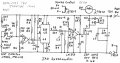
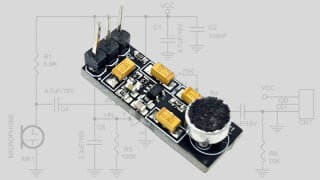
I think I understand. The 555 is configured as a monostable pulse generator that delivers positive pulses at a constant width of 10 µs, according to the values of R7 and C2. U2A's output goes low when light reaches U1 through a slot. This output is decoupled through C1, generating a brief low pulse at pin 2 of the 555, which is quickly pulled back up through R6. Guaranteeing that the 555 gets the short low pulse needed to trigger it. The 555 then outputs a 10 µs wide train of pulses (as the slotted wheel keeps spinning) through pin 3, which is then converted to a voltage proportional to its frequency through the integrator formed by R8, D1, Cr and R9. This voltage is then fed in the low input of U2B. The faster the wheel spins, the higher the voltage input to -U2B. The speed control pot acts as a voltage divider that adjusts the voltage being input at +U2B. Eventually, a state of equilibrium between the low and high inputs of U2B is reached when the wheel is spinning fast enough, turning its output on and off when this equilibrium is broken. This output in turn drives the N-Mosfet's (U4) gate, which turns the motor on and off according to the desired speed.... D2 acts as a snubber to protect the mosfet... not sure why C4 is needed, though... it seems to me that it will extend the rise and fall times of U4's gate, making it transition longer through its linear region, and quite possibly heating it up.
Is my description correct?
One possible improvement to this circuit would be generating a pulse every time the optical sensor changes state, regardless of its being in a slot or not. This could be done with a second 555, or a single 556. That way the slotted wheel's resolution would be increased by a factor of 2, allowing for even lower speeds.
There you go, I've done some retouching to your image file. I've connected pin 6 properly, and added dots to trace joints and clarified where traces do not join. I also added a 10 nF cap to pin 5 of the 555, as is customary, and did some cleaning here and there... it's my way of saying thanks for sharing.
Thanks, it looks much better, esp. the size. The first code wheel was reflective with only 9 segs. , second is 20 slots & gives desired result. Need for C4 ??, seemed like a good idea several months ago.
Thanks, it looks much better, esp. the size. The first code wheel was reflective with only 9 segs. , second is 20 slots & gives desired result. Need for C4 ??, seemed like a good idea several months ago.
I seriously doubt a cap is needed there, the mosfet's gate already has capacitance of its own, and adding more (much more in this case) only makes it take longer to turn itself on and off. A few months ago I had to add a cap such as that one in order to soften a little the sudden inrush of current going into a 90VDC motor while it was being PWM'd ... this diminished the noise being produced while switching, but it did add some heat to the fet, though not much.
In a small motor such as this one that condition is practically nonexistent.
As it looks like a dusty location, you might mount a code disc on bottom of turntable. Speed maybe 0 to 120
RPM so make black 1/8 in, width of a black marker pen, white 1/8 in. spaced in from outer edge by 1/2 in. Drill a hole in base plate for a reflective sensor, something like OPTEK K2362.

 Facebook
 Google
 GitHub
 Linkedin