I would suspect that if this is a typical ECM motor, you would need to dig deeper into the commutation control circuitry and see if this can be modified?
Probabally np mean task!
Since I have "some" documentation, if I can uncover their method of speed control I should be able to duplicate it.
Since figure 10 (other thread) shows pins 3 & 4 being powered with a small 24VAC transformer I'm wondering if the frequency has something to do with it. But with the potential for damaging a good motor - I don't want to start doing blind experiments on it. It's easy enough to vary the 24VAC down using an autotransformer, of which I have a few. But it might take 24VAC to power the regulatory electronics within the motor cover.
J48/P48 are pretty straightforward. Pins 4 & 5 are 120VAC
For testing purposes, applying 24VAC to P49/J49 pins 3 & 4 will cause the motor to run at 75%.
The "A92" (it looks like) isn the integrated control from where the fan speed is controlled. In order to use the control board I'd have to simulate heating cycles. I'm even further lost as to how to accomplish that. There doesn't seem to be any documentation.
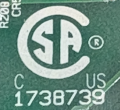
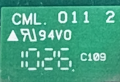
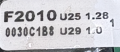
These are the only silkscreen markings (and label) I can find on the control board:
CSA 1738739 might be a part number. F2010 would seem to be the year, especially with a date code of 1026 (2010, 26th week). Not sure if the 0030C1B8 or the U25 1.28 or the U29 1.0 might be firmware numbers.
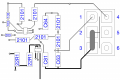
Far as I can see with bright lights behind the board, this is what I can make of the board schematic. There are two 6-pin devices but I can't make out any markings at all. Pins 1 & 4 on the big connector were not used, even thought there's traces to the pins. Pins 3 & 5 supply 24VAC which makes the motor run at 75%. Pins 2 & 6 are for +12V & Tx (didn't capture which is which). Pins 5 & 6 on the PCB go to hidden via's. I can't tell where they go other than they just disappear.
The lower (smaller) 6-lead device is silkscreened as Q8. The larger 6-lead device is not marked. If traces (lines) cross each other - they are connected. The eyelets are via's. Because the board is so opaque I can't tell where the via's go from where I've drawn them. I've drawn them so you know there are other connections. Some traces enter a component from the side. I ASSUME to know where they're going based on appearances. The heavy line doing down to nowhere just goes under a relay and I can't determine where it goes without taking the board apart. A bit more work than I want to do.
Thecontrol circuit is 24 volts because that is what furnaces and HVAC systems use for control wiring, because the safety rules make low voltage a lot cheaper, plus, no need for much power.
Someting to try to run the motor slower would be to reduce the mains supply power available with a triac type electronic light dimmer in series with the motor mains feed. That is a guess, because I have seen blower motors controlled that way.
I have also seen "motor speed controllers" marketed that use exactly that scheme. I was asked to "quickly repair" a restaurant vent fan that quit operating one day. The problem was that it had exactly that kind of controller, set at about 3/4 of full speed. I replaced it with an actual ON/OFF switch, which is required to be available for fans that might be serviced at some time.
But it does work to use for induction motors. It also works very well for universal (brush type) motors.

 Facebook
 Google
 GitHub
 Linkedin