how to sense small current on DC line

MisterBill2

Joined Jan 23, 2018
27,659
No, I meant what I said. HZ/HZ is the wiring to the bell push button at the front door to the block (and maybe outside the apartment door too). Its a simple switch contact. For that to work there must be a voltage across the contacts, or between one of them and GND. Typically this will be 3v or 5v but might be higher. The assumption is that is derived from the 30v and therefore is a safe proxy for it. The downside is that it will also vanish if someone presses the bell push. However since that's a relatively short process, a few seconds maybe, we can distinguish between a press of the door bell and a power cut by simply waiting to see if it lasts longer than, say, 30 seconds.

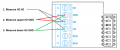
So take your voltmeter and measure across the HZ contacts and also between each HZ contact and GND, record what voltages you get. Then get someone to press your door bell and see what happens to those voltages. Finally, if you can, validate they also vanish when the 30v vanishes.
Certainly Irving offers a very good suggestion, certainly worth investigating with your meter. AND, that would be an excellent connection for an isolated voltage sensing scheme. A big "Thank You" to Irving for a very good suggestion.
 

BobTPH

Joined Jun 5, 2013
11,555
Measure between each terminal labelled HZ and the one labelled GND. One of them will likely read 0. It is the other that might be useful.
 

Tonyr1084

Joined Sep 24, 2015
9,744
Irving's post (#66) goes further than what I mentioned previously.
(post #34)
what's going on with SA and GND? Is there any kind of signal there? According to the posted document there should be 12V @ 50mA (MAX). Can you get any kind of reading there? • • • Only offering food for thought.
(post #40)
OK.
What about GND and any of the other lines? Can they be used without causing interferences?
Certainly Irving offers a very good suggestion, certainly worth investigating with your meter. AND, that would be an excellent connection for an isolated voltage sensing scheme.
A big "Thank You" to Irving for a very good suggestion.
Yes, thanks Irving.
Not to be pedantic I was first to mention sensing voltage from the other points of contact. Irving (and yes, thank you for making this clear) took and ran with my suggestion. I am sincerely thankful and recognize Irv's contribution.

Now: I'm really wondering why you need to sense power failure using this system. Why not just monitor the AC at an outlet? Likely if power goes out then everything goes out. I'm also still wondering how you're going to get an alert if power goes out. And though the TS said why he needs to be able to sense PF's I'm not following it. Maybe it's because I'm a "basics" kind of guy with limited electronics experience. BTW: my profile calls me an expert. NO I'M NOT! Understand that I'm only trying to pose questions that may help lead to a solution to the problem. As yet I still don't see the problem. But that's just me.
 
Last edited:

Irving

Joined Jan 30, 2016
5,140
@Tonyr1084 As I understand it, the TS is running some complex long running multi-machine process at home (crypto-mining?). Whatever it is, he wants to know, when he isn't there and the power goes off, if its just in his apartment - so its his problem and can put plan A into action - or if its more widespread eg whole block - in which case plan B applies.

My plan, now, would be a battery powered GSM monitoring unit that can send the TS an SMS text message in the event of a power failure, and could potentially receive and act on incoming SMS text messages as well...
 

Tonyr1084

Joined Sep 24, 2015
9,744
I am running some complex HW ecosystem and traveling a lot. For me its critical to figure out if the power outage is inside the flat - ie serious issue on my side, or its central ie whole buidling/area/city is off. Based on that i have to decide what to do with running Virtual machines etc etc etc.
@Tonyr1084 As I understand it, the TS is running some complex long running multi-machine process at home (crypto-mining?). Whatever it is, he wants to know, when he isn't there and the power goes off, if its just in his apartment - so its his problem and can put plan A into action - or if its more widespread eg whole block - in which case plan B applies.
How does plan A (whatever that may end up being) compare with plan B? If power goes out in my house then it's an individual issue. If power goes out in the neighborhood it's a local issue. Either way I've lost power. I'm failing to grasp why there's a need to understand if there's a difference. Is the doorbell system powered from inside the home or from outside? And if from outside and he has a PF from inside what would the TS know? I'm really lost on this one. Usually when lost I just keep quiet. But this one seems more like a "Logic's" problem. Sensing the difference between a neighborhood PF and a household PF. In all of my 50 years of home ownership or rentals I've only had one case where half my power would go out. And that was due to a bad connection inside the power meter. BTW: I'm in the US. We have split phase power. L1 to L2 is 240VAC whereas that's split into L1 & Neutral (120VAC) and L2 & Neutral (120VAC). Most if not all members here know this. But in case not - - - .
 

Tonyr1084

Joined Sep 24, 2015
9,744
Additionally: if he's traveling and the PF is home based (not public), what can the TS do from - say - Spain? Or Cook's Island? Other than calling a neighbor and asking them to reset a breaker. And in calling them - "Hey! I have a power failure in my home. Is it the neighborhood? Or is it just me?

Can you see why I'm having an issue understanding the differences? I would assume if it was "Neighborhood outage" then plan B would be to just wait till power is restored. If it were an issue in the home then plan A might be to call someone and have them reset a breaker. Or determine why the breaker tripped in the first place. That's ALL I can see from my basement in the US.

Maybe plan B would be to fire up a generator or power up a battery powered backup for powering the equipment.
 

Irving

Joined Jan 30, 2016
5,140
Maybe if its just his apartment maybe he can get someone to sort the problem before the UPS runs down, whereas if its widespread, he can just wait & hope power comes back soon....
 

Irving

Joined Jan 30, 2016
5,140
The readings are following
1. 2.9v
2. 0v
3. 2.9v
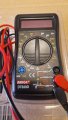
Perfect, now we know that we have a voltage we can monitor, that there is no significant 'common mode' voltage, and HZ-HZ is probably, but not definitively, GND referenced. Just as a check, what were you measuring with? Make & model please
 

Irving

Joined Jan 30, 2016
5,140
Go with #3. I'd call 2.9V Three volts. Maybe even 3.3V. Sometimes meters are not all that accurate. And 3.3V seems to be one of the universal voltages being used in electronics these days.
I'd probably go with differential sensing across HZ-HZ and keep the monitoring unit floating, rather than tie it to GND...
 

Irving

Joined Jan 30, 2016
5,140
Well, some assembly and software required; there's not an off-the-shelf ready to go solution AFAIK. Maybe some of my colleagues here know otherwise.

A lot will depend on where you are and what you have access to/can buy and if you're up to a little bit of soldering. Basically, I'm thinking a cheap MCU, e.g. Arduino Nano, a GSM 900 adapter, a LiPo battery, a charger/protection board for the same and a 5v wall-wart to keep it charged. The only other bit that isn't plug & play is building a little interface to the doorbell.
 
Top