How to run a 24DC linear actuator from 2 separate locations

Thread Starter

Davidvee

Joined Jan 13, 2025
9
Hello brains trust,
My first post here and I'm a total novice. Please excuse my descriptions and terminology, and apologies for the basic nature of this request. I'd like some help please with a low voltage DC circuit involving a linear actuator. I have looked into latching relays and various switches to achieve what I'm after but am not sure on a good way to create this.

Basically I want to extend a linear actuator (24V DC) whereby we can press a momentary switch in one location (press once only, and it can't be interrupted by pressing the same switch again - so that the actuator achieves full extension), and then in a second location be able to control the actuator in both extension and retraction phases. It is more important that the first 'extension' switch is momentary (or 'single shot'). For the second switch, the type of switch is not as crucial as the first and I'm open to suggestions (I was thinking a double throw/double pole switch)?

Any advice would be much appreciated! Thank you in advance, David
 

MisterBill2

Joined Jan 23, 2018
27,358
Quite an interesting set of requirements. And before any suggestions as to how they can be created, a question about what all ready exists: Every electric motorized linear actuator needs a means of switching the drive off when the physical end of motion is reached. Most often that is provided by limit switches added to interrupt the drive power when the end is obtained.

Until the TS can explain how the linear actuator is stopped at the end of motion, or will be stopped at the ends of motion, NO MORE ADVICE!! Just like in cars, stopping is important!!
 

Thread Starter

Davidvee

Joined Jan 13, 2025
9
Hi David, welcome to AAC.

Do you have a link to the actuator you have in mind?
Thank you everyone and Irving. The actuator is similar to this model;
https://www.motiondynamics.com.au/50mm-stroke-8mm-speed-3500n.html

There are only 2 wires (brown and blue) feeding into the actuator.

The limit switches are internal and the stroke is a set distance. I know that the actuator is rated at 12V but I intend to run it a slightly higher voltage (not more than 24V) to slightly increase the speed, hence wanting to have switch components that are rated higher than 12V. The two separate switches would be located no more than 5m distance from the actuator and hence no more than 10m apart from each other. Thank you. David
 

LowQCab

Joined Nov 6, 2012
5,101
Running it on ~24-Volts is a bad idea,
the specifications say its only rated at a 10% Duty-Cycle,
so you'll probably smoke-it at 24-Volts,

and,
the internal-Limit-Switches are only rated for 12-Volts,
and You can't change or bypass the Limit-Switches.

The maximum-force it can generate is stated as 3500N,
and it's rated for less than that in the ( "opposite" ???? ) direction.
You didn't say how much "force" You are expecting to need.
Is it possible for your mechanism to become jammed, or locked-up ?,
which would then exceed this rating ?
.
.
.
 

Thread Starter

Davidvee

Joined Jan 13, 2025
9
Running it on ~24-Volts is a bad idea,
the specifications say its only rated at a 10% Duty-Cycle,
so you'll probably smoke-it at 24-Volts,

and,
the internal-Limit-Switches are only rated for 12-Volts,
and You can't change or bypass the Limit-Switches.

The maximum-force it can generate is stated as 3500N,
and it's rated for less than that in the ( "opposite" ???? ) direction.
You didn't say how much "force" You are expecting to need.
Is it possible for your mechanism to become jammed, or locked-up ?,
which would then exceed this rating ?
.
.
.
Thank you LowQCab. I'm aware of the issues that I can run into with running it at higher voltage. It will be lifting a 2kg weight. I'm happy to get a different actuator (ie, 24V), but I first want to know if I can achieve the operation described in my original thread. Thank you. David
 

LowQCab

Joined Nov 6, 2012
5,101
If the Actuator is wired in a similar manner to the present one being discussed,
( only 2-Wires coming out with built-in Limit-Switches ),
the required Circuitry will be the same.

I'm not completely sure about your description of what You want.
here's my guess ...........

The "Remote-Station" is a single Push-Button,
which only operates the Actuator in one direction,
and,
must be manually held pressed-down to move the Actuator.

The "Main-Control-Station" operates in the same manner as the "Remote-Station",
with the exception that, it has 2-Buttons,
one for each direction of travel.

If You want a "Latching-Action" for either, or both, or all 3, of the Push-Buttons,
it can be done, but it will be somewhat more complex.

Any Button-Presses must automatically disable the opposing Station which is not currently being used,
this is required to prevent accidental Short-Circuits, and Fuse-Blowing or Circuit-Breaker-Tripping,
caused by having 2 opposing Buttons pressed at the same time.

No "Electronic-Components" are required,
only several Relays.
I recommend using ~12-Volts if for no other reason than it will allow You
to use common Automotive-Relays available at any Auto-Parts-Store.

Does this sound like what You want ?

What do You have in mind for a Power-Supply ?

What do You have in mind for Push-Buttons ?

.
.
.
 

MisterBill2

Joined Jan 23, 2018
27,358
OK, and an interesting description. So it has internal limit switches. Try it first on 12 volts.
To control the operation with two buttons will require two SPDT relays in the standard "H-Bridge" circuit that has been described many times. Just add a series diodes for the two buttons to isolate the dual button control location.
For the latched control, from a third push button, another SPDT relay and button combination, wired to close the N.O. contacts in parallel with the button when the button is pressed, with the coil feed to be thru a normally closed limit switch that opens when the actuator is at it's desired extended position. That connection could also be taken from the switched side of the actuator's motor feed.
 
Last edited:

Tonyr1084

Joined Sep 24, 2015
9,744
From the first end:
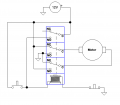
Using one momentary switch, normally open (NO) on one end and another momentary switch, normally closed (NC) and a 3PDT relay (or 4PDT) should be able to do the job. The relay has a constant power source. The NO switch momentarily applies power to the coil. The energized coil then gets power from the constant power source and locks on. two of the poles act as an H-Bridge which can reverse the polarity to the motor. In the latched position the relay (H-Bridge) drives the motor to (let's say) the open position. When the relay drops out it switches back and retracts the motor.

From the other end:
Using the momentary NC switch, since it is normally closed it provides ground (or negative) for the other coil lead. Without it nothing will function. When (as in the first example) the relay is closed and latched, two of the poles act as an H-Bridge to drive the (let's say) gate open. When you arrive at the remote switch you push the NC switch and the relay drops out and the H-Bridge again reverses the polarity, thus closing the gate.

Don't get confused with "reverses the polarity". I only mean that it changes the state from the previous state. If the gate (for example) is closed and you want to open it you push the first button. The gate opens. When the gate reaches the limit of its travel it stops. When you push the other button the gate closes until the limit switch stops the travel.

One normally open momentary switch to open the gate, one normally closed switch to close the gate and a 3PDT relay to act as a self latching circuit AND H-Bridge to either open or close the gate.

I am the one introducing the idea of opening and closing a gate. This may not be what the TS has in mind; I only use "gate" as a reference to performing some sort of work the TS wants to accomplish.
 

Tonyr1084

Joined Sep 24, 2015
9,744
In this configuration the gate should be closed.
Screenshot 2025-05-31 at 8.00.49 AM.png

Pressing the button on the left (NO) momentary switch, (left side) the relay will latch on and stay on. The motor will slew the gate to the full open position and stop. The relay being latched on will continue to use power to hold this position. Leaving the gate open will waste power.

Screenshot 2025-05-31 at 8.02.21 AM.png
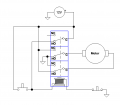
In this configuration the momentary (NO) button has been pressed and the relay has latched. The gate has opened.

Pressing the right momentary (NC) button will cause the latched relay to drop the ground from the circuit. The relay will drop out. This will cause the gate to fully close again. The motor will slew to the full closed position and the internal limit switches will prevent any further travel. This will also prevent any power from being used while the gate is fully closed. Power will only be used while the gate is slewing from one position to the other, or while holding the gate in the open position.
 
Last edited:

Tonyr1084

Joined Sep 24, 2015
9,744
in a second location be able to control the actuator in both extension and retraction phases. It is more important that the first 'extension'
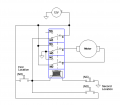
My approach does not fully address your requirements. The "second location" can't open the gate. I can't see a solution other than running another wire and button back to the first button (a third button, a momentary (NO) button at the second location wired back to the first location).
 
Last edited:

Tonyr1084

Joined Sep 24, 2015
9,744
This is the only solution I see without using some electronic switching. But that's just "ME". Others will likely have different approaches. Ultimately you have the final decision on how to tackle your issue.
Screenshot 2025-05-31 at 8.31.14 AM.png
 

Tonyr1084

Joined Sep 24, 2015
9,744
My last offering for the morning:
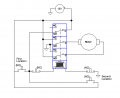
This configuration will allow you to open or close the gate (again, gate is merely an assumption on my part) with this you can open and close the gate from either location. (NO) opens the gate; (NC) closes the gate.
Screenshot 2025-05-31 at 8.36.39 AM.png
 
Last edited:

sghioto

Joined Dec 31, 2017
8,634
Any advice would be much appreciated! Thank you in advance, David
My version seen below in the standby mode.
When Sw1 is pressed relay RL1 activates and is latched sending +12 volts to the actuator for full extension.
Sw3 is the remote switch which allows operation of the actuator in both directions only after Sw1 has been pressed.
Sw2 resets RL1 back to the standby mode.
Diode D1 blocks the initial current surge from the actuator motor going through Sw1.
Diode D2 suppresses the EMF when RL1 is reset.
1748709271773.png
 
Last edited:

Tonyr1084

Joined Sep 24, 2015
9,744
Looking closer - when RL1 is latched there is motor power. SW3 simply changes direction (H-Bridge). When SW2 is pressed the relay unlatches and there is no power to the motor. Am I missing something?
 

sghioto

Joined Dec 31, 2017
8,634
OK, nice. Is SW3 DPDT Center off? Or NC - Mom NC? When you RESET - what drives the motor in the opposite direction?
Not center OFF or no power to the actuator when Sw1 is pressed.
Sw3 is a standard DPDT toggle switch shown in the forward postion.
After reset must press Sw1 again.
 

Tonyr1084

Joined Sep 24, 2015
9,744
Maybe I'm stuck on the idea that the TS wants a switch, (PB) at one end of a property. That switch extends the actuator. At the opposite end of the property the TS wants another button that can return the actuator to the original position. But the TS also wants to be able to push that second button a second time to once again extend the actuator. In my mind that's going to take a bit of electronics and some logic. Or an MCU, which is definitely overkill. That's why in my mind having two buttons at each location gives full control over the actuator, whether to extend or to retract. The relay only comes into play on the extend cycle. The relay locks to extend the actuator. When the relay drops out the actuator fully retracts.
 
Last edited:

sghioto

Joined Dec 31, 2017
8,634
I didn't read it that way.
Specifically said a momentary switch in one location and from his description must be latched when pressed.
I do see one possible issue with the design if Sw3 is left in the reverse position.
One option is to replace Sw3 with a DPDT relay and operate the relay using a momentary push button switch.
Need more feedback from the TS.
 
Top