I have found that capacitive coupling introduces a lot of noise to deal with (especially in a generator) and even the branded models are quite finicky to set up and are still not accurate,
I appreciate the method i am trying is uncommon, but I am really just trying to circumvent the short comings of capacitive methods and access the solid signal that already exists by trying out methods as offered by strantor
The Big question is ........
Why are You trying to obtain a Tach-Signal directly from an Ignition-Coil ?
Something controls the Power to the Coil,
either a set of Points, ( hopefully not ), or a Magnetic-Pickup,
either of which would be a better signal source than the Coil.
Installing a Hall-Sensor, or even a Variable-Reluctance-Sensor,
would be far more reliable, and would create a very clean Waveform.
.
.
.
I don't know enough to give you a confident answer. I suspect that, unloaded, the voltage could be in the tens of thousands. To me the voltage divider just feels safer. If I were doing this the way you plan to do it, I would use the divider. But if I were doing this I would be using a hall sensor like @LowQCab suggested.
So if you measuring wires W & B (white/black i assume) then you are measuring primary voltage which should be more safe than measuring the same voltage going to the spark plug (secondary voltage) maybe 200V really is the highest you'll ever measure? I still think though, if you disconnect the spark plug (disconnect the load on the secondary) the voltage on the primary will be much higher. I don't know how much higher, but probably not tens of thousands of volts as I stated earlier. If it's not clear, I am doing a lot of guessing here (note I did not spec resistor values, I don't know what min/max voltage to expect), and that's why I would prefer a hall sensor. No guesswork.
Here's a good candidate ........... Hall-Effect-Sensor DigiKey
DigiKey has a link to the wrong PDF-File,
the correct PDF is attached below.
It even has a built-in LED which You can use to determine the ideal mounting position.
simply apply more than ~5-Volts and watch the LED as You move the Sensor around
near the Flywheel with the Engine idling.
The flashing will be too fast to see at higher RPMs.
It also has either a Switched-Hot-Output, or a Switched-Ground-Output,
so it will be compatible with almost any Tach.
.
.
.
So if you measuring wires W & B (white/black i assume) then you are measuring primary voltage which should be more safe than measuring the same voltage going to the spark plug (secondary voltage) maybe 200V really is the highest you'll ever measure? I still think though, if you disconnect the spark plug (disconnect the load on the secondary) the voltage on the primary will be much higher. I don't know how much higher, but probably not tens of thousands of volts as I stated earlier. If it's not clear, I am doing a lot of guessing here (note I did not spec resistor values, I don't know what min/max voltage to expect), and that's why I would prefer a hall sensor. No guesswork.
Yes I will be sampling the primary side only and I know any anomaly on the secondary side will induce voltages greater in amplitude. What I originally visualised is having a single large positive spike to sample thru series resistor(s) and into transistor. The current into the transistor base ranging from a uA to a few mA - giving enough headroom for variance in the voltage spike. Does this make sense? I know the hall sensor approach is the fool proof method but my goal is to sample from the primary signal.
Thank you for your patient replies. I understand the hall sensor approach and I know its confusing why I don't want to use this reliable and foolproof method. But I am asking how would you approach sampling the given signal if that's all that you have?
Thank you for your patient replies. I understand the hall sensor approach and I know its confusing why I don't want to use this reliable and foolproof method. But I am asking how would you approach sampling the given signal if that's all that you have?
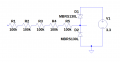
I'd go for this: Plenty of resistors in series so you don't exceed their rated voltage (generally about 200V), Schottky diodes to clamp the signal at the supply voltage.
You will probably need a resistor across one of the diodes to bias it to one logic level or the other when there is no pulse.
[Edit] It might be an idea to use the signal to trigger a 555, that would give a nice clean signal for your frequency counter. In which case you will need a resistor to bias it positive.
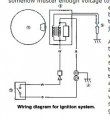
There is no primary. There are two coils in series that are energized by the flying magnet, and one has a capacitor across it. I don’t know what this configuration is designed to do, but I see no external power applied to a primary.
Can anyone tell me what these two symbols are in the wiring diagram?
There is no primary. There are two coils in series that are energized by the flying magnet, and one has a capacitor across it. I don’t know what this configuration is designed to do, but I see no external power applied to a primary.
Can anyone tell me what these two symbols are in the wiring diagram?
There is no primary. There are two coils in series that are energized by the flying magnet, and one has a capacitor across it. I don’t know what this configuration is designed to do, but I see no external power applied to a primary.
Can anyone tell me what these two symbols are in the wiring diagram?
There is a primary. TS is sampling it. See traces posted in OP. The spikes seen on the scope are nowhere near high (low) enough to ignite a spark plug. The video posted by TS explains (in excruciating detail) the interaction of the primary and secondary coils which are wrapped around the same core and appear from the outside to be a single coil. They would not put 20+kV across a cheap kill switch.
I think those symbols represent a ground lug and a single pin connector but I am not positive.
I'd go for this: View attachment 300348Plenty of resistors in series so you don't exceed their rated voltage (generally about 200V), Schottky diodes to clamp the signal at the supply voltage.
You will probably need a resistor across one of the diodes to bias it to one logic level or the other when there is no pulse.
[Edit] It might be an idea to use the signal to trigger a 555, that would give a nice clean signal for your frequency counter. In which case you will need a resistor to bias it positive.

 Facebook
 Google
 GitHub
 Linkedin