How to measure large DC current

neonstrobe

Joined May 15, 2009
200
A note of caution on cheap shunts - check the specifications. One I bought for 100A was only rated at 50A continuously. The element was really too small for 100A continuously. I ended up with a 200mm length of copper bus folded in a U shape (yes this might create a small inductance but the area is small) and with the TCR of copper. If possible build the shunt out of manganin or Eureka (constantan) but it will need to be big. I used a x100 D.C. amplifier to measure the voltage.
At 500A 1 milliohm will dissipate 250W so you really do need a low resistance (I think my copper shunt was 0.1 milliohm for 100A) and you need it to be physically able to dissipate whatever power expected. Connections to the shunt need to be very low resistance too. In fact you ought to use a microohmmeter to make sure the connections don't add up to much. (less than 1 microohm really). I used half-inch bolts.
 
I "shunt" is a 4-terminal resistor and it can be very large. the large current passes through two lugs and the voltage, use 50-100 mV is read on two smaller screws.

The precision resistance is between the smaller terminals. The voltage has to be measured diffeentially.

Here https://www.newark.com/canadian-shunt/lb-500-100/shunt/dp/73K4825 is a 500A shunt.

You said it's a wheelchair, but before I had an AC/DC current clamp I measured the voltage across the battery to alternator cable under load and recorded it for future reference when troubleshooting.

So, you can use a section of cable, but your stall caught up as you need a power supply and an ammeter to calibrate it,
Your DVM ammeter probably goes to 10A and is not continuous and you need two DVM's or a DVM and a resistor.
SO, power a standard old style headlight from a car battery with a smaller resistor or the shunt and "calibrate" the elngth of cable.

1st see if you get a measurable voltage.

Current clamps generally are not that accurate. The likely use for me is measuring alternator output. At work, I bought a $400.00 current clamp. The advantage was size.

The easiest is to calibrate a section of cable and a car battery, headlamp and a power resistor capable of handling the current of the lamp.

You have to measure the voltage agross two terminals (the "resistor" value) and the current through the resistor which can be anywhere in the circuit.

Your DMM uses a resistor. one voltmeter of mine, a Fluke 77, has a separate unfused 10A shunt. Then there is a 300mA or less scales that is fused. The voltage is usually less than a diode drop 0.6V because it's easy to use diodes for protection.

Now, I also have feedback ammeters that have less than 1mV drop at any current from pA to 20 mA and I've built FB ammeters to +-100mA.
 

nsaspook

Joined Aug 27, 2009
16,330
Last edited:

Irving

Joined Jan 30, 2016
5,137
Nothing on a wheelchair should be drawing anything like that current. My chair is fully instrumented and though the motors can draw 180A each on stall that never happens in reality as the controller current limits at 120A and rolls back to 90A after 10sec.
If your 100A breaker is tripping its faulty or you have a short somewhere. Or have you done some mod that has an unexpected side-effect?

For the record, standard power is 2 x12v 73Ah SLA Gel on most good chairs and 12awg wiring. My chair has 200Ah LiFePO4 batteries capable of 5C (1000A) discharge but my 100A OEM breaker has never tripped - it does after 15s at 140A which is its spec.
 
Last edited:

Thread Starter

LAOADAM

Joined Nov 21, 2018
956
A note of caution on cheap shunts - check the specifications. One I bought for 100A was only rated at 50A continuously. The element was really too small for 100A continuously. I ended up with a 200mm length of copper bus folded in a U shape (yes this might create a small inductance but the area is small) and with the TCR of copper. If possible build the shunt out of manganin or Eureka (constantan) but it will need to be big. I used a x100 D.C. amplifier to measure the voltage.
At 500A 1 milliohm will dissipate 250W so you really do need a low resistance (I think my copper shunt was 0.1 milliohm for 100A) and you need it to be physically able to dissipate whatever power expected. Connections to the shunt need to be very low resistance too. In fact you ought to use a microohmmeter to make sure the connections don't add up to much. (less than 1 microohm really). I used half-inch bolts.
Thanks.
I ordered 200A and 300A shunts.
 

Thread Starter

LAOADAM

Joined Nov 21, 2018
956
I "shunt" is a 4-terminal resistor and it can be very large. the large current passes through two lugs and the voltage, use 50-100 mV is read on two smaller screws.

The precision resistance is between the smaller terminals. The voltage has to be measured diffeentially.

Here https://www.newark.com/canadian-shunt/lb-500-100/shunt/dp/73K4825 is a 500A shunt.

You said it's a wheelchair, but before I had an AC/DC current clamp I measured the voltage across the battery to alternator cable under load and recorded it for future reference when troubleshooting.

So, you can use a section of cable, but your stall caught up as you need a power supply and an ammeter to calibrate it,
Your DVM ammeter probably goes to 10A and is not continuous and you need two DVM's or a DVM and a resistor.
SO, power a standard old style headlight from a car battery with a smaller resistor or the shunt and "calibrate" the elngth of cable.

1st see if you get a measurable voltage.

Current clamps generally are not that accurate. The likely use for me is measuring alternator output. At work, I bought a $400.00 current clamp. The advantage was size.

The easiest is to calibrate a section of cable and a car battery, headlamp and a power resistor capable of handling the current of the lamp.

You have to measure the voltage agross two terminals (the "resistor" value) and the current through the resistor which can be anywhere in the circuit.

Your DMM uses a resistor. one voltmeter of mine, a Fluke 77, has a separate unfused 10A shunt. Then there is a 300mA or less scales that is fused. The voltage is usually less than a diode drop 0.6V because it's easy to use diodes for protection.

Now, I also have feedback ammeters that have less than 1mV drop at any current from pA to 20 mA and I've built FB ammeters to +-100mA.
Thanks.
I learned a lot.
 

Thread Starter

LAOADAM

Joined Nov 21, 2018
956
A good option.
Just make sure it's a quality unit.
https://forum.allaboutcircuits.com/...c-controlled-battery-array.32879/post-1496750
https://forum.allaboutcircuits.com/...c-controlled-battery-array.32879/post-1474148

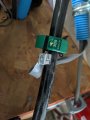
For my 2,000W 12VDC inverter power input I use this 300A unit: https://s3.amazonaws.com/amploc/PDFs/KEY100-AMP200-AMP300.pdf
View attachment 241603
That's a 0000 power cable for the Inverter current return connection.
Thanks.
Well, he did lot of more complex system.
 

Thread Starter

LAOADAM

Joined Nov 21, 2018
956
Nothing on a wheelchair should be drawing anything like that current. My chair is fully instrumented and though the motors can draw 180A each on stall that never happens in reality as the controller current limits at 120A and rolls back to 90A after 10sec.
If your 100A breaker is tripping its faulty or you have a short somewhere. Or have you done some mod that has an unexpected side-effect?

For the record, standard power is 2 x12v 73Ah SLA Gel on most good chairs and 12awg wiring. My chair has 200Ah LiFePO4 batteries capable of 5C (1000A) discharge but my 100A OEM breaker has never tripped - it does after 15s at 140A which is its spec.
Thanks.
I used wheelchair's power system to DIY some things like automatic truck, they all works very good. Usually the wheelchair used less than 1 KW motor, I heard that the 100A breaker tripping, and I am using 2 KW motor now.
 

Irving

Joined Jan 30, 2016
5,137
Those are not wheelchair motors and I don't understand how you're driving them from DC, as these are 220v motors, unless you have some other custom controller that does the joystick mixing...
 

Thread Starter

LAOADAM

Joined Nov 21, 2018
956
Those are not wheelchair motors and I don't understand how you're driving them from DC, as these are 220v motors, unless you have some other custom controller that does the joystick mixing...
Thanks.
Sorry of the wrong page, this one:
dc.PNG

It is not for wheelchair.
The wheelchair story came during my searching large DC motor.
 

Irving

Joined Jan 30, 2016
5,137
AGM are not good for this application. SLA Gel are much better. Even better are LiFePO4. Yes they are more expensive to start with ($1000 v $400) but:
  • You'll get a full 90-95% capacity rather than 50-60% with an SLA.
  • You'll get 3000-4000 charge cycles, thats 8-10y life at 80%DoD, you'll be lucky to get 2y life with SLA (so over 3-4y you'll be saving money).
  • They'll charge in 4 - 6h rather than 12 - 16h.
  • They weigh approx 50% less.
  • Depending on the controller you use, you'll get better turning and low speed response because of the lower battery impedance.

Why have you chosen those motors? Do you have a proper datasheet with the motor curves & performance parameters?
2kW motors are going to pull some serious current when turning (assuming tank steer like a wheelchair). What controller are you going to use?
 
Top