How to implement a rev limiter on a small engine?

Thread Starter

strantor

Joined Oct 3, 2010
6,875
There is actually a more severe condition than this,
and that is, "Down-Shifting" in a manual-transmission car, to slow the car down.
Under this condition, there is a continuous Vacuum on top of the Piston,
which stretches the Rod at high RPMs.
I didn't know this, but now that I do, I am going to built my next project around the engine of (or at least use the connecting rods from) a 1984 Mazda B2000. Because I have empirical data confirming that even with over 350k miles on the odometer, you can shift that truck into 1st gear at 75MPH and dump the clutch, sending the engine up into F1/jet turbine range and it won't throw a rod. Maybe that's something you can only do once though; I don't have any data from subsequent tests.
 

shortbus

Joined Sep 30, 2009
10,050
I didn't know this, but now that I do, I am going to built my next project around the engine of (or at least use the connecting rods from) a 1984 Mazda B2000. Because I have empirical data confirming that even with over 350k miles on the odometer, you can shift that truck into 1st gear at 75MPH and dump the clutch, sending the engine up into F1/jet turbine range and it won't throw a rod. Maybe that's something you can only do once though; I don't have any data from subsequent tests.
I can only hope that is sarcasm.
 

shortbus

Joined Sep 30, 2009
10,050
I meant precisely what I wrote .........
But maybe I should have been more explicit, and said,
the exact "instant" that the Throttle is closed.

I said nothing about the Engine "slowing-down".
So I'm wrong because I paraphrased you? What happens when you "instantly close the throttle"? The engine slows down. Or it does in my world.

I've studied every page, in every issue,
of Hot-Rod, and Car-Craft Magazines, from about ~1968 to ~1992, ( and occasionally a few others ),
and every Book ever written by Smokey-Yunick, Jim-McFarland, David-Vizard,
and and 4 or 5 other famous authors and innovators in the Hot-Rod and Racing fields.

All Connecting-Rods, in every Piston-Engine,
still follow all of the same principles and rules.
Some designs just do it better than others.

The key to understanding Connecting-Rod failures comes with
studying the varying Cylinder-Pressures inside an Engine,
and how those pressures can create both tremendous compression-loads on the Rod,
and, how they can exacerbate the incredibly high inertial-forces which are
trying to tear the Piston off of the end of the Connecting-Rod.

I too have done the same,but from around 1962.

I agree with your, "all rods follow the same principles". But more to rod strength is the material, heat treatment and after heat treat surface treatments.

Varying cylinder pressures have very little to no actual effect on rods. In the time I hung our with circle track, racers in their garages , tractor pullers in their garages motocross racers, and working in a engine rebuild machine shop all of those helping on engine building and maintenance, the number one reason for rod failure is lack of lubrication. Either the small end seizes or a rod bearing on the big end spins and seizes causing rod failure.

And I can tell you none of these things happen at " the exact "instant" that the Throttle is closed." They all happen at close to full throttle.
 

LowQCab

Joined Nov 6, 2012
5,101
strantor
OK, so maybe the analogy of a vacuum is not necessarily 100% accurate.
Because there's some slight pressure in the cylinder when the Exhaust-Valve is open.
But there definitely is far less average pressure helping to control the inertia of the Piston
as it very abruptly changes directions at Top-Dead-Center.

Car Engines are generally "over-built" to withstand a certain degree of abuse,
it helps cut down on warranty claims.

In the case of most Industrial / Lawnmower type Engines,
the Connecting-Rods are made out of "Pot-Metal",
( anything that kinda looks like metal gets thrown into the melting "Pot" ),
not some high-grade Aero-Space-Alloy of Aluminum.
They don't even have Bearing-Inserts,
they just run directly against the Cast-Iron Crankshaft.
They break easily.
This is why there are companies making good Money selling
Custom-Billet, high-grade-Aluminum-Alloy, Connecting-Rods for these Engines,
for around ~$150.oo for each piece.

Most modern Car-Engines have Connecting-Rods made of a proprietary Steel-Alloy in "Powder" form,
which is melted, and then forged, under tremendous pressure.
They're amazingly strong for being a cheap "mass-production" part.

Back in the day, I used to routinely run a Datsun L-16 4-cylinder Engine at over ~8000-RPM.
( this is the 4-cylinder version of the Datsun- "240-Z" Engine that came in small Trucks ),
None of the Rods ever failed, but the Crankshaft finally snapped in half.
.
.
.
 

shortbus

Joined Sep 30, 2009
10,050
way back when I used to build race-engines, ( and win races ), and
a set of "Pink-Rods" ( forged-Rods ) were the hot-setup for high-RPM Chevy-Engines.
So then it seems like you believe "pink rods" were made from a different material or forging? Not so. They were from a standard batch of forgings and just looked at and handled differently.

They came from normal rods but got magnufluxed to makes sure they had not hidden flaws. They were then shot peened as a surface treatment, then "blue printed" to make sure all the dimensions were correct, within the engineering specs. With babbited small ends. http://garage.grumpysperformance.com/index.php?threads/pink-rods-why-bother.1110/
 

LowQCab

Joined Nov 6, 2012
5,101
"" So then it seems like you believe "pink rods" were made from a different material or forging? Not so. ""

When did You become a really bad mind-reader ?
I guess You know better than me, what I "believe" ........
.
.
.
 

twister007

Joined Feb 29, 2012
93
I have a small gas powered UTV/buggy (think all-terrain golf cart). It has a Chinese v-twin engine and despite countless hours of fiddling with the carburetor I could not get it to run right. Much research indicates the carbs on those engines are just crap. So I replaced the stock intake manifold with a pair of adapters I machined, and put on dual flatside carbs. It runs much better now, but there was no good way to tie in the original mechanical governor. I still want to limit RPMs because it has the original valve springs and flywheel and shouldn't be taken above 5k RPM in this configuration.

So what is the best way to limit RPM? I will have some kind of electronic controller onboard (PLC, Arduino, or other programmable controller) so I will be able to do this electronically if that makes things easier. Can I ground the coils (in the same way the kill switch works) if RPM >4500? Or will that cause other problems? I could override throttle with a servo or something, but that would be more complex. I would prefer a simpler solution like grounding the coils provided that won't cause problems.
 

Thread Starter

strantor

Joined Oct 3, 2010
6,875
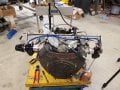
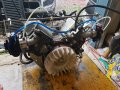
My throttle linkage with governor worked.

20221028_201247.jpg
20221029_173023.jpg

The shiny new inflated sense of self worth that I earned from linkage success was slowly deflated over many hours of struggling to get these carbs tuned and then completely snuffed out by the eventual realization that I am in fact a moron.

The reason I couldn't get them tuned and synced is because the engine was only running on one cylinder this whole time.

It seemed suspicious that only one side of the engine was getting hot, but the internet said that v-twins run hotter on one side and that's why they run 2 different sized jets.

It seemed suspicious that adjustments on one of the carbs didn't seem to have much effect. But I figured if one side runs hotter and needs a different jet, it must be "dominant" in some way, so maybe it makes sense that adjustments on that carb would have more effect. But it wasn't until I purposely adjusted the other carb WAY out of whack that I noticed it actually had NO effect whatsoever.

On the bad cylinder I had spark, I had fuel, and I had compression. My elementary knowledge of engines told me that if I had those 3 things, the cylinder had to be working. So I forged on.

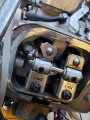
Finally I realized that the carb on that side had zero suction. Even at WOT, nothing at all. Now I know there is something going on. Swapped carbs between the 2 sides and problem stayed with the cylinder, both carbs work fine. Pulled the valve cover off and found this:

20221030_175531.jpg

Riddle me this: how the hell does a cylinder build pressure with the intake valve permanently closed? Where is it pulling air from? Or if the valve is permanently open, how does it build any pressure? Makes no sense to me.

This is probably why (or at least the biggest contributing factor to why) I was having so much trouble with the factory carb. This whole thing has been a waste of time and money and I'm pissed.
 

LowQCab

Joined Nov 6, 2012
5,101
You never know what you'll get from China.
There's probably several companies selling Aftermarket-Rockers for this very reason.
Looks like a faulty heat-treatment job, or maybe no heat-treatment at all.
At least it's an easy fix.
.
.
.
 

Thread Starter

strantor

Joined Oct 3, 2010
6,875
I am in fact a moron.
[...]
This is probably why (or at least the biggest contributing factor to why) I was having so much trouble with the factory carb. This whole thing has been a waste of time and money and I'm pissed.
I had an epiphany that allowed me to regain a small measure of self esteem. Putting on dual carbs wasn't really a waste of time. I probably never would have found the issue otherwise.
 

Thread Starter

strantor

Joined Oct 3, 2010
6,875
You never know what you'll get from China.
There's probably several companies selling Aftermarket-Rockers for this very reason.
Looks like a faulty heat-treatment job, or maybe no heat-treatment at all.
At least it's an easy fix.
.
.
.
It would be easy to just replace the rocker and pushrod but I'm going to tear the whole thing apart and inspect. It has gas in the oil after my hours of tuning attempts that wasn't present when I started. Not knowing what caused this, I want to make sure there aren't bigger problems. Faulty heat treatment is a good explanation but debris in the cylinder is another. If that cylinder is scarred, there's no point in continuing. I don't know how it could have compression with a scarred cylinder but I also don't know how it could have compression with a broken rocker and bent pushrod on the intake valve. There too much I don't know and the only way to find out is invasive exploratory surgery.
 

LowQCab

Joined Nov 6, 2012
5,101
This is a little confusing,
how do You know that cylinder has Compression ?

If the Valve-Springs are weak enough,
the Piston will just barely crack the Intake-Valve open on the Intake-Stroke.
Way back when Engines were a new thing,
many Engines didn't have any kind of mechanism to open the Intake-Valve other than Vacuum.
( but they ran really slow )
The high-speed Air flowing past the edge of the Valve was actually used as a crude Carburetor
to draw Fuel in with the Air.

I think your Engine will be just fine internally after the Oil has been changed a couple of times.
A little bit of Gasoline in the Oil is not a death sentence.

Your Engine has a "Centrifugal-Compression-Release" on the Camshaft,
which could also allow Air to enter the Cylinder at low speeds.

I would just replace all 4 Rockers, change the Oil, and see how it goes.
You have to replace the Rockers in any case.
If the Engine doesn't rattle or smoke, there's no need to take it apart.

P.S.
From taking a short look around, it would appear that your broke Rocker was a complete fluke.
The stock Rockers are routinely used with much heavier Valve-Springs,
( the stock Valve-Springs are ridiculously weak, I mean like unbelievably weak ).
The stock Springs are substantially less than ~18-Pounds at the normal installed height,
( An ~18-pound Spring is a supposed "High-Performance-Up-Grade" ),
THIS IS YOUR REV LIMITER, the Valves will "float" at around 5000-RPM with stock-Springs.
Valve-Float can unfortunately break Rockers too,
this may be what has happened to your Engine,
excessive running-time under Valve-Float conditions.
.
.
.
 

MrSalts

Joined Apr 2, 2020
2,767
Riddle me this: how the hell does a cylinder build pressure with the intake valve permanently closed? Where is it pulling air from? Or if the valve is permanently open, how does it build any pressure? Makes no sense to me.
The valve is slightly cocked to one side so it may be slowing air flow but not sealing off the air. You can move the pistons fast enough to create flow.
 

MrSalts

Joined Apr 2, 2020
2,767
This may help and inspire you to do more...
Worst case, the 22HP version of that VTwin Predator is $999 at Harbor Freight.

here is an interesting rebuild/with a bonus of the Predator...


Thread Starter

strantor

Joined Oct 3, 2010
6,875
This is a little confusing,
how do You know that cylinder has Compression ?
I took the spark plugs out and put in a compression tester, then ran the starter. Good cylinder had 75psi and bad cylinder had 55psi. in a forum thread on another website, people were posting their compression numbers. 60-80psi was the norm, and a couple had 50psi with engine running fine.

If the Valve-Springs are weak enough,
the Piston will just barely crack the Intake-Valve open on the Intake-Stroke.
I talked to a coworker today who builds small engines, races dirt bikes and quads in his spare time. He said the same. Makes sense I suppose, I just never expected that the vacuum in the cylinder would be enough to open the valve.

THIS IS YOUR REV LIMITER, the Valves will "float" at around 5000-RPM with stock-Springs.
Valve-Float can unfortunately break Rockers too,
this may be what has happened to your Engine,
excessive running-time under Valve-Float conditions.
.
.
.
I think the connecting rods are likely to break before RPM gets high enough for valve float to occur. Or at least that's what someone told me recently ;).

Governor has never been tampered with and my first objective after getting these carbs installed getting the Governor back into the loop. During the few hours I ran it on the bench with no Governor, I made absolutely certain not to exceed 4k rpm. I purchased and installed a tach JUST for this purpose. I have no problem admitting when I've been an idiot, but that's not what happened this time. The rocker was defective or there is some other explanation, but I can assure you this engine has never known valve float RPM.
 

Thread Starter

strantor

Joined Oct 3, 2010
6,875
This may help and inspire you to do more...
Worst case, the 22HP version of that VTwin Predator is $999 at Harbor Freight.

here is an interesting rebuild/with a bonus of the Predator...

The $999 Predator engine at HF and in that video, is the very same engine this thread is about.

I am subscribed to red beard and other channels for small engines like. He spent a lot (or would have, if vendors didn't toss him bones for publicity) of money on those parts and I don't think he ever really got it running to its full potential. The "Cars and Cameras" channel is currently playing the same engine in a mini dragster, running it on methanol with a turbo. There is a lot you can do with these if you have the money, but if I wanted to go for a real performance buggy build, my money would be spent on a more capable engine to start with.
 

Thread Starter

strantor

Joined Oct 3, 2010
6,875
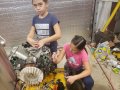
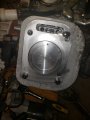
The pit crew and I pulled the head this evening to see if there was any hidden damage.

20221101_174627.jpg

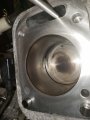
Piston and cylinder look beautiful. Head was disgusting.
20221101_180530.jpg
20221101_180328.jpg

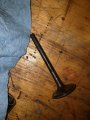
There's no way the intake valve was being sucked open(*) since the fact that it was glued closed with tar, appears to be the reason for the broken lifter and bent pushrod.

20221101_180646.jpg
20221101_182424.jpg
20221101_202102.jpg
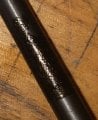
I had to soak the head in carb cleaner and then pound the valve out with a wooden mallet. That black ooze around the valve stem set up like superglue and the valve was frozen solid.

(*) So now I'm back to "how the hell did it have compression" and "where was it drawing air from?"

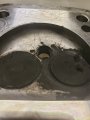
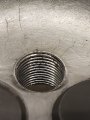
The head has a bunch of hairline cracks in it. Not sure how that happens. Seems to me to indicate overstressing somehow, but I know the complete history of this engine and it has never been abused. Maybe it was like that from the factory? Maybe this is normal? Any ideas?
20221101_180923.jpg

You can even see the cracks propagating down the threads

20221101_181658.jpg
 

SamR

Joined Mar 19, 2019
5,491
Pure crappy casting. Which is what you get along with poor quality control. Something china is notorious for. It may look nice and shiny on the outside but it the quality on the inside that matters. Reminds me of the old and very cheap china made SAE wrenchs that came on the market over 30 years ago that never really fit a nut or bolt head and were prone to breaking and the chrome plating scaling off. But they sure looked good new and were cheap.
 
Top